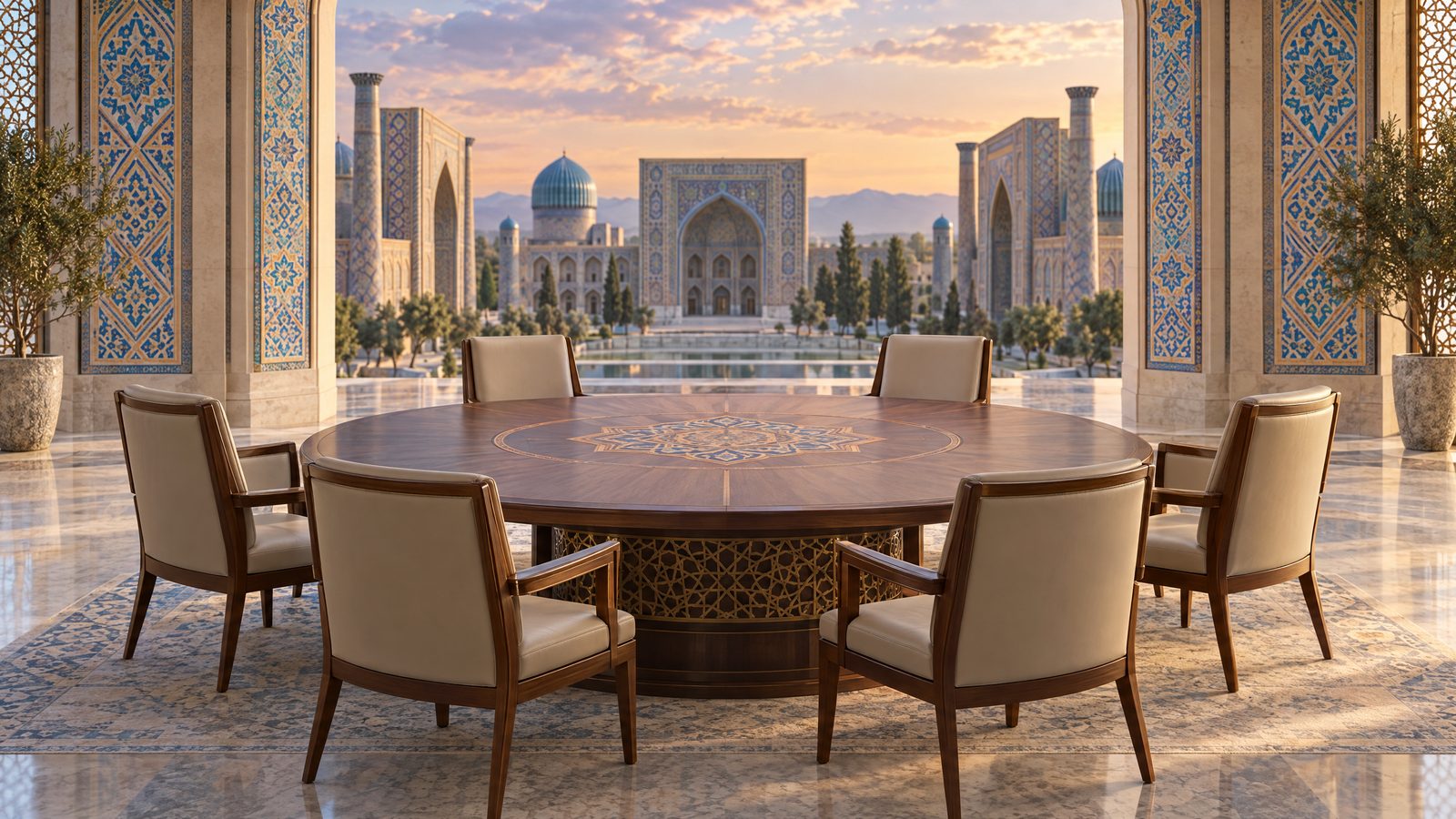

Foreign ministers from Kazakhstan, Kyrgyzstan, Tajikistan, Turkmenistan and Uzbekistan met the United States Secretary of State in Samarkand on 19 October under the C5+1 format. The meeting produced a joint statement setting out a broad agenda for economic links, energy and minerals, security, technology and cultural cooperation. Its language largely describes shared aims and intended work, rather than a list of funded projects or binding deadlines.
The C5+1 brings the United States together with the five Central Asian states. Samarkand also hosted the forum’s first ministerial meeting in 2015. At this year’s gathering, the six governments presented the format as a way of working on regional questions collectively while maintaining the sovereignty and independence of each country.
Transport and trade feature prominently in the statement. The governments said they want to strengthen connections along the Trans-Caspian Trade Route and to improve the infrastructure that supports it. They also set out an ambition for greater trade and investment between Central Asia and the United States, alongside more trade within Central Asia. Improved customs procedures and industrial cooperation are included in that agenda. The statement does not specify a funding amount, construction timetable or named infrastructure scheme for those objectives.
Business and technology form another part of the proposed programme. The governments said the B5+1 business platform should continue to create commercial opportunities for companies on both sides. They also referred to e-commerce, secure technology, English-language training and education as ways to build connections between people and markets. Those passages set direction for future cooperation; they do not establish that a particular company investment or training programme has been approved at the ministerial.
Energy and minerals were given equal weight. The statement envisages cooperation on energy security, geological data, mineral extraction and processing, and higher-value supply chains. It also refers to developing ways for Central Asian products to reach international markets. The Uzbek foreign minister proposed work ranging from mineral exploration to processing and local industrial clusters. The joint text, however, contains aspirations for cooperation rather than a quantified mineral agreement or a confirmed new project.
Security commitments cover counter-terrorism, transnational organised crime and border security. The six governments said they would place particular importance on tackling illegal migration, human trafficking, illicit drug trafficking and arms trafficking. They also identified cybersecurity and cybercrime as areas for closer work. Separately, the statement refers to nuclear security, safeguards, protection of nuclear material and the peaceful use of nuclear energy. It does not identify a new security operation, target a country or announce an immediate enforcement measure.
The agenda extends beyond commerce and security. The governments said they intend to expand cultural, educational and professional exchanges, and to pursue cooperation on protecting cultural heritage. Tourism and the creative economy were also named as potential areas of business cooperation. These elements place people-to-people links alongside transport, energy and security in the partnership’s stated scope.
The immediate confirmed outcome is the joint statement and the ministerial discussion in Samarkand. Its practical effect will depend on decisions taken after the meeting, including whether governments translate the stated priorities into financed programmes, specific projects and measurable results. For now, the document records a common framework for further C5+1 work, not proof that its longer-term economic, security or connectivity goals have already been delivered.