

For most travellers, Bali is a postcard paradise—sunset skies melting into the Indian Ocean, the scent of frangipani in the air, and waves rolling in as far as the eye can see. For 15-year-old Lascha Giostanova Sinantong, a high school student at St Yosep in Bali, this backdrop is not a holiday escape. It is the stage where she is learning to balance her passions: surfing, culture, and the digital world.
Surfing as a Classroom – Lascha Giostanova Sinantong
Lascha spends hours in the water, and she insists that surfing has taught her as much as any textbook. Each wave, she says, carries a lesson.
“When you paddle out, you learn patience and respect,” she explains. “The ocean is bigger than you, but it teaches you not to give up. I try to use the same lesson when I learn something new online.”
For her, surfing is not simply about adrenaline or aesthetics. It is a discipline that demands focus, resilience, and humility. Those qualities, often overlooked in the glamourised image of Bali’s surf scene, are shaping how she approaches her future.

Beyond the Tourist Stereotype
Surfing in Bali has long been tied to images of Australian backpackers and global nomads chasing waves. Lascha’s story offers a different perspective. She is part of the island itself—born and raised in Bali, growing up with the rhythm of its ceremonies and the pulse of its tides. She surfs not as a visitor but as someone deeply connected to the place.
This rootedness matters in an era when Bali’s global image can sometimes overshadow its local realities. Her presence in the surf lineup is a reminder that Bali is not just a backdrop for others’ adventures. It is also home to young Balinese shaping their own identities.
From Reef Breaks to Keyboard Clicks
But Lascha’s journey does not stop at the shoreline. Recently, she began exploring digital media through Hey Bali, an independent platform that highlights the island’s culture, lifestyle, and stories. What might have been just another blog to casual readers became, for her, a learning ground.
Instead of scrolling passively, Lascha started contributing—experimenting with articles, trying her hand at content management, and learning the mechanics of online publishing. She discovered that the internet, like the ocean, has its own currents to navigate: algorithms, audience engagement, and the challenge of building something meaningful amid the noise.
In this way, she mirrors the digital nomads who flock to Bali’s co-working spaces, hoping to turn passion into livelihood. But unlike the stereotype of the laptop-toting expat, Lascha’s perspective is rooted in her local identity. Her “office” might be a surfboard or a school desk, but her ambitions reach into the same global conversation.
Holding on to Culture While Reaching Outward
What makes Lascha’s story resonate beyond Bali is her ability to move between tradition and technology. She participates in cultural rituals and values her Balinese heritage, not as a relic of the past, but as the foundation for her future.
This dual fluency—being equally at home in temple ceremonies and in online dashboards—is what makes her part of a new generation of Balinese youth. They are not rejecting modernity, nor are they abandoning their culture. Instead, they are weaving the two together, creating an identity that feels both global and distinctly local.
As Lascha puts it: “I don’t want to choose between surfing, culture, and learning business. For me, they belong together. Surfing gives me strength, culture gives me identity, and online learning gives me a future.”
A Broader Shift in Bali
Lascha’s story is not isolated. Across the island, young people are beginning to see opportunities beyond the traditional pathways of tourism and hospitality. While millions visit Bali each year for holidays or wellness retreats, local youth are quietly redefining what it means to live here. They are picking up cameras, coding websites, designing brands, and yes, still surfing.
This shift matters for Bali’s future. Tourism has long been both a blessing and a burden—bringing economic growth but also dependency and cultural pressures. A generation that can create, innovate, and contribute digitally has the potential to reshape that balance.
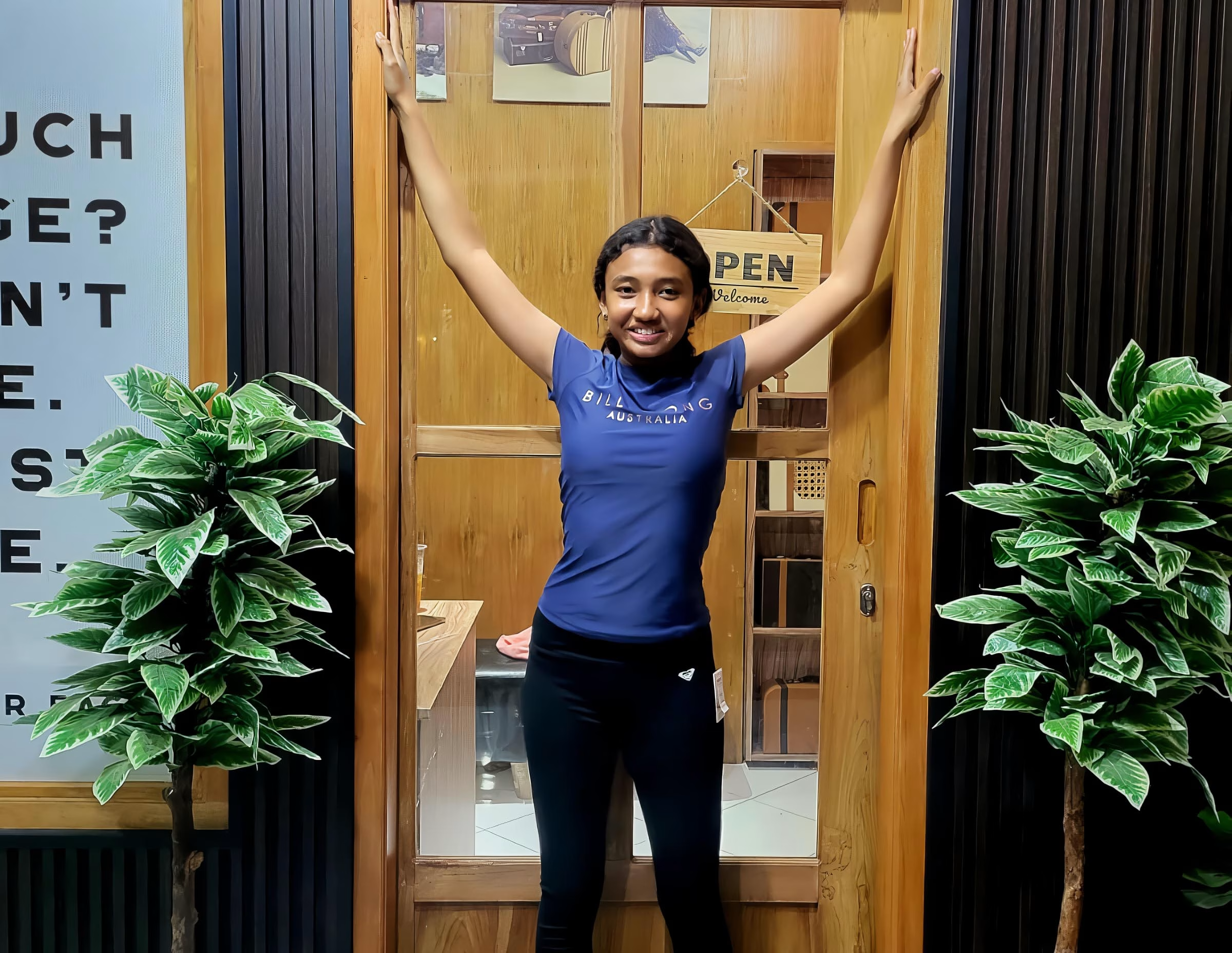
Riding the Next Wave – Lascha Giostanova Sinantong
Lascha’s journey is still at its beginning. She is, after all, only 15. But the way she has started to combine surfing, culture, and digital entrepreneurship offers a glimpse of what Bali’s future might look like. It is an island that does not only receives the world but also contributes to it—through the creativity and resilience of its own people.
For decades, Bali has been known primarily as a destination. Lascha and her peers remind us it is also a place of origin: of talent, of stories, of ideas. They are the new face of Bali—surfing waves in the morning, attending class in the afternoon, and experimenting with the digital frontier at night.
And perhaps that is the real lesson of Lascha’s story. The next great Bali digital nomad is not arriving on a plane. She is already here, learning from the ocean, rooted in culture, and ready to ride the waves of the future.
Reported for the London Daily News by Fabio Agung in Denpasar, Bali. This report was filed by journalists from Hey Bali and Bali Today