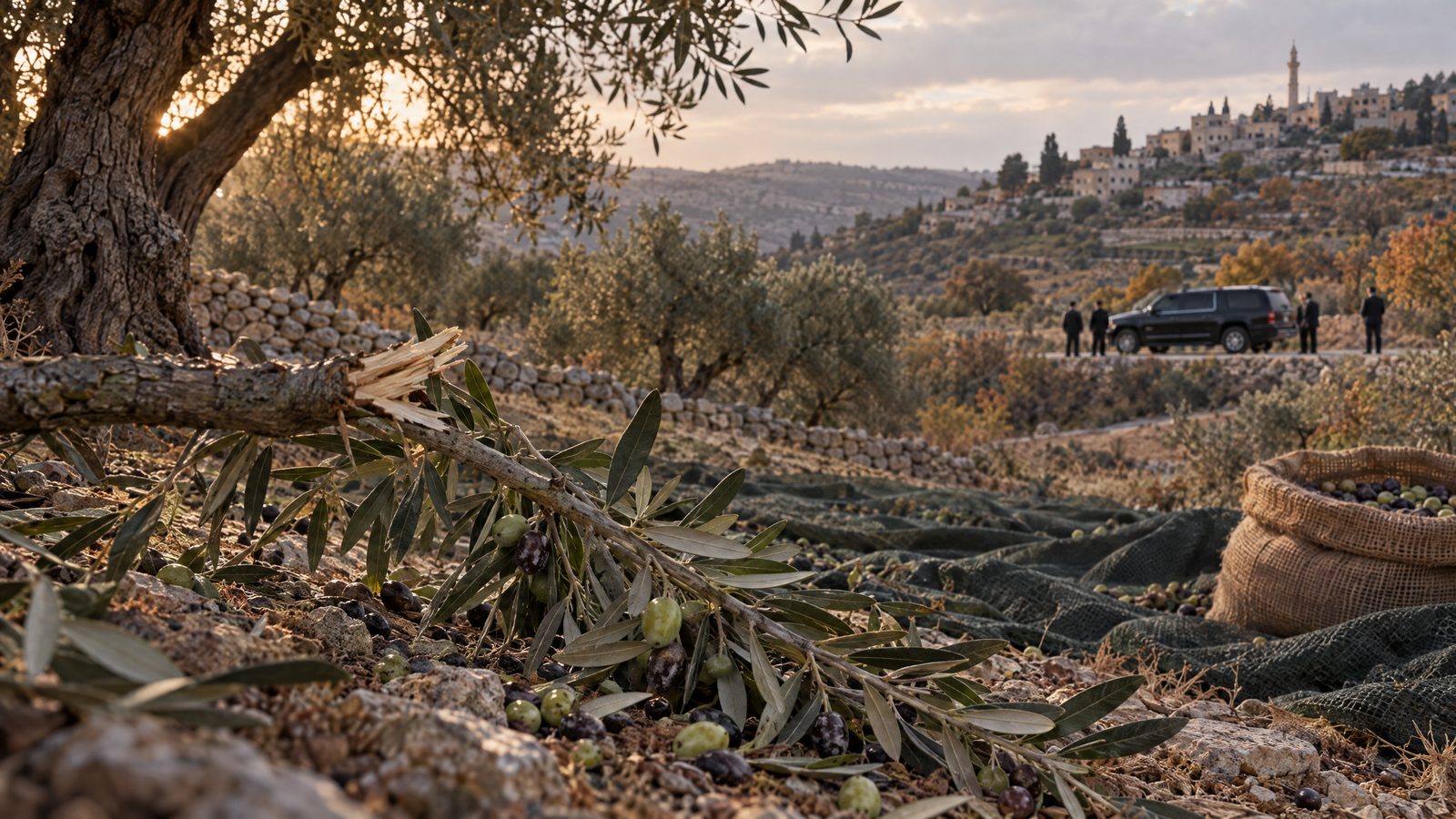

Palestinian olive harvesters and a group of European diplomats were attacked near Taybeh in the occupied West Bank on Saturday, 17 October, according to Belgian and Polish officials and eyewitness accounts. The incident involved Belgium’s consul general, French and Polish diplomats, Catholic representatives and a visiting French mayor. An armoured vehicle belonging to the Belgian mission was damaged. Israeli police said an investigation had been opened; no arrests had been announced in the reports reviewed.
Attack during a solidarity visit
The visitors had gone to land near the Christian Palestinian town of Taybeh to join the olive harvest and show solidarity with residents. Bernard Baudoux, mayor of Aulnoye-Aymeries in northern France, said masked men threw him to the ground. A witness described one attacker shouting at him as he tried to get into a vehicle with diplomatic plates. The mayor was in the area for a town-twinning initiative, according to accounts from the visit.
The reported violence was not confined to the foreign visitors. People working on nearby slopes said settlers approached Palestinian harvesters, took olives and assaulted residents. A woman in her seventies was reportedly kicked and abused, while a man sustained a head wound that required six stitches. Those details come from witness accounts; no independent official casualty assessment was available in the material reviewed.
The Belgian vehicle’s broken window was a tangible sign that diplomatic status did not prevent the confrontation from reaching the convoy. Poland’s foreign ministry said its officials were unharmed. Belgian Foreign Minister Maxime Prévot said the consul general and other members of the delegation were among those targeted, and called on Israel, as the occupying power, to protect Palestinians, diplomats and journalists and bring those responsible to justice.
Investigation and competing accounts
Israeli Foreign Minister Gideon Sa’ar condemned the violence and described the perpetrators as Israeli rioters. He also argued that advance co-ordination with the Israeli military might have helped protect the visitors. That was his explanation of a possible precaution, not a finding that the delegation’s presence justified or caused the attack. The account of police opening an investigation was reported after Israeli officials’ comments; there was no public announcement of arrests or a completed inquiry.
The incident raises a practical question beyond the immediate damage: what protection is available to Palestinian residents when international visitors are not present? Taybeh’s parish priest said foreign diplomats had not previously been targeted there and described the assault as an escalation. That is a local assessment, rather than a formal determination by investigators. The reports also describe the visit as an effort to support the harvest, but do not establish who organised the specific attack or whether any suspect has been identified.
Prévot said Belgium would press for European Union sanctions against those responsible and those who support them. Such a call is a proposed diplomatic response, not an adopted EU measure. The incident does not itself establish that sanctions will follow, and no timetable or agreed European action was announced.
A harvest under pressure
The attack came during a season in which olive picking is both an important source of income and a longstanding part of Palestinian community life. Residents and rights advocates say settler violence, damage to trees and restrictions on access to farmland have made harvesting more difficult. Wider annual totals and claims about the scale of violence vary by source and are not needed to establish what happened at Taybeh; this account confines itself to the specific incident and statements directly connected with it.
Friday’s assault on an American photographer covering olive picking near Abu Falah, reported separately, formed part of the immediate backdrop cited by Belgian officials. It was a different incident at a different location and should not be conflated with the Taybeh attack. The repeated targeting of people harvesting or documenting the crop makes safe access a concrete concern for local families as well as visiting observers.
The key outstanding facts are whether police identify suspects, what evidence they collect and whether anyone is charged. An investigation is a procedural step, not proof of guilt or confirmation of a final account. Until authorities publish findings, the accounts of the mayor, diplomats and local witnesses remain attributed testimony, while the damage to the Belgian vehicle and the reported launch of a police inquiry are the clearest independently corroborated points.