
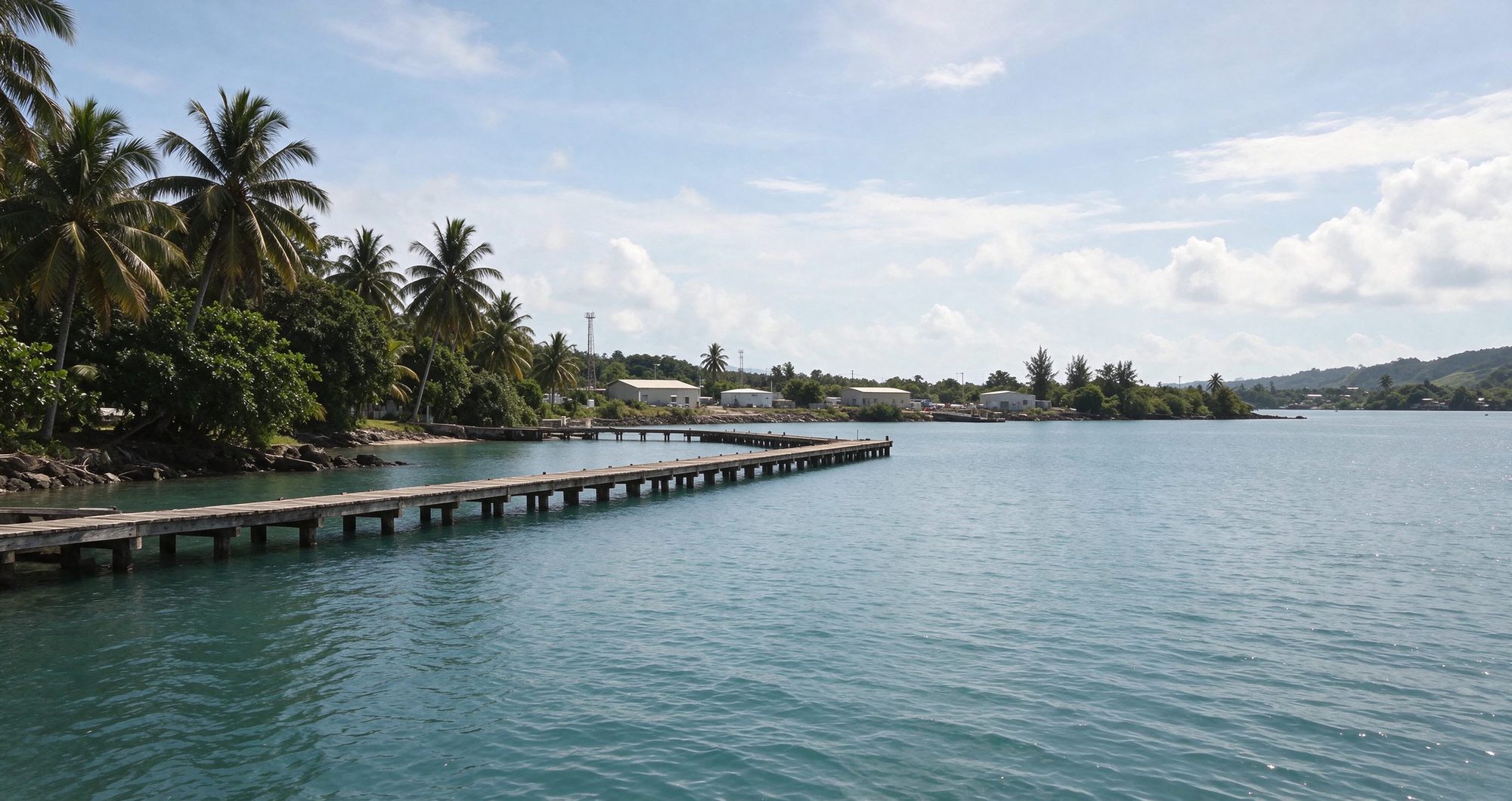

The Northern Mariana Islands’ main utility is exploring whether floating nuclear power could become an alternative to its diesel-dependent electricity system, after its executive director briefed the board on a visit to a reactor-development facility in California.
Commonwealth Utilities Corporation executive director Kevin Watson described the visit during a board meeting on Saipan this month. Further discussions with developers and federal officials are being arranged, but no formal agreement to install a reactor in the territory was announced at the meeting.
A possible start as early as 2028 was raised as a conditional prospect, dependent on the territory’s interest. It is not an agreed commissioning date, a construction commitment or confirmation that a plant has received the permissions needed to operate.
A proposal based on barges
Watson visited a small modular reactor development facility at the Port of Long Beach after discussions with federal officials in San Francisco. A representative of the US Department of Transportation invited him to the facility, where he met senior management, boarded a barge and examined equipment.
The concept under discussion would place reactors aboard barges rather than build a conventional nuclear power station on land. Small modular reactors use nuclear technology on a smaller scale than traditional large reactors. The visit and subsequent contacts do not establish the size, cost or final design of any system for the Northern Marianas.
Follow-up interest has included the Department of the Interior’s Office of Insular Affairs and discussions involving a federal energy laboratory. Those contacts remain preliminary. They do not amount to a federal undertaking to finance or authorise a plant.
Governor David Apatang supported considering nuclear energy in October as an alternative to ageing diesel generators and high electricity costs. That political support is separate from the technical, financial and regulatory decisions needed for any installation.
Financial pressure on the utility
The exploration comes as the corporation faces substantial recovery costs and financial strain. Its unaudited figures show an operating loss of about US$42.5 million for the financial year ending in September 2026. A separate end-of-October snapshot put unrestricted cash at US$4.4 million.
The corporation is pursuing a US$40 million line of credit to help meet disaster-recovery obligations while awaiting federal reimbursements. Pursuing that facility does not establish that the borrowing has been secured or drawn down.
The territory meets nearly all its energy needs through imported petroleum products. Its electricity system has relied on five diesel-fuelled plants across Saipan, Tinian and Rota, while customers’ electricity prices are roughly twice the US average. Storm damage and ageing equipment add to the challenge of maintaining reliable supplies.
Electricity is only part of the corporation’s responsibilities. It also provides drinking water on the three main populated islands and wastewater services on Saipan. Its annual programme includes replacement generation, solar and battery projects, grid modernisation and water infrastructure improvements alongside continuing storm recovery.
Licensing routes are not project approval
Federal regulation already provides routes for licensing maritime nuclear reactors. The Nuclear Regulatory Commission and US Coast Guard have also established a framework for coordinating oversight of civilian nuclear systems on vessels. Having a licensing route available is different from obtaining a licence for a particular plant.
The Port of Long Beach’s separate cooperation agreement with federal maritime authorities concerns technology development and work on safety standards and operating procedures. It is expressly nonbinding and commits neither side to funding, procurement or a specific technology. It is not an installation agreement for the Northern Marianas.
Territorial rules also require careful consideration. The constitution restricts the storage of nuclear or radioactive material and the dumping or storage of nuclear waste, except as provided by law. A law enacted in 2010 created a limited exemption for certain small modular reactors used solely to generate electricity and meeting specified certification conditions. Whether a prospective barge system would satisfy those conditions has not been established.
The next step remains continued discussion. Whether the concept develops into a financed, licensed and deliverable project is still open, and the proposed 2028 possibility should not be mistaken for electricity capacity already secured.







