

In the UK, the full rate of new State Pension amounts to approximately £221 a week £11,502 per year (as of 2024). While this offers a financial safety net, it is far below what most people would need to enjoy a secure and fulfilling retirement.
Recognising this gap, many individuals contribute to private or workplace pensions, yet, a surprising number of people have not considered how much they actually need per year to retire on average.
Using household spending data and average mortgage costs for those aged 65 and up Shepherds Friendly has identified the average amount people need to retire per year in 2025.
Predictions show retirees need £36,915 to live on per year, which is is £25,413 more than the yearly state pension
The amount needed for retirement is personal and can highly depend on the individual’s lifestyle. By analysing the average weekly and yearly spending of households across different income levels, Shepherds Friendly estimated typical expenses for retirees in one year. This analysis was done for the 65-74 and 75+ age groups, giving an overall average for both groups in the UK.
The average overall spend per year in 2025 is predicted to be £36,915 per year which takes into account spending on both necessities and non-essentials. This means if people were to just rely on a state pension in 2025, they would be over £25,000 short of what is needed on average for retirement.
In 2025, households are predicted to spend over £3,500 on food and drink and over £1,600 on restaurants and hotels
When it comes to retirement spending, the biggest costs are predicted to be mortgage repayments (£7,600 on average per year) and additional housing costs, fuel, and power (£3,600 in total), transport (£3,392), and food and drink (£3,530).
Meanwhile, spending on non-essentials for retirees such as recreation and culture could reach £3,238 on average, whilst spending on restaurants and hotels are predicted to be around £1,667.
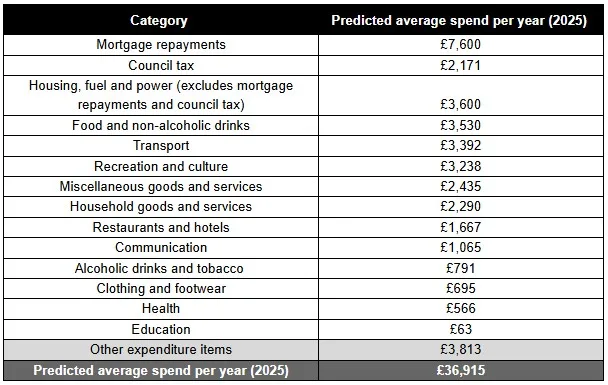
Research has also shown that retirees have an average of £38,000 left to pay on their mortgage by the time they turn 65, which is taken to be the year of retirement for this study. For a five year mortgage term, this could leave retirees needing to pay out around £7,600 per year in order to pay this off. However, you can increase your mortgage term if you plan to retire later to help spread out the cost.
Almost £50,000 per year will be needed to retire comfortably in 2025
With different households having different ways of living, the research also considers what you’d need to retire at a basic level, as well as the amount needed per year for a moderate and comfortable retirement style in 2025. The research shows that to retire comfortably, households will need £49,815 per year to retire in 2025, whilst a moderate retirement would cost around £31,848.
Derence Lee, Chief Finance Officer at Shepherds Friendly shares essential tips on planning for a secure and stress-free future
“As we navigate through our working life, it’s easy to put off thinking about our later years in life. The rising cost of living can make saving for the future difficult for some, so we have compiled some tips to help you prepare as best you can:”
- Start saving early: “Relying only on a state pension to cover your retirement costs is extremely challenging. Most people contribute to a workplace pension, which is automatic for most employees, or open a self-invested personal pension to help save alongside a state pension. Whatever the method, the earlier you start saving, the more your investments can grow.
- Consider inflation when making your decision: “Inflation and increased living costs are important considerations when planning your financial security in later life. Planning ahead allows you to adjust your savings to meet these rising costs, ensuring that your money lasts and you can enjoy your retirement without worrying about your finances.”
- Review your finances regularly: “Frequently reviewing your finances is important to make sure you stay on track with your financial goals, even those beyond retirement. Consider where you could cut spending if possible, and consider whether saving any extra disposable income into a pension or savings account will be beneficial. Retirement planning is a long-term process, so completing regular reviews of your spending and saving habits is important for staying ahead.”
- Prepare with investments: “Making your money go further by investing can be key for beating inflation and growing your savings pot over a longer period of time. A stocks and shares ISA, for example, can be an extremely beneficial way to save for retirement if you are at least five years away from finishing work due to the better likelihood of earning higher returns in the medium to long run. With a stocks and shares ISA, you also won’t have to worry about paying interest or capital gains tax on your earnings.”
Methodology:
This study looks at whether the UK state pension is enough to cover the average spending of people aged 65 and above, taking inflation into account up until 2025. Please note that the research shows the gross amount needed and that pension income is taxable, therefore you should make considerations for this.
To find out how much households are spending per week and per year in 2024 and the predicted figures for 2025, Shepherds Friendly used data from the ONS Family Spending Workbook.
They focused on spending figures for different income types (Tabs A15 and A16), and the average number of people per household.
They found the total household spending and divided it by the average number of people per household to get the spending per person. They then adjusted the spending figures for 2024 and 2025 using inflation rates.
Average council tax rate taken for 2024/25 for Band D properties with this size being the average. This average was used for all household types including ‘comfortable’ and ‘moderate’ retirement types.
The Guardian article was used as a source for the average amount of mortgage debt retirees have left at 65. This was divided by 5 to calculate the average amount due over a five year term. This average was used for all household types including ‘comfortable’ and ‘moderate’ retirement types.