
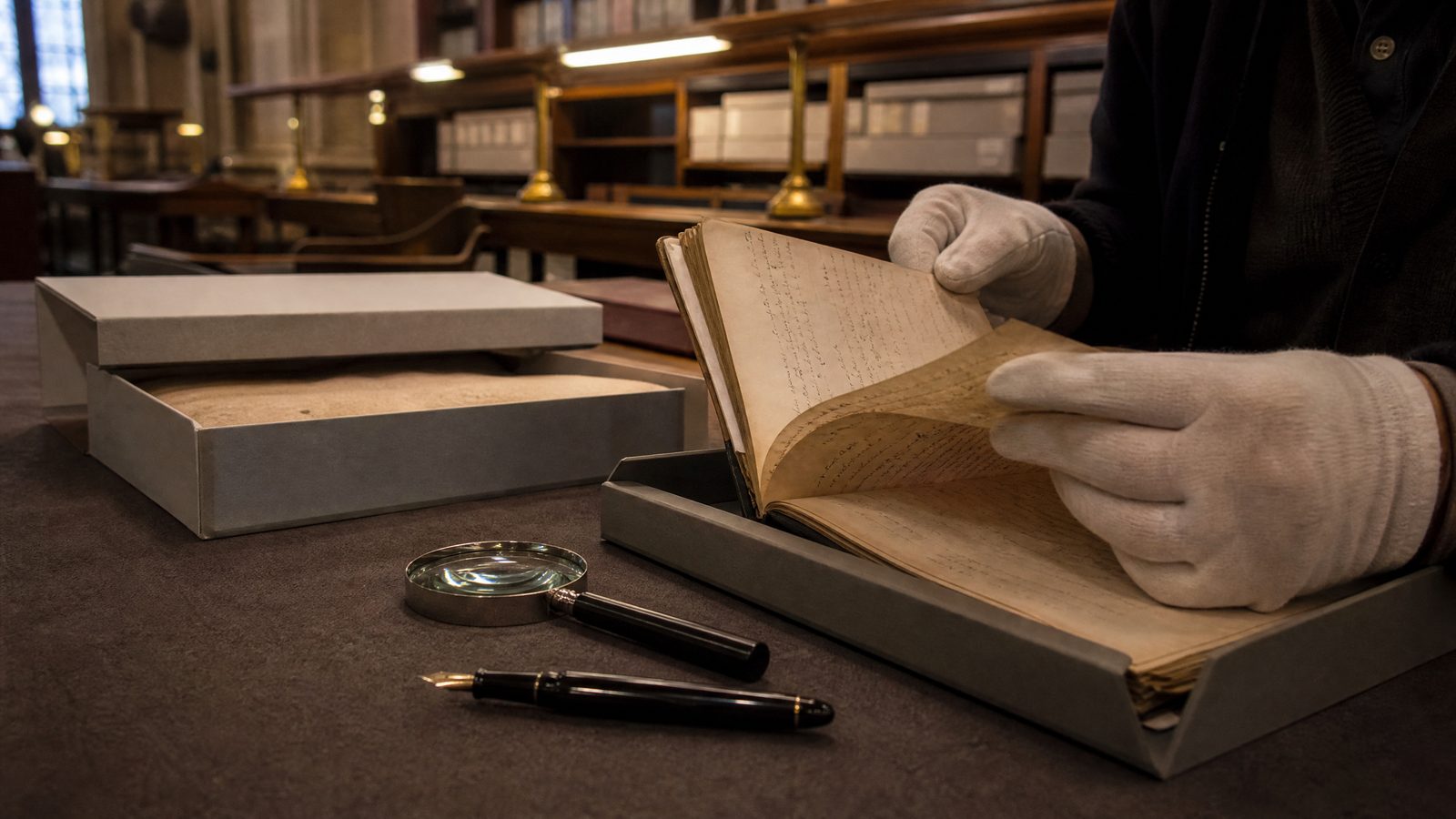

A racy, unfinished short story by Alan Turing has been transcribed and studied by a Cambridge literature professor, offering a fresh perspective on the codebreaker as playful, witty and sexually frank—rather than the withdrawn, joyless prodigy of popular myth. The six-page manuscript, titled “Pryce’s Buoy” and held in the King’s College, Cambridge archives, is believed to have been written in late 1952 or early 1953, shortly after Turing’s arrest for gross indecency.
Professor Sarah Dillon, of the University of Cambridge, has published her findings in the academic journal Review of English Studies. She argues the text demonstrates Turing’s love of literature and a lively sense of humour, positioning him not only as a pioneering scientist but also as an engaged, experimental writer. Dillon’s analysis suggests the story complicates the enduring image of Turing as an isolated mathematician lacking social ease.
A candid, unfinished tale
“Pryce’s Buoy” is a short, incomplete narrative that features two named characters—Ron Miller and Alec Pryce—whose paths cross in a sexually charged encounter. The manuscript switches perspectives and plays with tone, according to Dillon’s study, signalling Turing’s interest in voice, nuance and ambiguity. While the fragment is not long enough to yield definitive conclusions about plot or character development, its frankness and mischievous humour, Dillon suggests, mark it out as a notable piece of creative writing.
The story’s title hints at wordplay, and its protagonist, Alec Pryce, is presented as a scientist. Some readers may be tempted to see Pryce as an autobiographical stand-in. Dillon’s interpretation explores that possibility, but she also cautions that any such reading remains speculative. The manuscript itself offers only a snapshot, and the text breaks off—underscoring the limits of what can be reliably inferred.
Written in the shadow of persecution
Turing’s life at the time was under immense strain. In 1952 he was arrested and prosecuted for gross indecency. He accepted chemical castration rather than serve a prison sentence, and in 1954 he died aged 41 of cyanide poisoning; a coroner ruled suicide. Decades later, the UK government issued a formal apology in 2009 for the “appalling” way Turing had been treated.
Set against this backdrop, the story’s energy and candour are striking. Dillon contends that the manuscript indicates Turing was neither cowed by shame nor disengaged from the pleasures of everyday life and language. Her study also notes that the piece had been known to specialists but had not previously been fully transcribed or analysed in depth by a literary scholar, in part because of the difficulty of deciphering Turing’s handwriting.
Reframing a towering figure
Turing is best known for his wartime codebreaking at Bletchley Park—particularly work on the German Enigma system—and for his postwar research at the University of Manchester, which helped lay foundations for modern computing and artificial intelligence. For many, his public image has been shaped by a 2014 biopic that popularised elements of his story. Dillon’s assessment invites readers to look beyond the conventions of cinematic heroism to a more multifaceted figure who enjoyed literature, irony and flirtation.
The manuscript’s timing is critical. Dillon dates it to late 1952 or early 1953—months when Turing’s legal case and its consequences were immediate. In that context, the story’s sexual frankness appears as an act of self-possession. Yet Dillon and archivists alike urge caution: a single short, partial text cannot rewrite a life. Instead, they say, it adds texture to the historical record and enriches our understanding of Turing’s interests and voice.
What the manuscript can—and cannot—show
The document’s value lies not in any revelation of secret facts about Turing’s private life, but in its literary qualities and the light it sheds on how he played with form and perspective. The characters’ names—Ron Miller and Alec Pryce—are clear in the text; beyond that, much remains interpretive. Dillon’s reading emphasises the story’s playfulness, its double entendres and its attentive portrayal of a tentative sexual negotiation. Other readers may disagree on emphasis, and Dillon acknowledges that multiple legitimate interpretations are possible.
Scholars note that such manuscripts are often fragmentary, and overinterpretation is a risk. Here, the balance of evidence suggests that Turing engaged earnestly and inventively with creative writing, but it does not license sweeping claims about his psychology or relationships. The archive context matters, too: as an item within the King’s College, Cambridge holdings, the story can now be examined alongside Turing’s other papers, allowing future researchers to situate it more precisely.
Archives and publication
The manuscript is preserved at King’s College, Cambridge, where Turing studied as an undergraduate and was later elected a fellow. The college’s archive team curates his surviving papers and supports research access to them. Dillon’s analysis appears in the peer-reviewed Review of English Studies, offering a textual transcription and discussion intended to make the piece accessible to scholars beyond the immediate circle of Turing specialists.
For readers tracing the official record, the UK government’s apology to Turing in 2009 remains an important milestone in how his legacy is framed in public life. Meanwhile, institutions associated with his scientific achievements continue to highlight the breadth of his contributions to computing.
Why it matters now
“Pryce’s Buoy” will not replace the established historical narrative of Turing’s scientific achievements or his persecution under unjust laws. But it does invite a recalibration. If Turing could be, as Dillon contends, playful, funny and cheeky on the page, then the stereotype of a socially detached genius is at best incomplete. That recognition enriches how we teach, interpret and commemorate his life—bridging the gap between the man who helped transform computing and the human being who read, wrote and flirted with equal relish.
As with any archival find, this text is a beginning rather than an end: an opening for debate, further study and, perhaps, the recovery of more overlooked fragments that complicate tidy myths. For now, the six pages of “Pryce’s Buoy” add a surprising new register to Turing’s voice—one that sounds not from a laboratory bench or a cipher machine, but from a playful, literary imagination at work.
Sources and further reading: The manuscript is held in the King’s College, Cambridge archives. Dillon’s analysis appears in the Review of English Studies. The UK government’s 2009 apology to Turing can be read on GOV.UK.







