
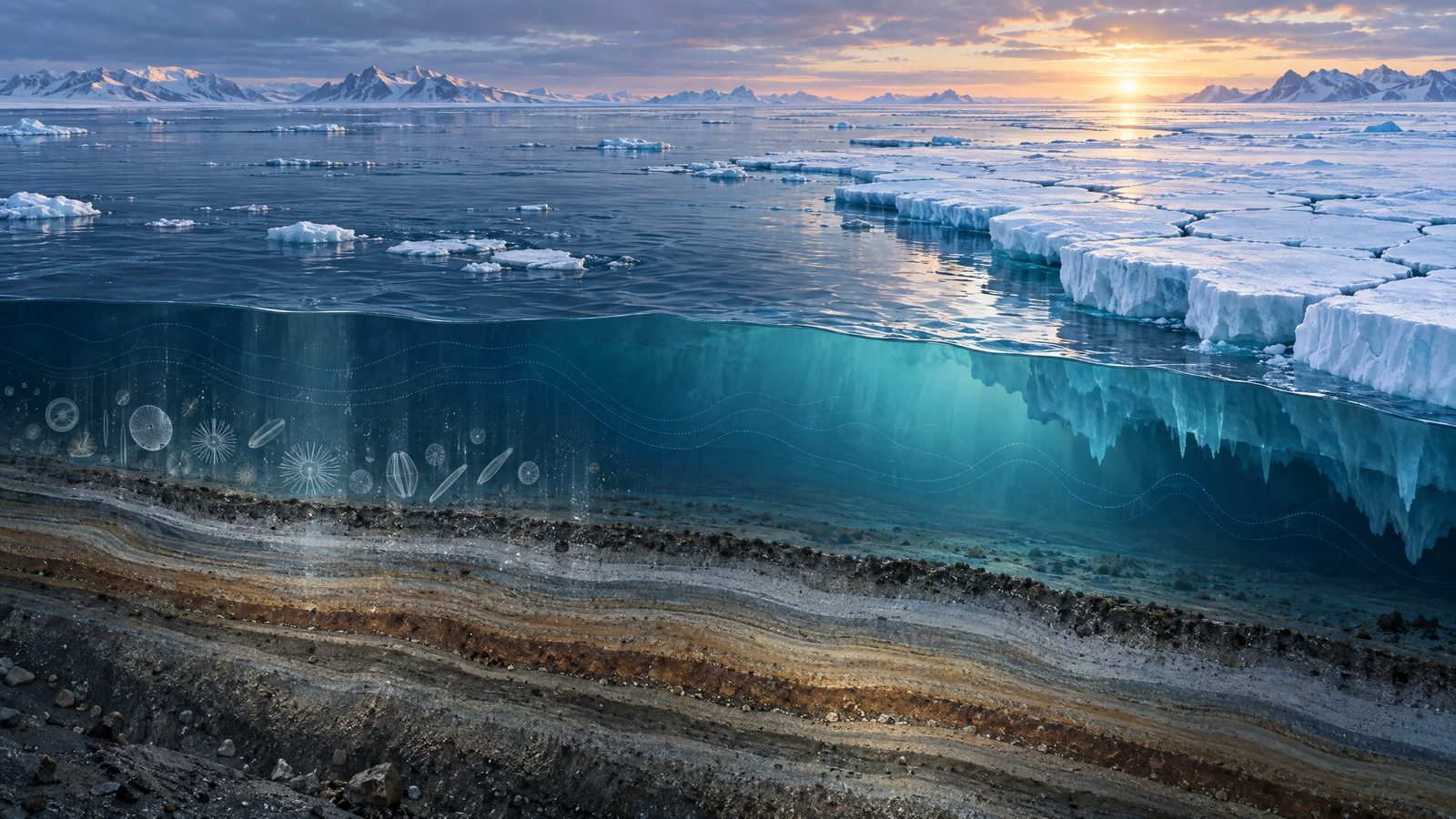

Arctic winter sea ice could be nearly one million square kilometres lower in coming decades than earlier climate-model estimates suggested, a new study has found. The researchers used evidence preserved in ancient ocean sediments to test how well climate models represented sea ice during a warmer period thousands of years ago.
The work focuses on winter, when models disagree most about how much ice will remain. Researchers from the University of Cambridge and Mexico’s Centro de Investigación en Matemáticas compared geological evidence from the mid-Holocene, around 6,000 years ago, with simulations from 27 climate models. Their analysis found that, taken together, the models had tended to overestimate winter ice extent.
Algal traces provide a test of past ice
The team assembled a large Arctic-wide database of IP25, a biomarker produced by algae that live in sea ice. They also used complementary biomarkers from organisms associated with open water. Measurements from ocean-sediment cores allowed the researchers to estimate past ice conditions, which could then be compared with climate-model simulations for the same period.
Rather than treating every model equally, the researchers applied Bayesian weighting. In this approach, models that better reproduced the ancient evidence receive greater influence in the combined estimate. The team used those weights to adjust simulations of historical and future conditions, on the premise that the physical processes governing sea ice remain informative across different climates.
After weighting, the study reports that the positive bias in historical simulations was eliminated. For future projections across coming decades and possible emissions scenarios, the weighted model average indicates nearly one million square kilometres less winter sea ice than previous estimates. The analysis also reduced the range of uncertainty by as much as 85 per cent, to a level comparable with year-to-year variability, the researchers report.
Winter ice matters beyond the Arctic
Sea ice helps regulate the transfer of heat and moisture from the ocean to the atmosphere. Changes in winter ice cover can therefore affect atmospheric circulation and weather well beyond the Arctic. The study discusses links between reduced ice and colder winters and heavier snowfall in parts of northern Europe and North America, but it does not forecast specific weather for the UK or any particular year.
The researchers also applied their revised model weighting to precipitation projections. They found indications that snowfall over south-east Greenland and rainfall in the Mediterranean may be underestimated as well. These are model-based suggestions, not direct measurements of future precipitation; the authors describe potential implications for Greenland ice-sheet stability and flood risk in southern Europe rather than established outcomes.
The work uses mid-Holocene evidence from roughly 5,000 to 7,000 years ago, when Arctic conditions were warmer, but the causes of that warmth differed from those operating today. The analysis relies on proxy records from sediment and on assumptions used to connect those records with modelled ice conditions. Bayesian weighting narrows uncertainty within the model ensemble; it does not remove every source of uncertainty or make projections certain.
The findings were published on 16 October in a peer-reviewed research article by Crystal Fu, Michael Osman and Marco Aquino-López. The study offers a way to use ancient climate evidence quantitatively when assessing future projections, while underscoring that the amount and location of future winter ice loss remain projections rather than observations.







