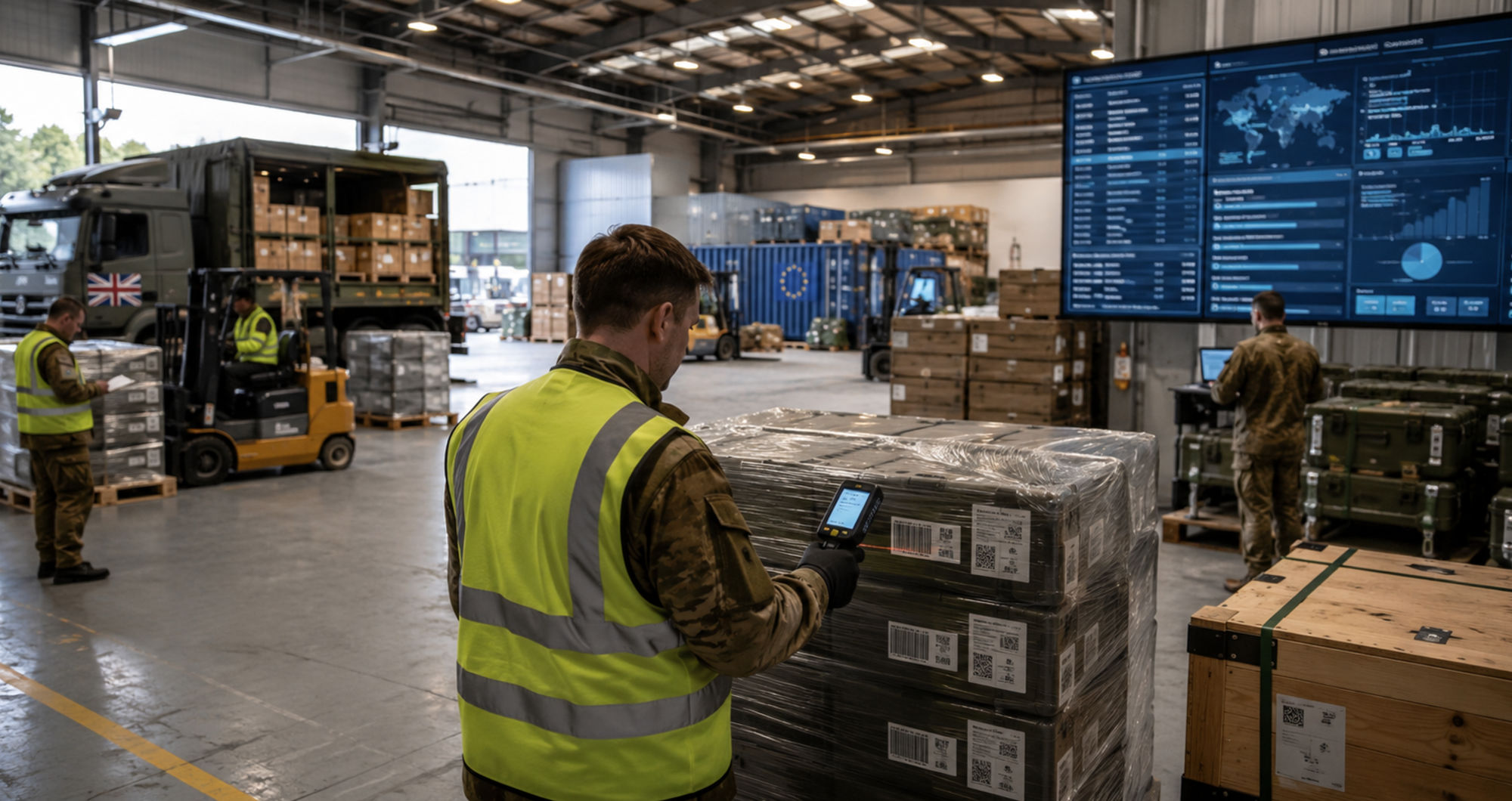

The NATO Master Catalogue of References for Logistics holds roughly 17 million NATO Stock Numbers mapped against 37 million manufacturers’ part numbers, according to the NATO Codification System documentation published by NATO Group of National Directors on Codification (AC/135). That ratio is the coalition logistics problem stated in one line. For every agreed item identity there are more than two supplier identities competing to describe the same object.
When a pallet moves from a UK depot to a German forward support point, the delay is rarely customs. It is that the receiving system cannot resolve what is physically on the pallet to a record it already holds. The forklift stops. Someone opens a case, reads a plate, types a part number into a search box and gets three candidate matches or none. In-transit visibility collapses at that moment, for reasons of item identity rather than transport.
What in-transit visibility means in a multinational force
In-transit visibility (ITV) is the ability to see the identity, quantity, condition and location of materiel while it is moving between nodes. Inside a single national system, this is largely solved. Each nation runs its own inventory system, its own barcode conventions and its own scan points, so a consignment leaving a British depot is legible to every downstream British node.
Multinational ITV is a different task. It requires that a scan performed by one nation produces a record another nation can read without manual translation. The unit of exchange is not the shipment. It is the item. If two nations cannot agree that object A and object B are the same thing, no amount of tracking software reconciles the two ledgers.
This is why NATO treats identification as a standardisation problem rather than an IT problem. STANAG 2290 sets a uniform structure for the Unique Item Identifier so that a serialised asset carries one identity for its whole life, regardless of which nation is holding it at the time. Camcode Global’s work on NATO interoperability covers how unique identification and data cleansing combine to make that exchange work in practice.
Why coalition ITV fails at the item level
Three defects account for most of it.
Duplicate identities. The NATO Codification System documentation reports that parts for brand new equipment match an item already in the catalogue more than 30 percent of the time in the United States. In Canada and many other NATO nations, the figure is closer to 60 per cent. Those are items already held, already stocked, already funded, being re-catalogued as if new. Every duplicate is a future visibility gap: the same physical part sits under two numbers in two systems, and neither ledger can see the other’s stock.
Unreadable marks. A consignment is only visible at the points where it gets scanned. Painted stencils, adhesive labels and ink-jet marks degrade in salt, fuel, abrasion and UV. A mark that cannot be read at the receiving node forces a manual entry. Manual entry is where transposition errors enter the record. One wrong digit on a serial number breaks the audit trail for the life of the asset.
Missing serialisation. A NATO Stock Number identifies a type of item. It does not identify a specific instance of that item. Without a Unique Item Identifier, you can tell a partner nation that a crate contains six pumps of a given NSN. You cannot tell them which six, what their maintenance histories are or whether two of them are already condemned. Type-level data supports stock counting. Instance-level data supports maintenance, warranty, condemnation and cross-national transfer.
Three handoff points where visibility is lost
Manufacture to national inventory. If an item enters a national system with a supplier part number rather than a codified NSN and a UII, the gap is baked in on day one. Retrofitting identity later means finding the asset again, which is expensive once it has deployed.
National inventory to multinational stockpile. Pooled arrangements make this acute. NATO’s own reporting on multinational capability cooperation describes the Multinational Ammunition Warehousing Initiative as its largest high-visibility project with 26 participating countries. Land Battle Decisive Munitions has 24. Shared warehousing only works if 26 national ledgers describe the stored items identically.
Stockpile to deployed unit and back. The return leg is the one that gets neglected. Items go forward under a national identity, get consumed, transferred, repaired or cross-decked to another nation’s unit, then come back. If the mark did not survive the deployment, the item comes back as an unknown and usually ends up in a quarantine bay.
The UK National Audit Office found in its September 2023 report on defence inventory management that the Ministry of Defence held more than 105,500 cubic metres of unfit inventory in central warehouses, against a total portfolio valued at £11.8 billion covering around 520,000 inventory types and around 460 million individual items. Two of the core inventory systems supporting that estate were nearly 40 years old at the time of the report. Quarantine volume on that scale is a symptom of identity failure as much as physical condition.
What codification solves and what it does not
The NATO Codification System is a catalogue discipline. It assigns one NSN per item type across more than 40 countries that use the system in some form. It is the reason a partner nation can identify what an item is. The AC/135 material puts around 16 million items in the system, with 7 million active items in the United States central catalogue alone.
Unique identification is a separate discipline. It assigns one permanent identifier per individual asset. The two are complementary and neither substitutes for the other. Programmes that implement codification without serialisation get accurate stock lists and no maintenance traceability. Programmes that serialise without codifying get traceable assets nobody else can classify.
Building an ITV baseline that survives contact
A workable sequence looks like this.
- Cleanse before you mark. Deduplicate the register first. Marking a dirty register only makes the duplicates permanent and machine-readable.
- Mark at the item level with a durable medium. The mark has to outlive the asset’s service environment. Photosensitive anodised aluminium plates and laser-etched metal survive conditions that destroy printed labels.
- Encode to the standard, not to the vendor. Data matrix content should follow the STANAG 2290 UII structure so a partner nation’s scanner resolves it without a lookup table.
- Register the identity centrally. A mark that is not in a registry is a serial number nobody can query.
- Instrument the scan points. Decide where scans happen: outload, transhipment, receipt, issue, return. Gaps between scan points are gaps in visibility. They are a design decision rather than an accident.
- Mark in place where you have to. Legacy fleets already in service are the hard case. Mobile marking capability that goes to the asset avoids recalling equipment purely to give it an identity.
The cost case
The NATO codification material reports that private sector organisations adopting standard identification methods cut inventory by as much as 50 per cent. The mechanism is the same one that produces the duplication rates above: when you can find what you already hold, you stop buying it twice.
Sustainment is where the money sits. The US Government Accountability Office reported in February 2024 that operating and support costs account for about 70 per cent of a weapon system’s total life-cycle cost, with seven of the 16 systems it assessed for fiscal year 2022 showing critical cost growth. Sustainment decisions run on asset records. Records that cannot be trusted produce conservative decisions: order another one, hold more stock, replace rather than repair.
The timing makes this hard to defer. NATO reports that European Allies and Canada spent more than 571 billion US dollars on defence in 2025 in 2021 prices, over 90 billion more than in 2024, under a Hague Summit commitment to reach 5 per cent of GDP by 2035. New equipment is arriving faster than most national catalogues can absorb it. Every asset fielded without a durable identity is a gap that gets more expensive to close each year it stays open.
Frequently asked questions
Is in-transit visibility a tracking problem or a data problem? Both, but the data problem comes first. Tracking systems report what they are told. If two nations hold different identities for the same item, better tracking produces two confident and contradictory reports.
Does a NATO Stock Number provide item-level traceability? No. An NSN identifies an item type. Instance-level traceability requires a Unique Item Identifier under STANAG 2290 or an equivalent national standard.
What breaks a machine-readable mark in field conditions? Abrasion, fuel and solvent exposure, salt, UV and heat cycling. Printed and adhesive media fail first. Anodised aluminium and laser-etched metal plates are specified where the mark has to last the life of the asset.