
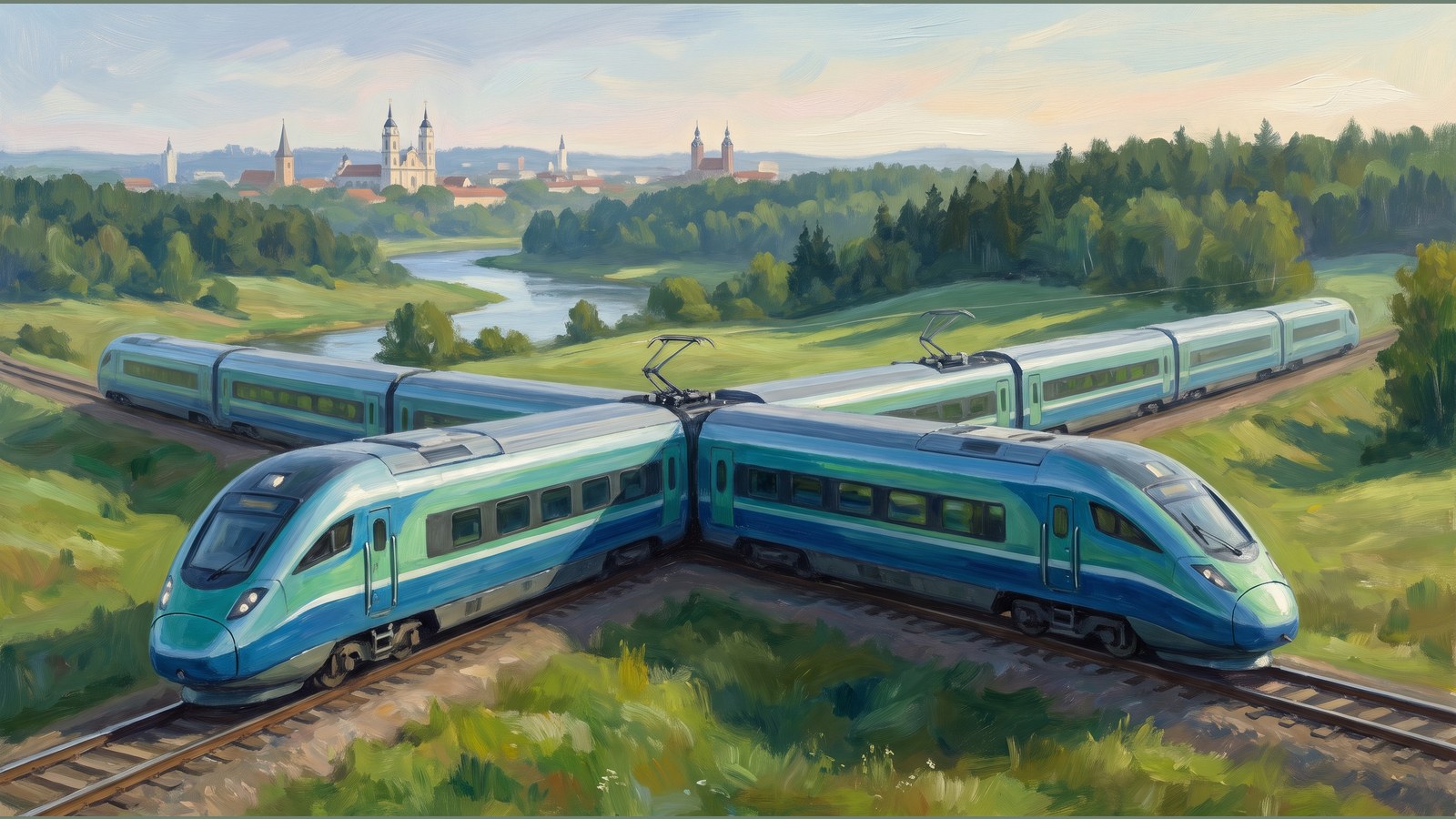

The first of a 15-train order has begun regular passenger service between Vilnius and Kaunas, marking the first operational step in a wider renewal of Lithuania’s passenger fleet. The new Stadler FLIRT electric train entered service on the Vilnius–Kaunas–Vilnius route on 22 October, with the launch marked at Vilnius Railway Station.
For now, the new electric train is operating between the capital and Kaunas. Further electric services are planned for the Vilnius–Klaipėda–Vilnius route, where the new fleet is intended to cover the majority of journeys by the end of 2026. The immediate change is therefore the entry of one train into regular service, while the wider replacement programme is due to unfold over the coming months.
A 15-train renewal programme
LTG Link has ordered 15 trains from Stadler. Nine are electric and six are battery-powered. The battery-powered units are designed to operate on both electrified and non-electrified sections of railway, allowing the operator to introduce the new rolling stock on routes that do not have continuous overhead power equipment.
The contract also includes an option for additional trains of the same type. No timetable for exercising that option has been announced. The current order is the basis of the fleet renewal now beginning on the Vilnius and Kaunas corridor.
Battery-powered trains are planned to start carrying passengers in December. Their first scheduled routes are Kaunas–Šiauliai–Kaunas and Radviliškis–Klaipėda–Radviliškis. In the second half of December, they are also planned to begin running on the Vilnius–Varėna–Marcinkonys–Vilnius route. Those plans remain separate from the electric train that has now started the Vilnius–Kaunas service.
More room and different facilities
The incoming trains are wider than standard models by more than half a metre. They are intended to provide greater capacity, a point that may matter most at busier periods when passenger flows are higher. Their interior layout includes ramps and features intended to make moving around easier for people with mobility needs.
Passengers will find more spacious seating areas, tables and charging points for electronic devices. The fleet will also include additional room for bicycles. A bistro area is planned to offer hot food and drinks, returning that facility to Lithuanian passenger trains after several decades.
Those features do not alter the service pattern overnight. They describe the specification of the new fleet as it is introduced. Existing trains will be replaced gradually on major routes rather than all at once, and the scale of the practical change will depend on the delivery and deployment of the remaining units.
What the first service signals
The new service links two of Lithuania’s principal cities and is the first public use of the new fleet. It also sits alongside broader work to renew trains, electrify major rail lines and modernise rail infrastructure. The battery-powered units are particularly significant to that approach because they are planned for lines which include non-electrified sections.
The rollout has a clear sequence. Electric operation has begun on the Vilnius–Kaunas route, further electric services are planned for the line to Klaipėda, and battery-powered passenger operation is scheduled to follow in December. For travellers, the confirmed development is the first regular service now running. The wider programme remains a staged change, with the timing and route coverage of later services still set out as plans.







