Something extraordinary is happening on the internet. Independent developers, researchers and investigative communities are creating platforms that allow ordinary people to explore the destruction of forests, follow the financial connections behind war, examine evidence of atrocities, trace industrial pollution and monitor activity across the world’s oceans. Information once reserved for governments, specialists and major institutions is becoming available to anyone with an internet connection.
We may be witnessing one of the most important transformations in public access to information since the arrival of the internet itself.
From forests disappearing beneath satellite cameras to the financial networks behind military industries, a new generation of digital platforms is giving the public unprecedented tools to investigate our world.
There was a time when understanding what was happening on the other side of the planet required access to information most people would never see.
Satellite imagery belonged largely to governments and specialist institutions. Investigating corporate ownership meant navigating complex financial records. Tracking commercial vessels required maritime data. Understanding global emissions meant interpreting technical inventories. Documenting human-rights abuses depended on journalists, witnesses, investigators and organisations working to preserve evidence.
Much of that information was either inaccessible, expensive, fragmented or extraordinarily difficult to understand.
That world is changing.
Today, a person sitting at home can open a browser and explore forest loss in the Amazon, examine the estimated emissions of industrial facilities, follow commercial fishing activity across the oceans, investigate publicly documented financial connections or access preserved footage from a conflict zone.
And in many cases, they can do so for free.
Behind this transformation is an extraordinary combination of satellite technology, open government records, artificial intelligence, machine learning, geospatial analysis and independent software development.
But technology alone is not the most interesting part of the story.
The real change is who gets to ask the questions.
These platforms are challenging the idea that understanding complex global issues should be limited to those with institutional access, specialist software or significant financial resources.
They represent an emerging form of public-interest intelligence – one in which the evidence is increasingly available for people to explore themselves.
1. BL00D.MONEY: Following the Financial Connections Behind War
Website: https://bl00d.money
Behind modern warfare sits an immense international network of defence manufacturers, technology providers, investors, contractors, financial institutions and governments.
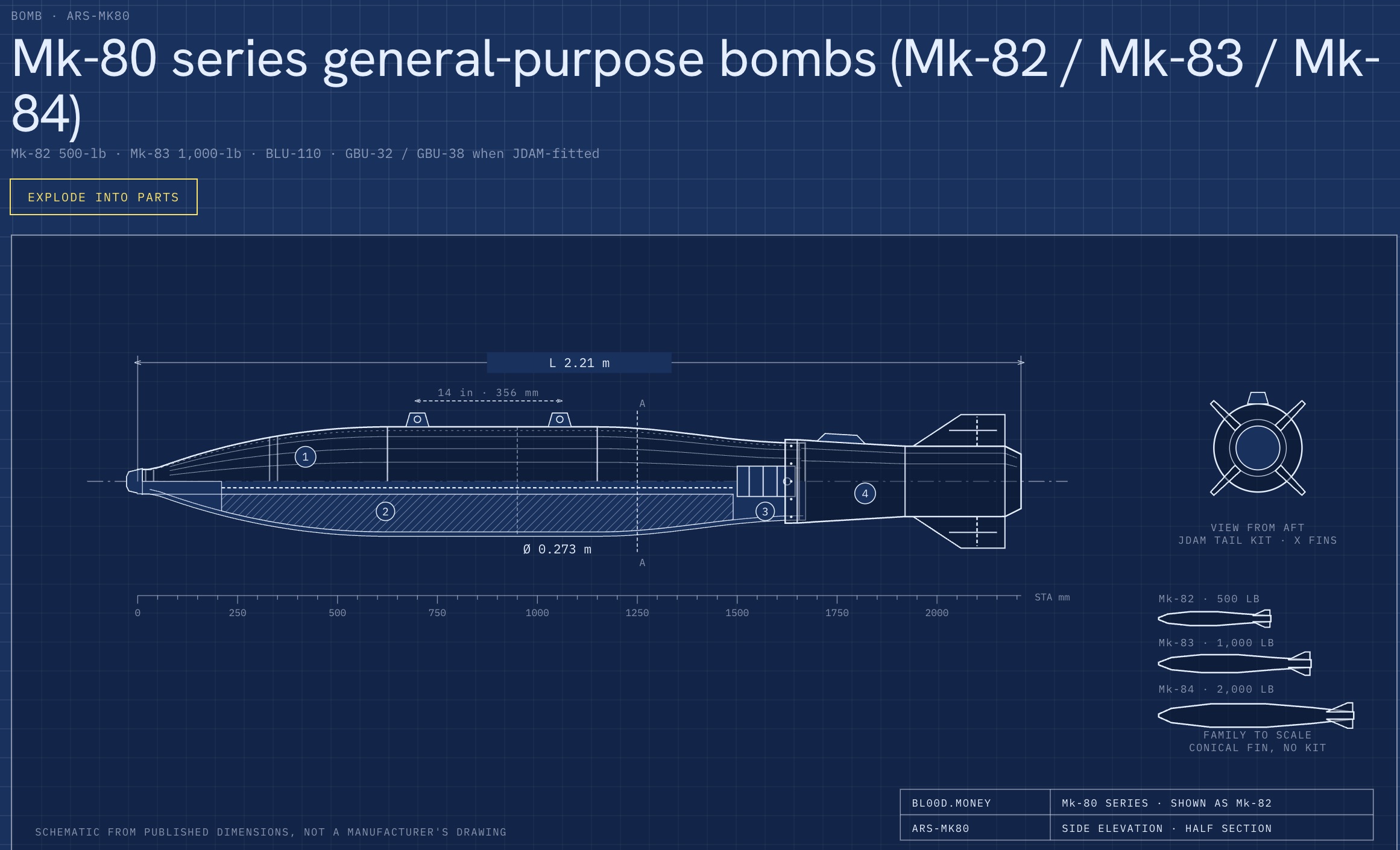
Explore the global networks behind the weapons of war, uncovering arms manufacturers, financial connections and the corporations linked to the military industry.
Understanding that network can be profoundly difficult.
A weapon may be manufactured by one company, assembled using components from several others, financed through institutional capital and sold through procurement agreements that extend across national borders.
BL00D.MONEY, associated publicly with the creator X.Vendetta (Instagram), is part of a newer movement seeking to make these connections more visible.
Its premise is compelling: allow users to explore financial and corporate relationships connected to Israel’s military activities and the war in Gaza through a digital interface.
Traditionally, following these relationships might require manually searching corporate filings, investment records, procurement databases and investigative reports.
A carefully constructed visual network can help people understand how organisations, assets and financial relationships connect.
It can also raise questions that are rarely addressed in conventional reporting.
Who manufactures particular military technologies? Which institutions hold investments in the relevant companies? What relationships are publicly documented? Which claims are supported by direct records, and which require further investigation?
These are questions of enormous public interest.
They also require extraordinary care.
A company appearing within a financial network does not necessarily mean that it has committed wrongdoing, endorsed a military operation or bears legal responsibility for its consequences.
Investment, commercial involvement, direct operational participation and legal complicity are fundamentally different propositions.
The credibility of such a platform ultimately depends on its sources, methodology and willingness to distinguish documented relationships from allegations.
BL00D.MONEY is an emerging example of what visual investigative technology might make possible. Its individual findings should be examined against their original evidence.
The wider innovation is clear: complex financial structures can increasingly be represented as networks that ordinary people can investigate.
2. Felled.org: Looking Beyond the Disappearance of Trees
Website: https://felled.org
Every year, forests are cleared, fragmented, degraded or replaced across the world.
Some losses are immediately visible: vast areas cleared for agriculture, roads cut through previously continuous habitats, or fires leaving scars across enormous landscapes.
Other changes happen gradually.
A forest may be thinned, divided by infrastructure or replaced with commercial tree plantations.
Satellite measurements can identify certain changes in vegetation cover, but these observations do not automatically explain the ecological consequences or the economic activities behind them.
That distinction matters.
A centuries-old woodland is not interchangeable with a newly planted commercial plantation.
Natural forests develop complex ecological relationships over long periods. Their soils, fungi, insects, birds, mammals, waterways and plant communities form interconnected systems.
Planting a large number of fast-growing trees does not immediately replace the ecosystem that existed before.
Felled.org is a newly launched independent platform created by a data journalist known as Saturn, built around the need to look more deeply at deforestation and its consequences.
Its ambition is not simply to display forest-loss statistics, but to encourage investigation into the wider forces driving environmental change.
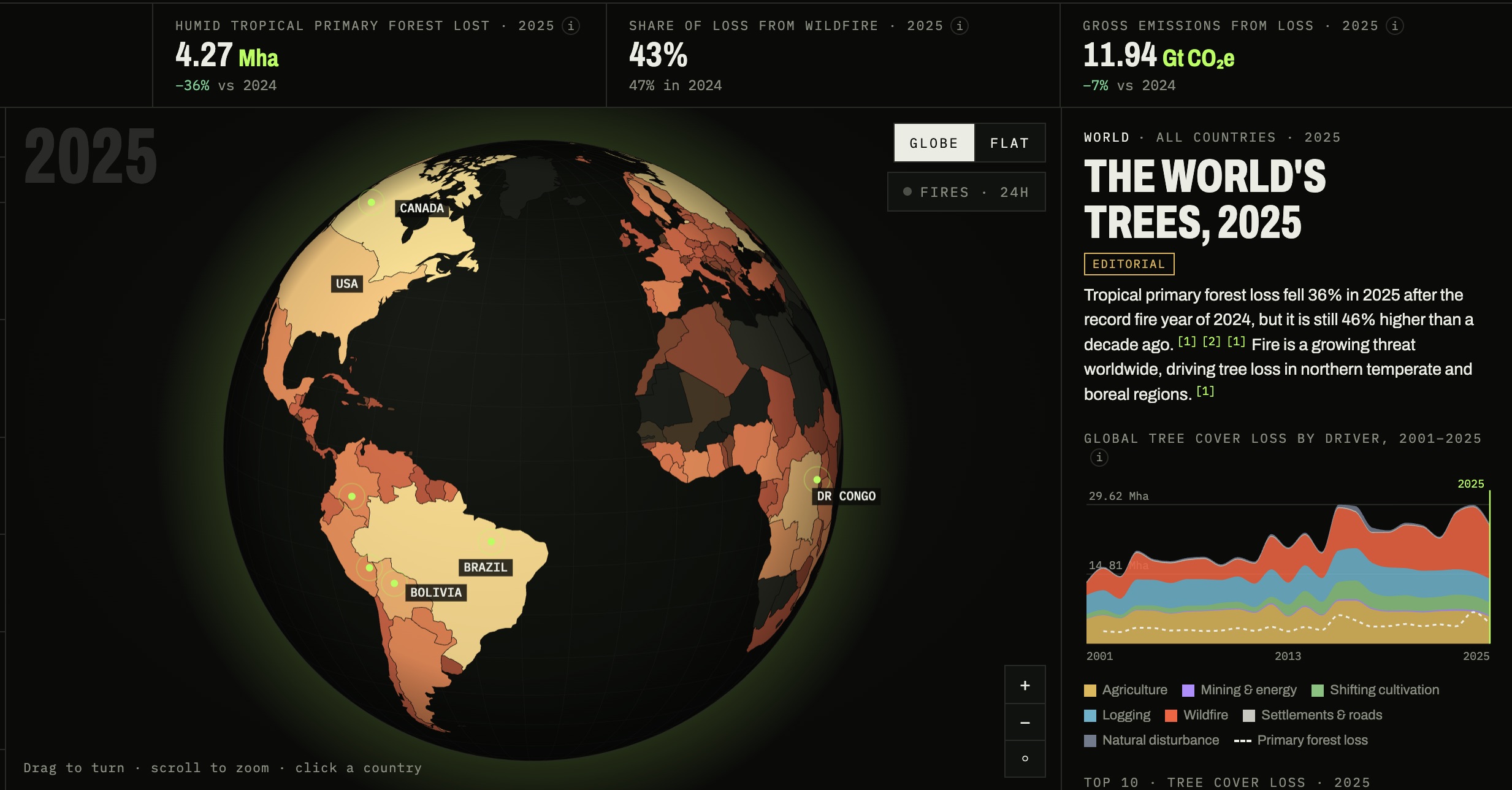
Explore our interactive world map and uncover the data behind global forests, tree loss and deforestation
Why are forests being cleared? Which industries create pressure on land? How does forest loss connect to biodiversity, climate change and commercial agriculture? What can satellite observations reveal, and what additional evidence is needed to understand responsibility?
These questions deserve more than a single global counter.
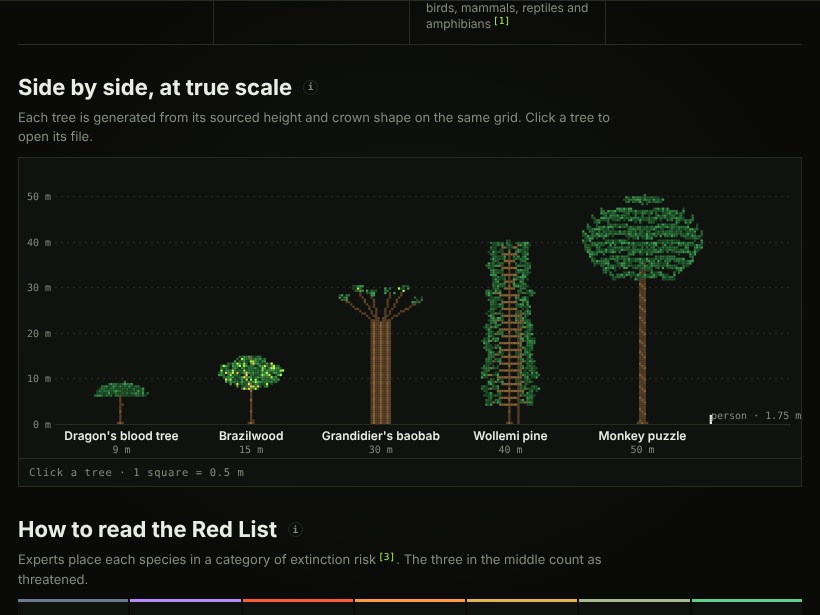
An interactive platform can make environmental data accessible and relatable, helping visitors understand that forest loss is not an abstract event occurring somewhere far away.
It is a change to a living ecosystem, often connected to economic decisions and supply chains that stretch across continents. But attribution must be evidence-based. Detecting forest clearance does not automatically identify the person or company responsible.
Beyond tracking deforestation, Felled.org has evolved into a valuable educational resource, giving students and curious minds the opportunity to explore endangered tree species, discover trees with medicinal properties, and understand their ecological importance through a dedicated interactive species library that brings the extraordinary diversity of our planet’s forests to life.
As Felled.org develops, that distinction will be central to its value.
It is not enough to know that a forest has disappeared. We need to understand what was lost, why it happened and what the evidence tells us about the forces involved.
3. PRISM: Making Humanitarian Intelligence Accessible
Website: https://www.prismonitor.eu
Humanitarian emergencies are extraordinarily complicated.
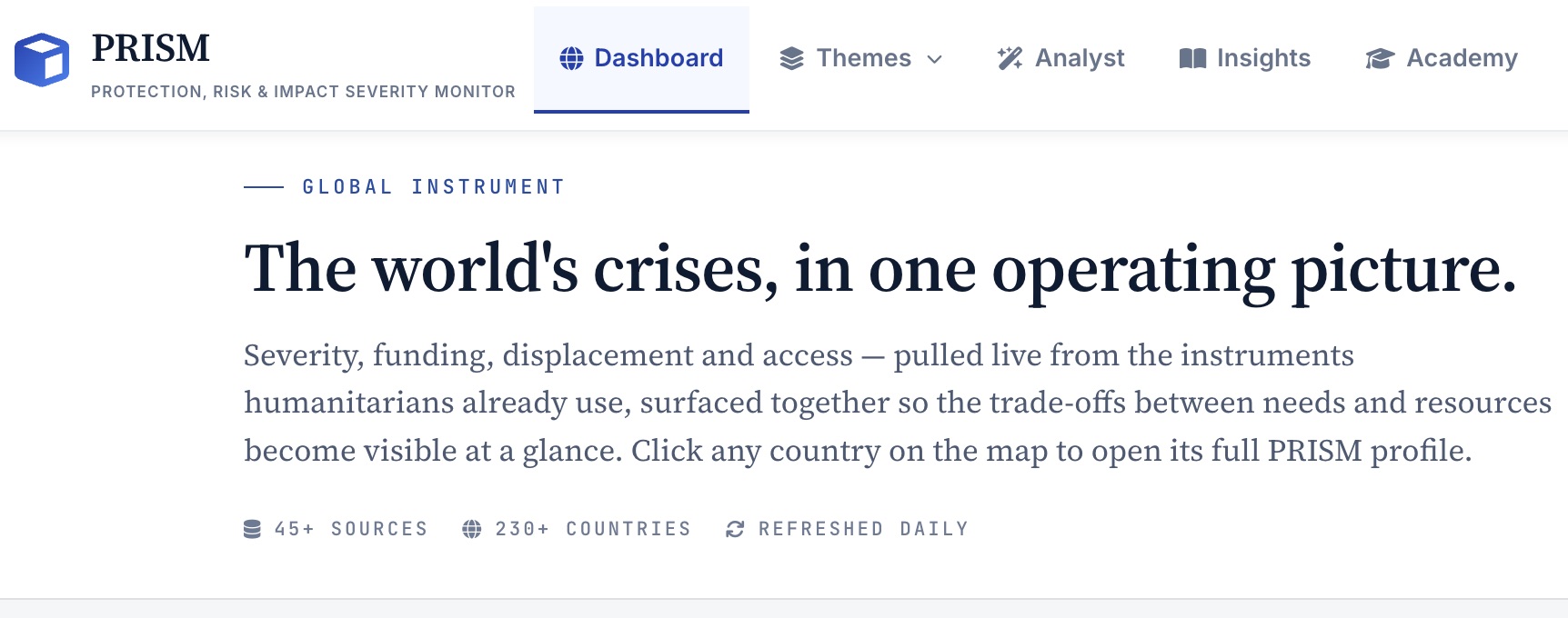
Explore global humanitarian crises through interactive maps, live data and powerful insights into conflict, displacement and the challenges facing communities worldwide.
A country experiencing armed conflict may simultaneously face displacement, hunger, collapsing infrastructure, disease outbreaks and severe shortages of international funding.
The information needed to understand these crises often exists across numerous different organisations.
The United Nations may report displacement. Another organisation may monitor food security. Others document conflict events, aid funding, humanitarian access or disaster risks.
Bringing these datasets together can be a major analytical challenge.
PRISM – the Protection, Risk & Impact Severity Monitor – is attempting to solve that problem.
First launched in October 2025, the platform now reports integrating more than 45 datasets and 32 live API feeds covering humanitarian, migration and climate-related information.
Its interface allows visitors to explore global crisis severity, displacement, humanitarian funding and other indicators through connected dashboards.
The particularly interesting development is its AI-powered analyst.
Rather than asking an AI system to answer solely from its general training, PRISM is designed to retrieve relevant records from named datasets and provide citations and reproducible queries.
This points towards a potentially transformative approach to artificial intelligence.
Imagine asking: How has displacement changed in a particular country? How much humanitarian funding has been received? Which other indicators suggest the situation is deteriorating?
Instead of searching dozens of institutional websites, users can begin examining the relationships through a shared analytical interface.
PRISM does not eliminate gaps, delays or uncertainty in humanitarian statistics. Its answers remain dependent on the quality and coverage of the contributing datasets.
But the underlying principle is important.
Information becomes more powerful when it can be connected, questioned and traced back to its source.
4. Climate TRACE: Seeing the Emissions Behind Global Industry
Website: https://climatetrace.org
Climate change is usually communicated through global temperature records, national emissions totals and international climate commitments.
These figures are essential, but they can also make responsibility seem distant and abstract.
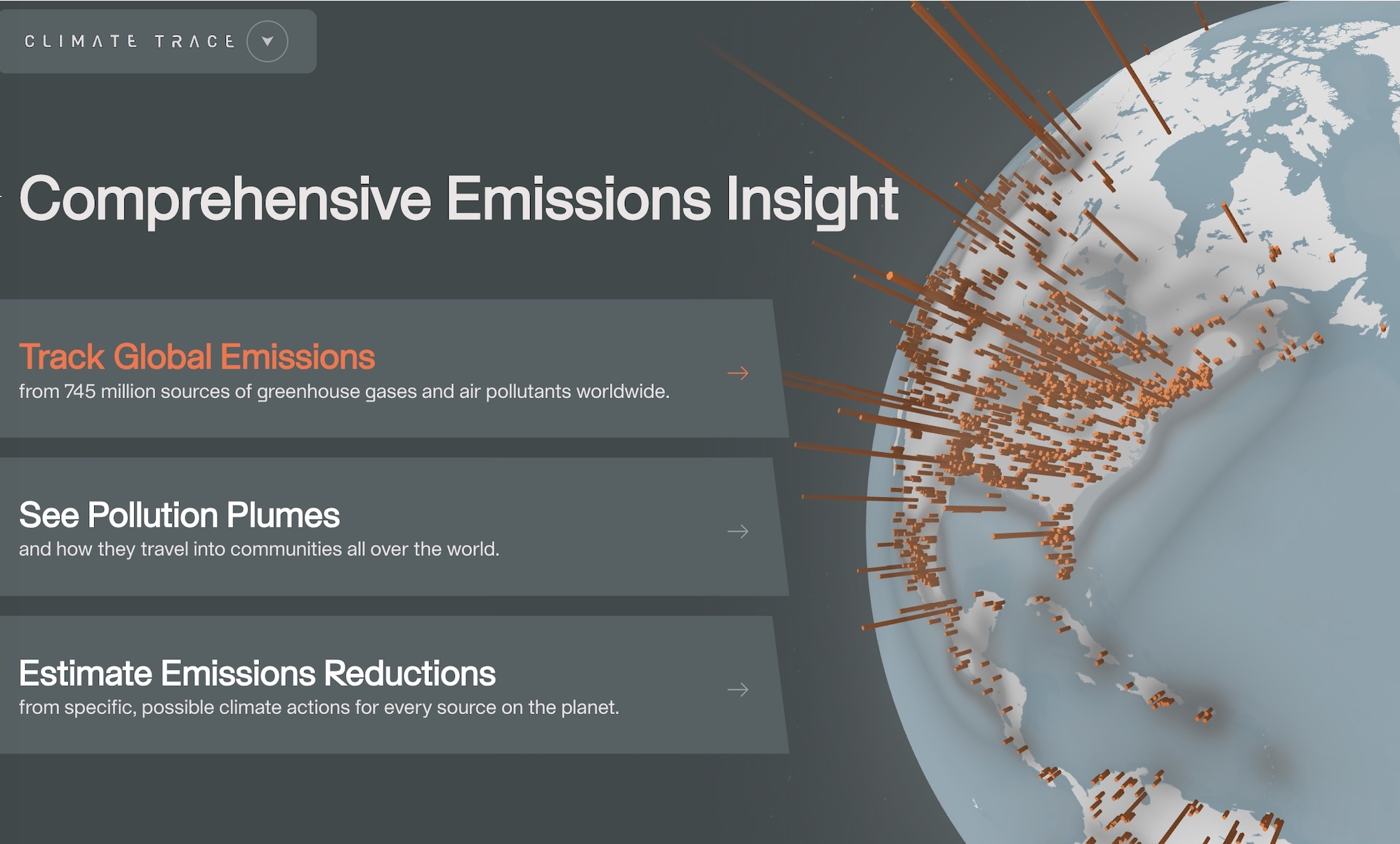
Explore global greenhouse gas emissions through interactive maps and powerful data, revealing where pollution originates, which industries are responsible and the environmental impact of human activity.
Where, precisely, are greenhouse gases being emitted?
Which industrial sectors contribute to those emissions?
How do individual facilities and locations compare?
Climate TRACE is helping to make these questions easier to investigate.
The initiative combines multiple forms of data, including satellite observations and analytical models, to produce estimates of greenhouse-gas emissions associated with industrial and other sources around the world.
Its public database allows users to explore emissions by geography, sector and, where available, individual source.
The scale is extraordinary.
The project offers downloadable data, geospatial information and an API, enabling researchers and developers to work directly with its emissions estimates.
Its September 2026 release included monthly emissions data through July 2026.
Crucially, the underlying data is not a continuous direct measurement of every emitting facility.
Emissions are estimated using methodologies that carry different levels of uncertainty.
Even with that limitation, the achievement is significant.
A person no longer needs access to a private industrial database simply to begin investigating emissions patterns.
Students can explore them. Journalists can compare them. Researchers can analyse them.
Communities can examine estimates associated with facilities in their regions.
This creates opportunities for informed public discussion that were previously much harder to access.
Climate accountability becomes more tangible when global totals can be connected to identifiable activities and locations.
5. Archive Genocide: Preserving Evidence the World Must Not Forget
Website: https://archivegenocide.org
War is documented differently today than at any previous point in human history.
Smartphones, social media and digital communications have created vast records of events that, in earlier generations, might have remained undocumented or been captured by only a handful of journalists.
Yet digital evidence is remarkably fragile.
Videos disappear. Accounts are suspended. Posts are deleted. Devices are destroyed. Original files can be lost, and the context surrounding an image can become detached from the image itself.
Archive Genocide is an ambitious attempt to confront this problem in the context of Gaza and the West Bank.
The independent project describes itself as a free public archive of more than 156,000 videos and photographs documenting reported atrocities and destruction since October 2023.
Visitors can explore footage, search records, examine source information, and navigate related incidents through an interactive map.
Its Gaza Node Map is particularly striking.
Instead of viewing thousands of disconnected videos, the visitor can explore relationships between documented events, named people, places, facilities and other recorded entities.
This introduces a different way of understanding an enormous body of material.
A single piece of footage is one record. But when multiple records are organised around locations, events and dates, patterns may become visible that are difficult to recognise when watching isolated clips.
The project’s importance also lies in preservation.
Future investigators, journalists, historians and legal professionals may need access to original material long after a social media post has disappeared.
There are important distinctions between archived footage, an independently verified incident, an attributed perpetrator and a legal finding. The existence of a record is not by itself proof of every claim made about it.
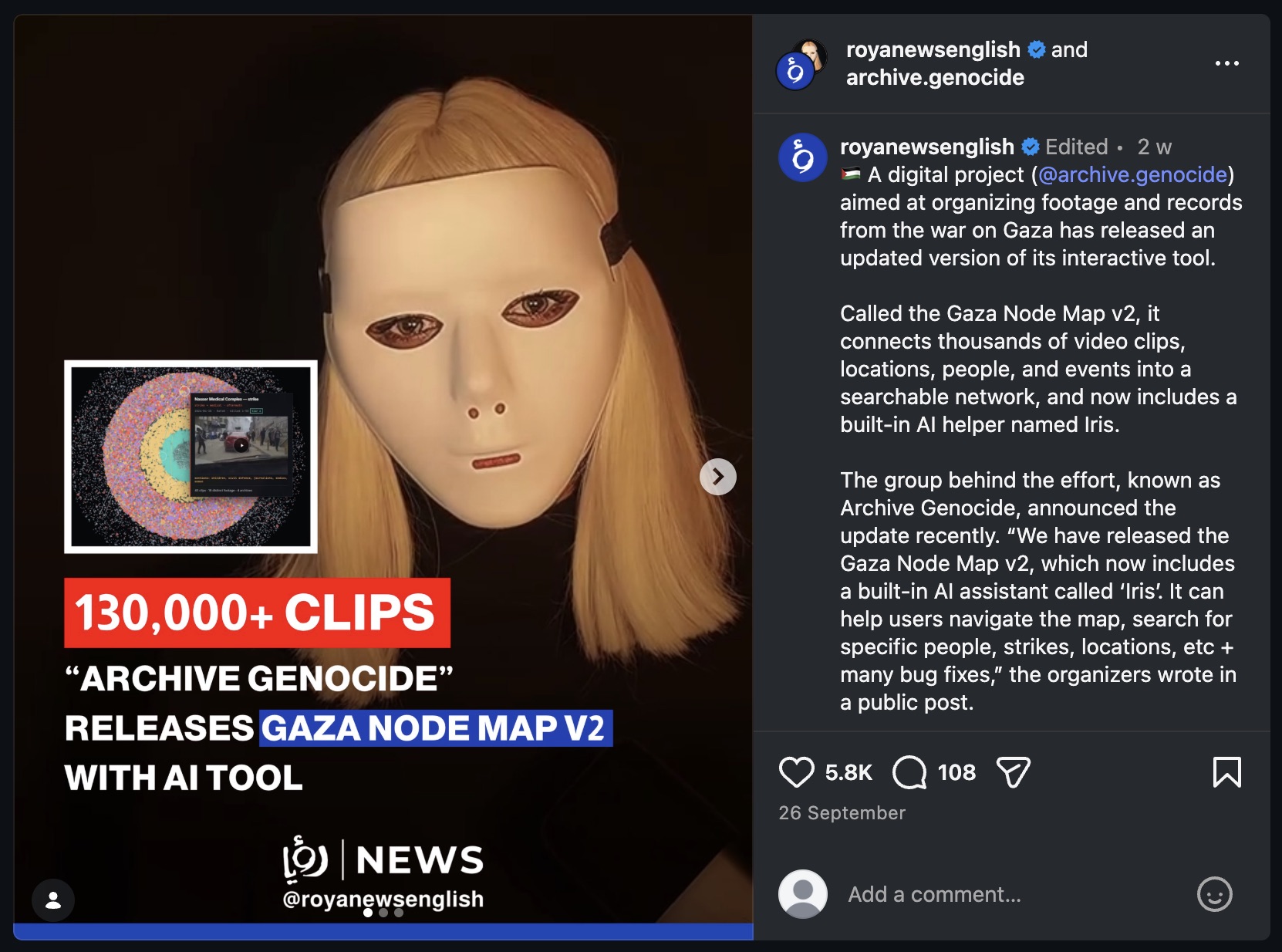
The identity of the person behind Archive Genocide remains undisclosed
Nevertheless, Archive Genocide illustrates an important possibility: independent digital archives can preserve and organise material on a scale that would have been difficult for a small team to contemplate a generation ago.
The internet is becoming not only a place where events are reported, but a place where their underlying records can be preserved and examined.
6. Global Fishing Watch: Bringing the Oceans Into View
Website: https://globalfishingwatch.org
The world’s oceans cover most of the planet, but human activity across them has historically been difficult for the public to observe.
Commercial fishing vessels travel enormous distances, operating far beyond the sight of coastal communities and traditional monitoring systems.
Global Fishing Watch has spent years developing technology to make aspects of this activity visible.
Using vessel tracking information, satellite observations and machine learning, its public map enables visitors to explore apparent commercial fishing activity, vessel movements, port visits and encounters at sea.
A visitor can navigate across oceans, select regions, investigate activity over time and examine the behaviour of individual vessels.
It is an extraordinary demonstration of what happens when complex geospatial data is transformed into an interface designed for public use.
There are significant limitations.
Not every fishing vessel broadcasts tracking information. Coverage varies between regions and vessel sizes. Algorithms can misclassify activity, and suspicious-looking movements are not necessarily evidence of illegal behaviour.
The platform explicitly acknowledges these uncertainties.
That transparency is part of what makes it valuable.
It illustrates how public-interest technology can expand scrutiny without pretending that every observation is definitive.
A generation ago, accessing this level of maritime activity data would have been prohibitively difficult for many ordinary people.
Today, much of it can be explored through a free online map.
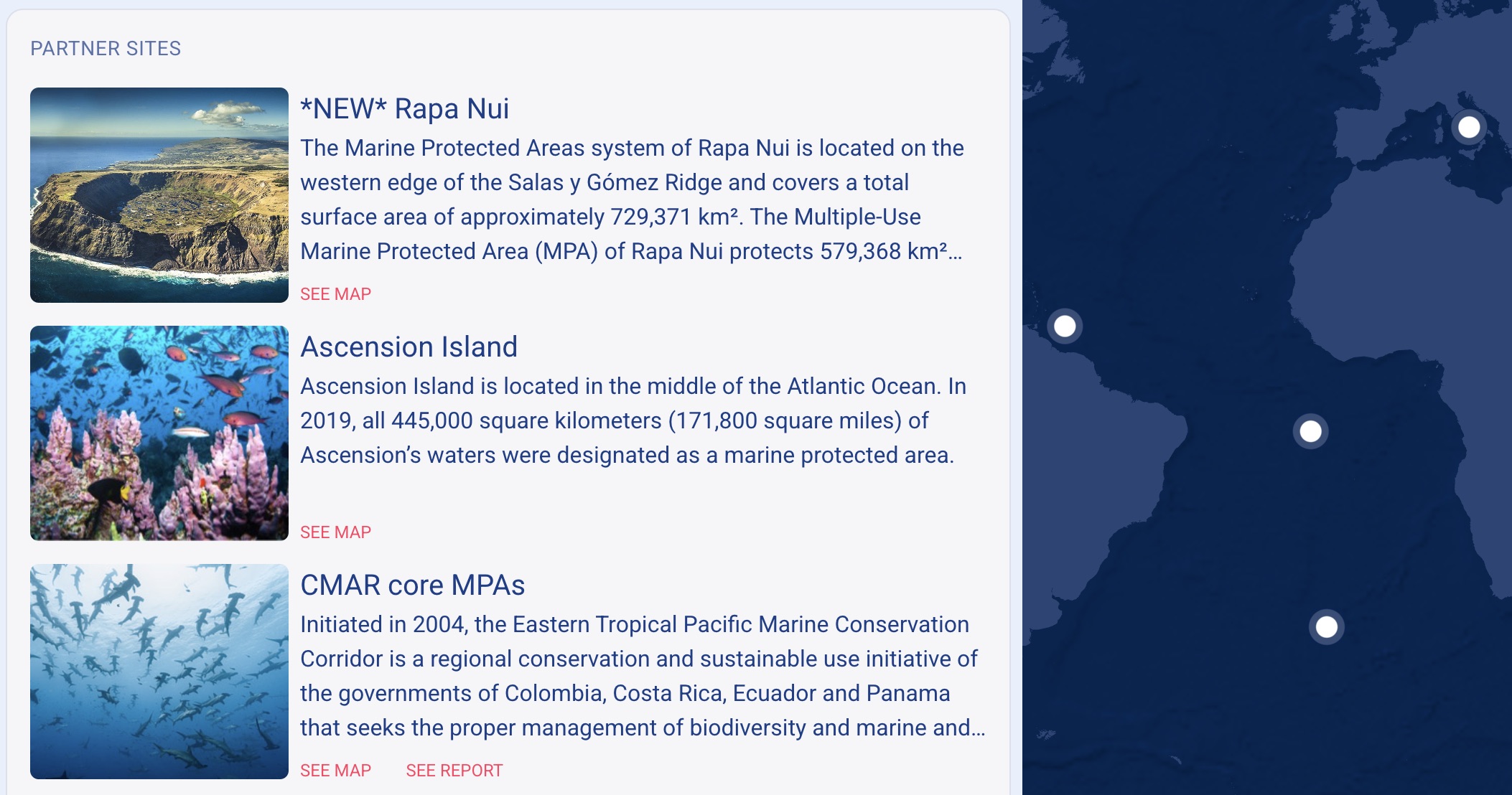
Explore the world’s oceans through interactive maps and satellite data, uncovering global fishing activity, vessel movements and the human impact on marine ecosystems.
An immense part of the planet that was once largely out of public sight is becoming more observable.
The Bigger Story: The Democratisation of Intelligence
What makes these platforms remarkable is not that each contains data.
Governments, universities, researchers and international organisations have been collecting data for decades.
What is changing is the combination of accessibility, scale and interactivity.
A satellite image becomes a searchable map.
A financial filing becomes part of a network.
A collection of documentary footage becomes a connected archive.
A series of humanitarian reports becomes an interactive evidence base.
A global emissions inventory becomes a public investigative tool.
And increasingly, an AI system can help a non-specialist navigate information that once demanded years of technical training.
These developments reduce the barriers between specialist knowledge and public understanding.
They do not remove the need for expertise. They do not guarantee that every dataset is accurate. And they certainly do not mean that every compelling visualisation represents an established fact.
But they change who can participate.
A student researching environmental destruction can investigate global land-cover data. A coastal community can examine fishing activity. A journalist can connect corporate filings. A concerned citizen can explore publicly documented humanitarian information.
This is a profound shift.
From Watching the World to Questioning It
For much of the internet’s history, people have been encouraged to consume information.
Read the news. Watch the footage. Follow the commentary. Share the headline.
These new platforms offer another possibility.
Investigate the evidence. Compare the records.
Examine the timeline.
Question the methodology.
Follow the connections.
It is a movement away from the internet solely as a publishing medium and towards the internet as a public research environment.
In that environment, the most meaningful platforms may not be the ones with the most dramatic animations or the fastest-moving counters.
They may be the ones that allow users to move from a striking statistic to its original source, understand its limitations and investigate its context.
The Responsibility That Comes With Making Information Public
There is, however, an important warning.
The easier it becomes to create convincing analytical interfaces, the easier it also becomes to create an appearance of authority.
A beautifully designed dashboard can still contain misleading information.
A number updating every second may be a projection rather than a real-time observation.
Two apparently independent reports may originate from the same unverified claim.
A relationship between two companies may be real without supporting an accusation of wrongdoing.
AI-generated summaries may omit context or misinterpret data.
And a satellite-derived estimate may contain meaningful uncertainty.
The future of public-interest intelligence cannot be built on presentation alone.
It must depend on transparent methodologies, traceable sources, careful distinctions between facts and allegations, responsible handling of personal information, and a willingness to correct errors.
Real accountability requires more than making information visible.
It requires making it trustworthy.
What Could Come Next?
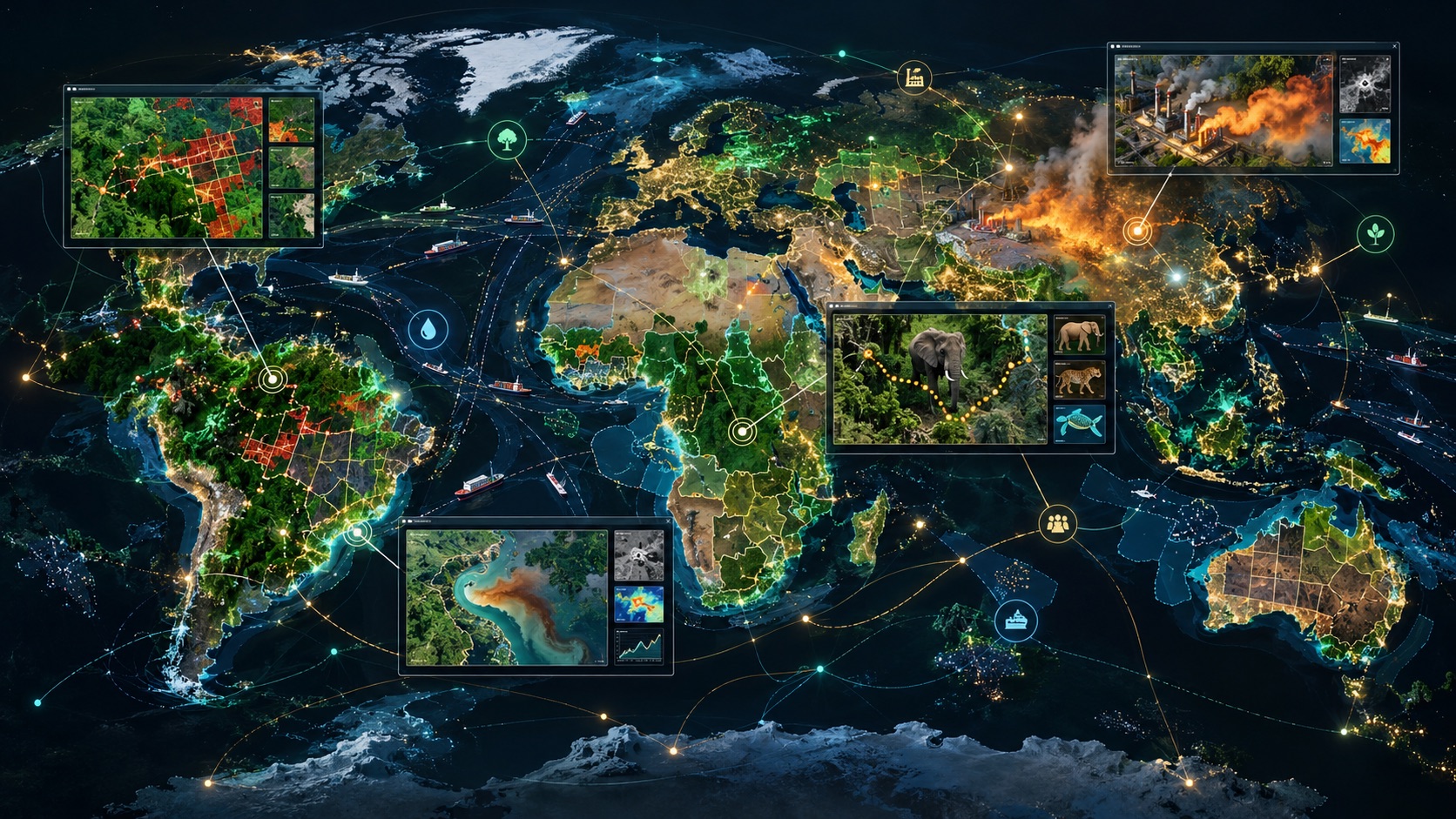
Perhaps the most exciting aspect of this technological movement is the possibility that we are only witnessing its beginning. The platforms emerging today demonstrate how information that was once scattered, difficult to interpret or accessible only to specialists can be transformed into powerful tools for public understanding. But they also raise a fascinating question: how much more could we uncover if we applied these same technologies to other areas of our world?
Satellite imagery is already helping us monitor the disappearance of forests, but similar technology could reveal the gradual destruction of wildlife habitats, the expansion of industrial agriculture and the changing condition of our natural landscapes. Vessel-tracking systems could offer coastal communities greater insight into the industries operating in their waters, while artificial intelligence could bring together fragmented public records on water pollution, waste disposal, land ownership and corporate activity. The archival methods used to preserve evidence of conflict could also help document environmental destruction, ensuring that records of damaged ecosystems and industrial incidents are not simply lost to time.
What makes these possibilities particularly remarkable is that much of the underlying information already exists. The challenge is no longer solely about collecting data, but about connecting it, interpreting it responsibly and presenting it in a way that people can genuinely understand and explore.
This is where a new generation of independent developers, researchers, journalists, conservationists and public-interest organisations has an extraordinary opportunity. With open datasets, increasingly sophisticated software and accessible artificial intelligence, small teams can now undertake projects that might once have required the financial resources and technical infrastructure of major institutions. An individual with a compelling idea, the determination to investigate and the ability to build can create something with genuine global relevance.
Of course, not every platform will succeed. Maintaining accurate information, securing long-term funding, protecting credibility and keeping complex systems operational are significant challenges. Some projects will remain experimental, while others may grow into indispensable resources for researchers, journalists, policymakers and the public. But together, they point towards something far more important: a future in which access to meaningful intelligence becomes less dependent on wealth, geography, institutional influence or professional status.
A Different Kind of Internet Is Being Built
At a time when so much of the internet is designed to capture our attention, encourage endless scrolling and turn personal information into commercial value, there is something remarkable about people choosing to build technology for an entirely different purpose. These developers are creating platforms that encourage us to question, investigate and understand the world around us, rather than simply consume another stream of headlines.
Their work is making previously inaccessible information visible, whether that means tracing the disappearance of ancient forests, examining the emissions associated with global industry, preserving documentary evidence of human suffering, monitoring commercial activity across our oceans or uncovering the financial and institutional relationships that influence events around the world. Each project approaches a different issue, yet all contribute to a much larger transformation in how information is organised, shared and understood.
The people behind these platforms come from different backgrounds, represent different causes and possess vastly different resources. Some work within established scientific organisations, while others are independent creators building ambitious projects with relatively small teams. They may have little in common beyond a belief that important information should not remain buried in complicated databases, inaccessible archives or systems that only a privileged few can navigate.
What unites them is the determination to make evidence more accessible and to give ordinary people the opportunity to explore questions that matter. Their work reminds us that some of the most important technological innovations are not necessarily those that generate the greatest profits, but those that expand our collective understanding of the world.
We are entering an era in which the world’s information is no longer simply being collected. It is being connected, analysed, visualised and increasingly placed in the hands of the public. And while access to data does not automatically guarantee truth or accountability, it creates new opportunities to ask better questions, challenge established narratives and examine the evidence for ourselves.
For perhaps the first time on this scale, people are no longer limited to being told what is happening to the world. They are being given the tools to investigate it themselves.
The future of the internet should not simply be about connecting people to information. It should be about giving them the power to understand it.
Explore the Platforms
- BL00D.MONEY – Corporate and financial networks connected to war
- Felled.org – Deforestation and ecological accountability
- PRISM – Humanitarian data and crisis analysis
- Climate TRACE – Greenhouse-gas emissions intelligence
- Archive Genocide – Conflict evidence and digital preservation
- Global Fishing Watch – Global maritime activity and fishing intelligence