
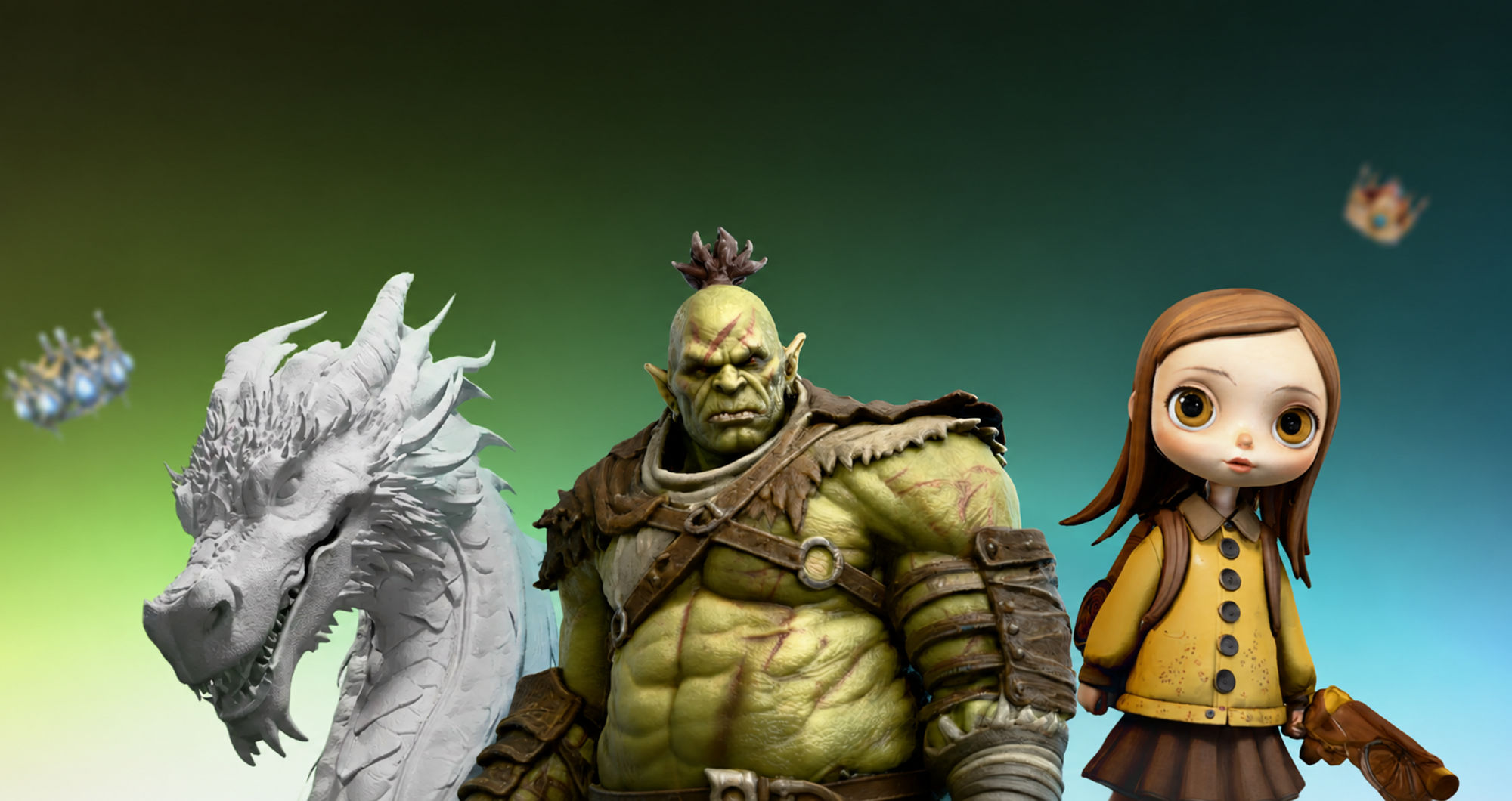

AI 3D agents help small teams turn text or images into multiple 3D concepts, refine a selected direction conversationally, and hand the result to traditional tools for production work.
For years, creating a 3D asset usually meant learning specialist software before a creator could make anything useful.
A designer might begin in Blender or Maya, spend time learning navigation and modelling tools, build a mesh, create UVs, apply materials, and then move through several more stages before the original idea started to resemble a finished object.
That workflow still matters for professional 3D production. What is changing is the point at which people can begin.
A new generation of AI tools is making it possible to describe an idea in ordinary language, explore several visual directions, and create an initial 3D model before mastering a traditional modelling package.
The more interesting development is not simply faster model generation. It is the emergence of AI agents that turn 3D creation into an ongoing conversation rather than a single prompt followed by a single result.
For small studios, independent developers, product designers, and digital creators, that could change who participates in the early stages of 3D work.
The Traditional Barrier Was Not Just Time
Professional 3D software is extraordinarily capable, but capability comes with complexity.
Someone creating a simple object still needs to understand concepts such as meshes, topology, materials, lighting, coordinates, file formats, and cameras. A person working toward games or animation eventually encounters additional topics such as rigging, UV mapping, texture baking, and optimisation.
That knowledge is valuable. It is also a significant barrier when the immediate goal is simply to answer a creative question.
Imagine a small product team discussing a new tabletop speaker.
At an early meeting, they may want to know whether the design should feel soft and domestic or technical and industrial. They might want to compare a cylindrical body with a wider rectangular version or see how different control layouts change the personality of the product.
None of those questions initially require a production-ready engineering model.
They require something visible enough for the team to discuss.
This is where AI-assisted 3D creation has begun to change the workflow.
From Describing an Idea to Seeing It in 3D
Text-based generation removes one of the earliest obstacles: starting from an empty scene.
Instead of manually creating the first primitive shapes, a creator can describe an object and ask an AI system to interpret the description.
A prompt might specify a compact desk lamp with a rounded base, adjustable metal arm, matte finish, and minimal Scandinavian styling.
A platform such as Meshy AI can turn text descriptions or reference images into textured 3D models, giving creators a starting asset that can be reviewed before they decide how much further work the idea deserves.
The first result should not automatically be treated as the final design.
Its value is often in making an abstract idea concrete enough to criticise.
Perhaps the lamp is too tall. Perhaps the base feels unstable. Maybe the shape looks more industrial than expected.
Those observations become possible because the team now has something spatial to evaluate rather than another paragraph describing what the object might look like.
Images Give Teams More Control
Text works particularly well when the direction is still open, but many creative projects already have visual material.
A company may have product sketches. A game team may have concept art. An illustrator may have a character drawing. An architect may have a reference object intended for an early visualisation.
In those situations, Image-to-3D can provide a more controlled starting point because the AI has visible information about proportions, shapes, colour relationships, and overall style.
This does not mean that a single image contains everything required to reconstruct an object perfectly.
The back of an object may be hidden. Transparent surfaces can be difficult to interpret. Thin structures, mechanical connections, or exact dimensions may require additional work.
The important shift is that the reference image can now participate directly in the 3D workflow rather than simply sitting beside the modeller as inspiration.
For teams already working visually, this makes the transition between concept art and spatial exploration much shorter.
Why AI Agents Are Different from One-Shot Generators
Early generative tools often followed a simple pattern.
Write a prompt. Generate an output. Decide whether to keep it or try again.
That approach can accelerate production, but it does not necessarily match how creative decisions are actually made.
Design usually develops through questions.
Should the body be wider?
Would this character look better with a heavier jacket?
Can the surface feel less mechanical?
What happens if the proportions are exaggerated?
Could we keep the same visual language but create three related props?
That is why conversational AI agents are becoming an important development.
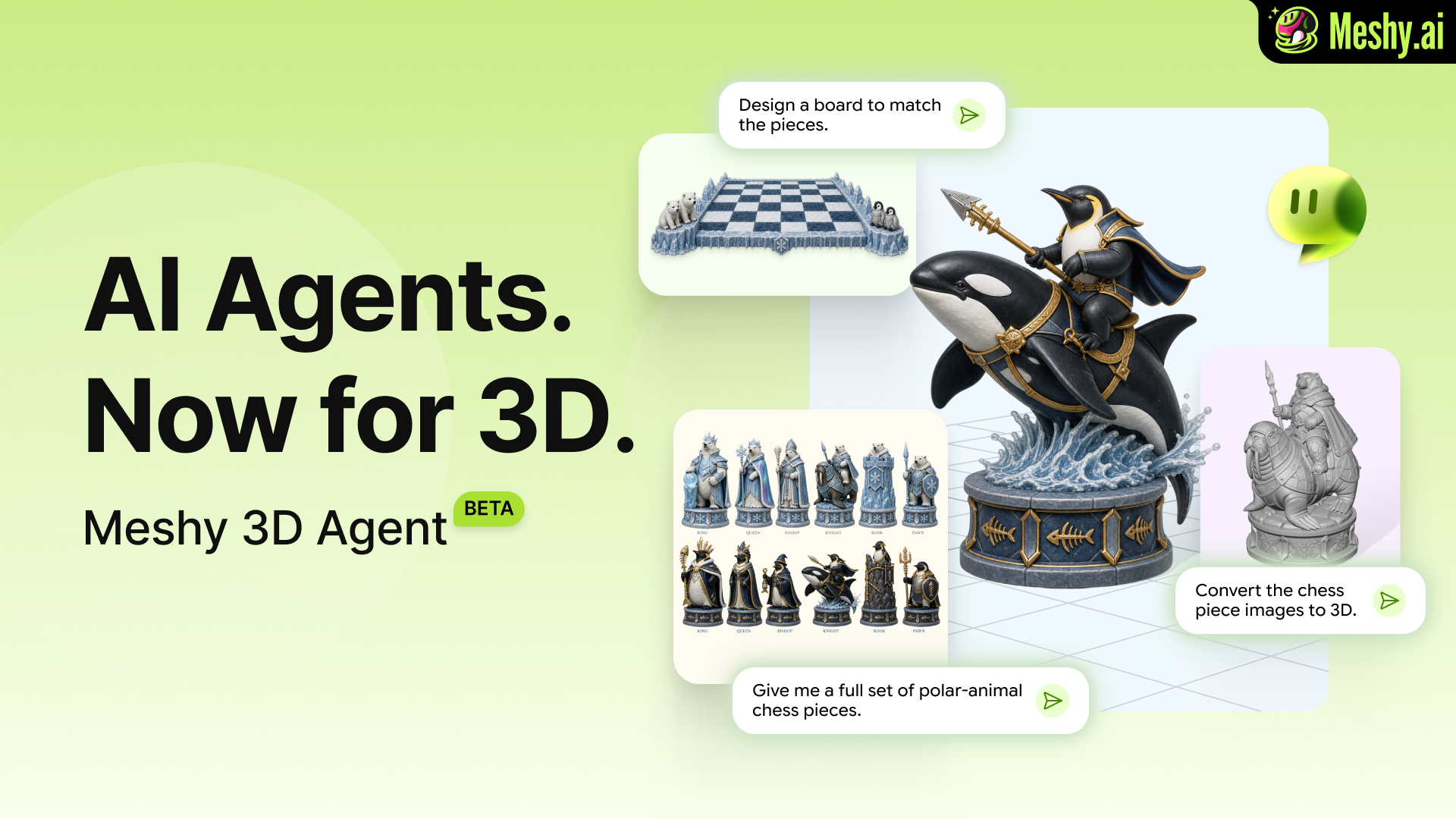
An AI 3D agent can support a multi-step process in which a creator describes an idea, reviews different visual directions, refines the concept through conversation, and then turns the selected direction into a 3D model.
Meshy 3D Agent, for example, can begin with text, a photograph, or a sketch and generate several concepts before moving the chosen design into 3D.
The difference may sound subtle, but it changes the role of the tool.
Instead of asking the user to know exactly what they want before generation begins, the system can become part of the process of discovering what the user wants.
How Do AI 3D Agents Speed Up Concept Iteration?
Creative teams rarely struggle because they cannot imagine one possible solution.
The harder problem is choosing between several reasonable ones.
If every alternative requires hours of manual modelling, teams naturally reduce the number of directions they explore. They may commit early to a design simply because rebuilding it repeatedly would take too much time.
AI generation changes the economics of that decision.
A team can compare different silhouettes, proportions, accessories, materials, or styles before committing to detailed production work.
This does not mean generating hundreds of random versions.
Good iteration still requires clear judgement.
The advantage is that the cost of asking “What if?” becomes lower.
That matters particularly for small teams, where one artist or designer may be responsible for a large portion of the visual workload.
3D Skills Are Still Important
Making 3D creation more accessible does not make professional 3D knowledge obsolete.
Once an asset moves from exploration into production, technical requirements become more important.
A game developer may need to optimise topology and texture sizes before putting the model into a real-time environment. A character artist may need to check whether the geometry will deform properly during animation. A product designer may need accurate dimensions that an AI-generated concept cannot guarantee.
An architectural visualisation may require correct scale and placement. A 3D-printing project needs geometry that behaves properly in a slicer.
AI can shorten the route to the first useful model.
It does not remove the need to understand what makes a model suitable for its final destination.
That distinction is important because it suggests that AI and traditional software are more likely to become complementary than mutually exclusive.
The Workflow Is Becoming Less Linear
Traditional digital production often involves moving between specialised tools.
A creator might sketch in one application, model in another, texture somewhere else, rig the asset separately, and finally import everything into a game engine or renderer.
AI platforms are beginning to connect more of those stages.
Meshy, for example, currently combines Text-to-3D, Image-to-3D, AI texturing, animation, and conversational 3D creation within the same wider workflow. Models can then be exported into commonly used formats for further work in other software.
This does not mean every project should remain inside one platform.
Professional pipelines will continue to use specialised software because different tasks require different levels of control.
What changes is the amount of setup required before a creator can begin exploring.
Instead of building the entire pipeline before testing an idea, teams can increasingly begin with the idea and introduce specialist tools when the project reaches the stage where they are actually needed.
Small Teams May Feel the Change First
Large studios can distribute work among specialised artists.
Small teams cannot always do that.
An independent game studio may have one environment artist responsible for dozens of assets. A startup may have a designer but no dedicated 3D department. A freelancer may need a simple model for a client presentation without wanting to become a full-time modeller.
These are situations where the ability to create a useful starting asset quickly can have an outsized effect.
The gain is not necessarily that AI produces a final model without human involvement.
The gain is that more people can participate in visual decision-making before specialist production begins.
A product manager can communicate an idea spatially.
A developer can test whether a prop fits a game scene.
A designer can compare multiple shapes before investing in detailed modelling.
The 3D artist may then receive a clearer direction instead of starting from an ambiguous brief.
Which Small-Team Projects Benefit Most From AI 3D?
Probably, but that does not mean every project needs it.
When a technology becomes easier to access, people naturally experiment with it more frequently. We have already seen this with image generation, video editing, and website building.
3D is likely to follow a similar pattern.
More ecommerce teams may test interactive products. More independent developers may use 3D during prototypes. More designers may include spatial concepts in presentations that previously relied entirely on flat imagery.
But accessibility should not be confused with necessity.
A 3D asset still needs a purpose.
If a photograph communicates the idea more clearly, use the photograph. If a rough sketch is enough for a meeting, there may be no reason to generate a model.
AI becomes most valuable when it removes unnecessary friction from a task that already benefits from spatial information.
The Bigger Change Is Who Can Start
The most significant development in AI 3D may not be a particular model or generation speed.
It may be that the starting point is changing.
For decades, the path into 3D creation usually began with learning the interface of a professional modelling application. Today, it can begin with a sentence, a photo, a sketch, or a conversation.
Professional artists will still be needed to create polished assets, solve difficult technical problems, establish visual identity, and prepare models for demanding production environments.
But the earliest part of the process is becoming available to a much wider group of people.
That means 3D may increasingly become less of a specialist destination and more of a normal part of how teams think through ideas.
For small creative teams in particular, the real benefit of AI may not be replacing the people who already know how to create 3D.
It may be giving everyone else a way to join the conversation earlier.







