
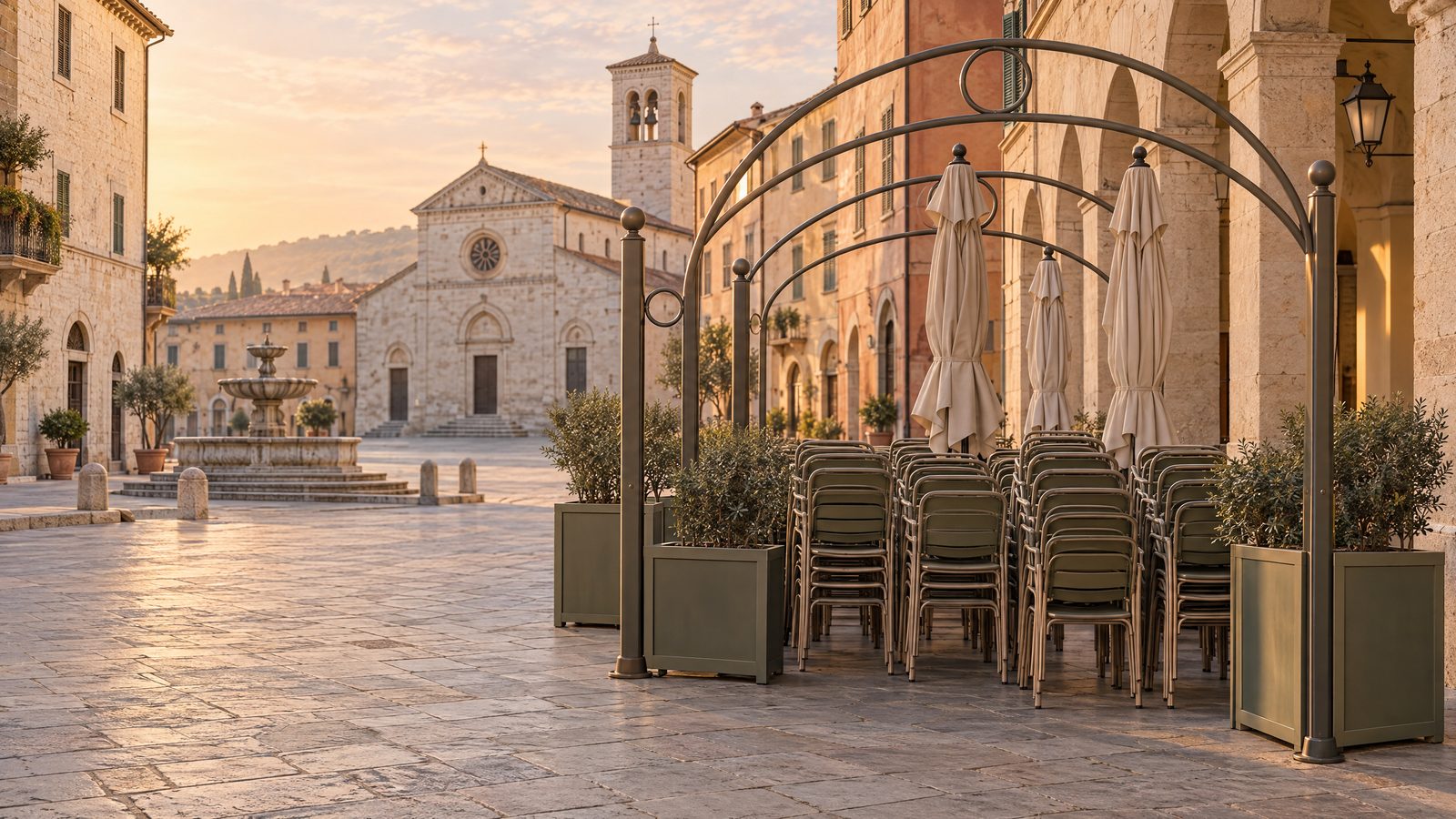

Italy’s Cabinet has given preliminary approval to a proposed legislative decree that would set a more permanent framework for removable outdoor hospitality structures in public spaces with cultural or landscape significance.
The proposal concerns the outdoor areas used by hotels and public food-and-drink businesses, commonly described in Italy as dehors. It is intended to replace a patchwork of temporary arrangements with clearer rules for businesses, councils and heritage authorities. The Cabinet’s decision is an important stage, but it is not the final passage of the decree and does not mean that the proposed rules are already in force.
What the proposal covers
The draft distinguishes between two broad kinds of outdoor structure. One category includes installations that can form enclosed spaces. The other covers movable or simply anchored items without masonry work, such as tables, chairs, umbrellas, platforms and windbreaks.
That distinction matters because the proposals deal separately with heritage controls and building procedures. Where a removable structure forms an enclosed space, the draft would make a certified notice of works available as an alternative route to a building permit. Existing rules for work that does not require formal building consent would remain in place.
The central aim is to simplify the process in many historic urban settings while retaining tighter controls around places of exceptional cultural importance. The proposal would not remove the separate need for permission to occupy public land. Local authorities would continue to regulate that use of streets, squares and pavements.
Different approach near exceptional sites
Under the draft, many removable installations in open urban spaces of artistic or historic interest would no longer require the cultural and landscape authorisations currently specified in the heritage code. The exemption would not apply immediately beside archaeological sites or other immovable cultural assets of exceptional artistic, historic or archaeological importance.
>
Those specially protected locations could include nationally important monuments, religious buildings of exceptional cultural value, major urban fountains and sculptural complexes.
Within 30 days of the decree entering into force, the national heritage directorate would be required to identify the exceptional assets and the areas directly in front of them. The lists would be made available through a mapped information system and updated every three years.
For outdoor structures proposed in those closely protected areas, decisions would be based on factors including the visibility of the heritage asset, distance from it, the appearance and consistency of furnishings, and public access to the site. The proposed decision period is 45 days. If no decision is made by then, consent would be treated as having been obtained. A refusal would be permitted only where conditions could not make the proposal compatible with protection of the site.
Local rules and access
The draft also envisages agreements between councils and local heritage offices. These could set advance conditions on design, materials, colours, positioning and furniture. An installation that met those conditions could be authorised automatically or through a simplified procedure.
Local regulations would still have practical duties to meet. The proposals require rules to protect access for emergency vehicles and to leave adequate pavement space for pedestrians, including people with limited mobility. Simplification for business use would therefore sit alongside continued responsibilities for public safety and accessibility.
What happens to existing structures
The decree includes a transitional route for certain structures installed under earlier emergency arrangements. Once the new protected-area lists are published, operators with installations immediately beside exceptional assets would have 90 days to apply for authorisation. If consent were refused, the structure would have to be removed and the site restored within 60 days of 30 June 2027.
Until then, the public-land occupation permission for those structures would remain effective. That is not the same as a permanent approval under the proposed framework. It is a temporary bridge while the new lists, applications and decisions are completed.
For businesses, the proposal points towards clearer boundaries between routine outdoor seating and installations in the most sensitive settings. For residents and visitors, the practical test will be whether faster procedures can operate without blocking pavements, impeding emergency access or weakening the protection of important places.
The next stages of the legislative process will determine the final wording, timetable and legal effect. Until the decree has completed that process and entered into force, operators and councils must continue to work within the rules that currently apply.







