

A London-led research partnership has secured Innovate UK funding to test whether artificial intelligence can infer detailed molecular information from routinely collected human-tissue data. The work is an initial feasibility study, not a clinical tool: researchers will first assess whether the approach can be built and whether a larger programme is viable.
The project, called DESTINY, is being developed by PharosAI, a collaboration involving King’s College London, Queen Mary University of London, Guy’s and St Thomas’ NHS Foundation Trust and Barts Health NHS Trust. Its researchers aim to combine different types of tissue information so AI models can predict molecular features that might otherwise require separate, costly and time-consuming tests.
Testing whether data can work together
Human tissue can be described in several ways. Pathology images show its appearance under a microscope, while genomic, transcriptomic and proteomic measurements capture different aspects of its biological make-up. Clinical records add information about a patient’s care. DESTINY will investigate whether models can learn from combinations of these data and estimate information that is not directly available in every sample.
The project’s central technical challenge is that data is held by different institutions and cannot simply be pooled without addressing privacy, security and governance. DESTINY plans to investigate federated learning, in which models learn from data stored at separate organisations without transferring the underlying records into one central repository. The method could enable analysis across a wider range of information, but its use with complex combinations of biological and medical data remains less extensively explored.
Researchers intend to use existing tissue and data resources brought together through the PharosAI collaboration and its partner biobanks. The feasibility work will test whether the models can predict molecular information from routine tissue samples and whether the technical approach can operate across institutional boundaries. The announcement does not report any performance results; those are what the study is intended to assess.
A first stage, not a promised clinical system
The funding sits within the first phase of the national Frontier AI Discovery competition. This phase supports short feasibility projects that examine technical plans and the prospects for later development. The competition allows successful projects to seek a larger second-phase award, but that would require a separate application and approval. DESTINY’s current funding therefore should not be confused with a confirmed multi-million-pound development grant, and no project-specific award value has been announced.
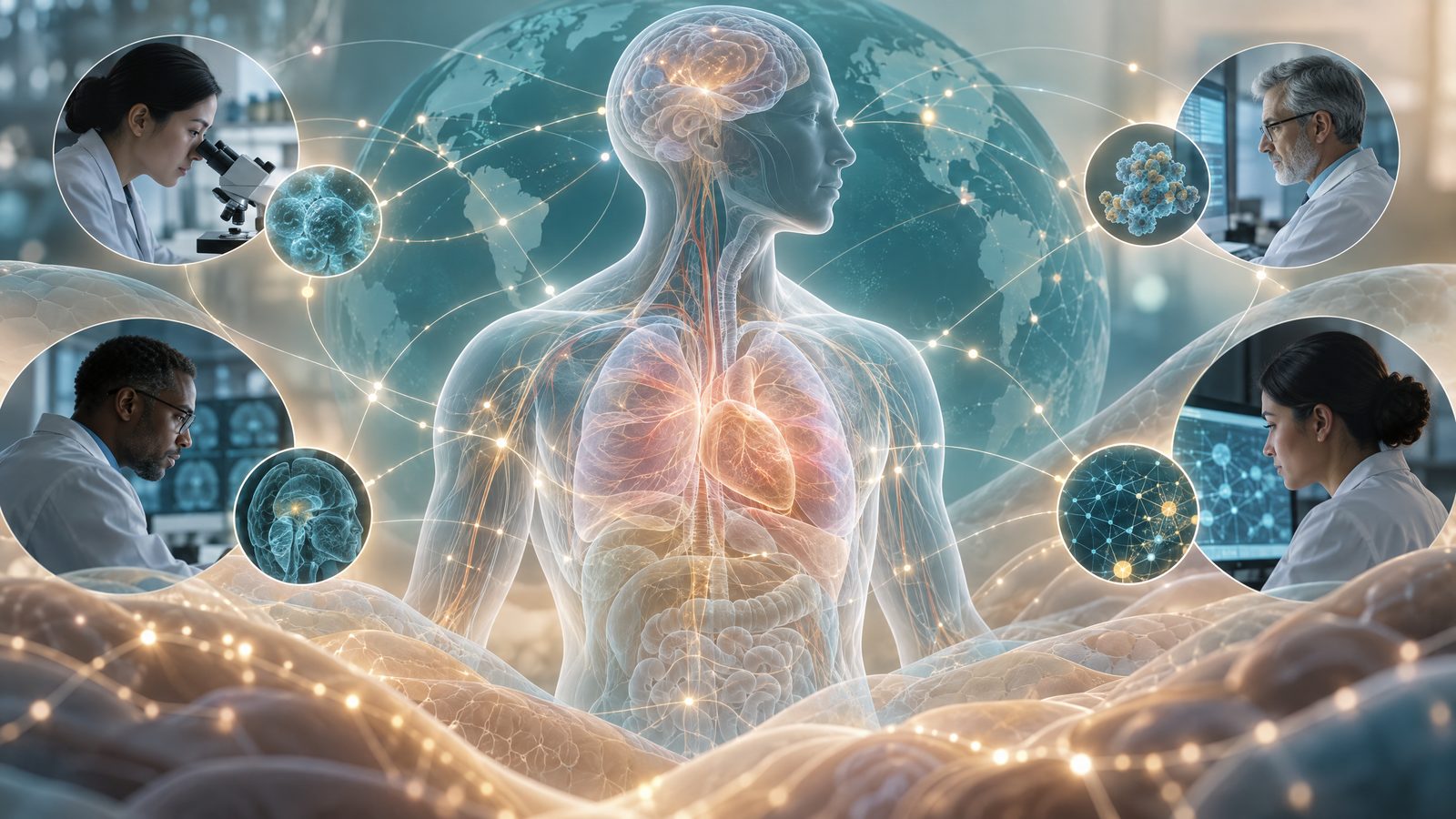
If the approach proves workable, the longer-term ambition is to create “digital twins” of human tissue: digital representations that combine information about its biological characteristics. Such models could give researchers a way to draw more insight from samples already collected, rather than requiring every molecular feature to be measured directly in each case. The team has described possible applications in understanding cancer, supporting drug discovery and informing diagnosis research, but these are prospective uses rather than demonstrated benefits.
PharosAI’s academic and NHS partners bring together cancer research, clinical services and tissue-data resources. The project is also supported by Flower Labs and Michael Roberts, a professor of applied artificial intelligence at the University of Cambridge. PharosAI is seeking collaborators developing cancer treatments, although that invitation is separate from evidence that the feasibility study has produced a usable product.
The immediate test is narrower: whether AI can make reliable predictions from routine tissue data while learning across organisations that retain control of their own records. Any clinical use would depend on further validation beyond this initial feasibility phase. The study is intended to establish whether that next step is technically and commercially plausible.







