
Researchers have mapped a way in which immune cells around a tumour’s blood vessels can limit the build-up of other immune cells that help fight cancer. The work, led by a London research team, used mouse models of breast cancer and examined existing data from people with the disease.
The experiments suggest that blocking an enzyme in the vessel-associated cells, alongside chemotherapy, can help a particular group of cancer-fighting T cells accumulate in tumours. In the mice, the combination was associated with better control of tumour growth. It has not been shown to be an effective treatment for patients.
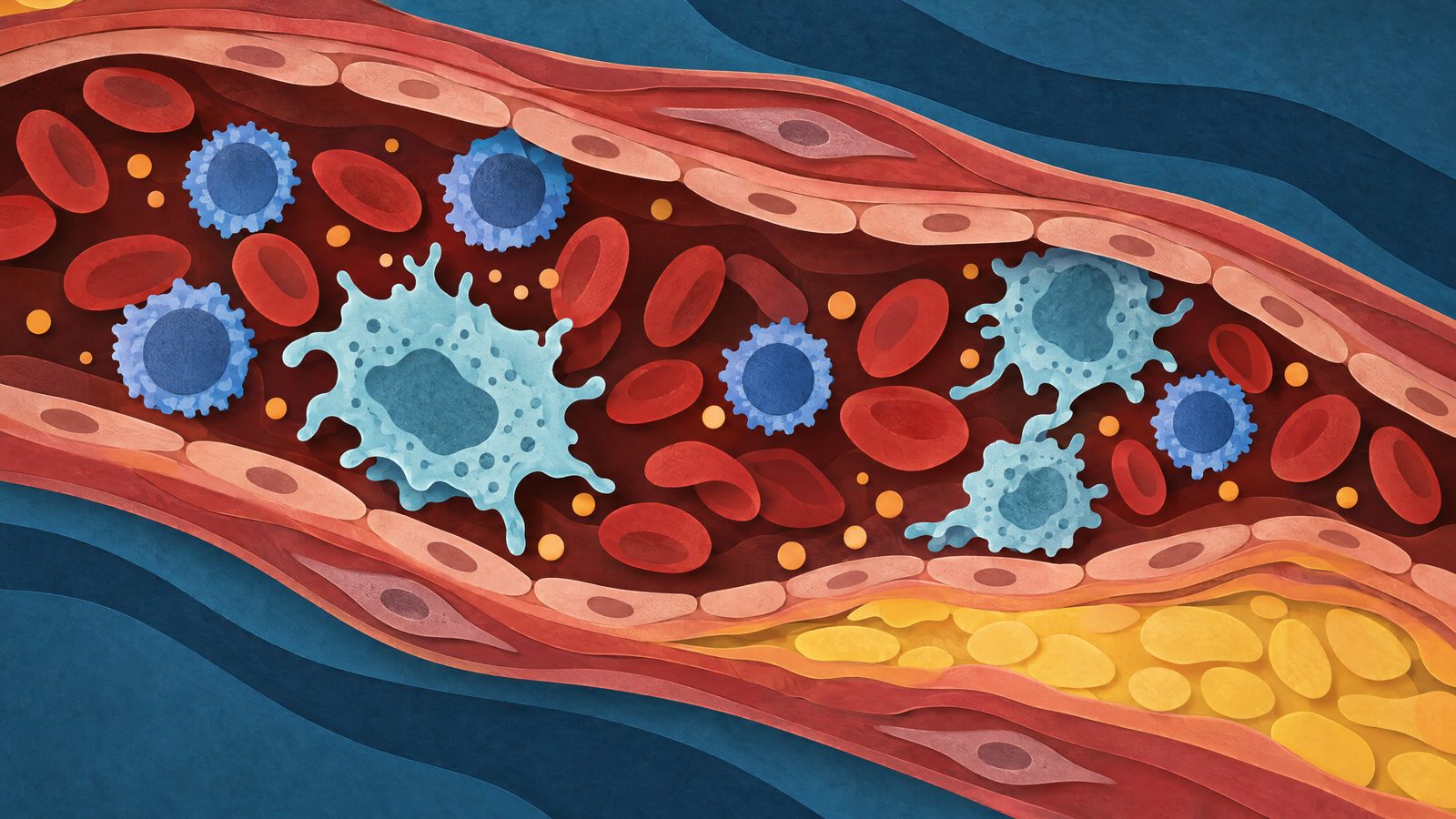
The cells at the centre of the study are a type of macrophage, a white blood cell that can have different roles depending on its surroundings. The researchers examined macrophages close to tumour blood vessels that produce an enzyme called haem oxygenase-1, or HO-1.
Their findings suggest that HO-1 activity in these cells helps restrain the accumulation of stem-like CD8 T cells in the tumour environment. These T cells are of interest because they can renew themselves and give rise to more specialised cells capable of attacking cancer.
A closer look at the signals
The new paper is not the first to suggest that HO-1 affects the response to chemotherapy. Earlier research had already found that blocking the enzyme alongside chemotherapy helped control tumour growth in mouse models. The latest work investigates the early immune changes and signalling that may help explain that result.
The researchers compared tumours in mice given chemotherapy, an HO-1 inhibitor, or the two approaches together. They also used a genetic method to reduce HO-1 activity in the relevant macrophages. In their experiments, blocking the enzyme on its own was not enough to control tumour growth. Combining the approaches increased the number of stem-like CD8 T cells in the tumour and improved immune control in the models.
The study used a model in which breast tumours arise spontaneously and another involving implanted breast cancer cells. Researchers examined the mix of cells in the tumours, including by analysing gene activity in individual cells. Much of the detailed analysis focused on the first 36 hours after treatment began, providing an early snapshot rather than a complete picture of the response over time.
A further part of the work examined supporting cells called fibroblasts. One group of these cells produced a signalling molecule called CXCL12. The stem-like T cells carried a receptor called CXCR4 that allows them to respond to that signal.
The researchers’ model suggests that chemotherapy and reduced HO-1 activity can encourage the expansion of these supporting cells and help stem-like T cells accumulate. They found that CXCR4 was required for the T cells’ accumulation in the tumour. The precise molecular steps linking the macrophages to the supporting cells still need to be worked out.
What the human data can and cannot show
The team also analysed existing breast cancer data and identified a human T-cell population with a pattern of gene activity similar to the cells studied in mice. In two groups of people with triple-negative breast cancer, a stronger stem-like T-cell gene signature was associated with a longer period without the cancer returning.
One group included 81 people who received chemotherapy; the other included 209 people who had received a range of treatments. These were associations in existing data, not a trial of HO-1 inhibition. They do not establish that the signature caused better outcomes or identifies who will benefit from chemotherapy.
The mouse experiments also have important limits. Both models were of breast cancer and used female mice, and they cannot capture the full variety of human disease. The authors say further work in patient-derived models and clinical samples is needed, as well as studies at later time points and in other cancer types.
A senior researcher disclosed an equity and management interest in a company developing a related inhibitor and is an inventor on an inhibitor patent. The work provides a direction for further research, not evidence that a new cancer treatment is ready for clinical use or that patients should change their care.
Featured image: AI-generated illustration.