
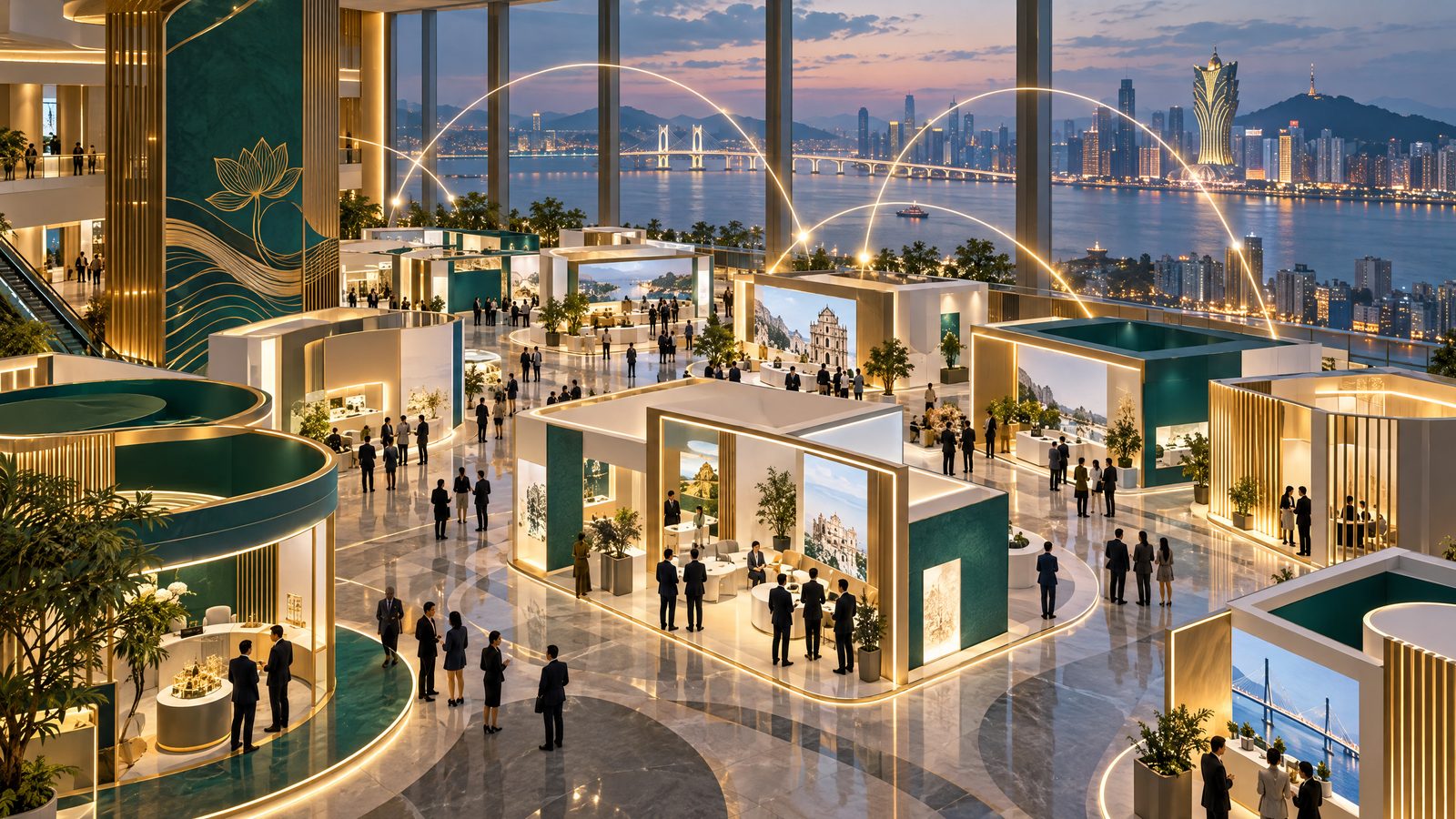

Three concurrent trade exhibitions in Macao have ended after a four-day programme combining business meetings, public access and investment-promotion work. The events brought together the 31st MIF, the Portuguese-speaking markets showcase known as 2026PLPEX, and 2026MFE, the city’s franchise exhibition. Their shared run lasted from 21 to 24 October.
The four days registered more than 90,000 entries, including in excess of 17,000 visits from trade participants. The meeting tally exceeded 1,100 and culminated in roughly 140 signed agreements. These measures describe activity during the programme. They do not reveal the monetary value of each agreement or show whether every proposed project will proceed.
Meetings and exhibitors
The three fairs were arranged as one programme rather than as completely separate occasions. In addition to the exhibition stands, the schedule included conferences, promotion sessions, awards, visits away from the venue and targeted discussions. Taken together, there were more than 90 trade and economic activities. Holding them concurrently also allowed visitors to move between investment, product and franchise discussions in one trip, rather than treating each fair as an isolated appointment.
The programme included over 1,000 exhibitors from 55 countries and regions, spanning Asia, the Americas, Europe and Africa. Displays ranged across innovation, health, farming, marine-related enterprise and brand licensing. The mix was intended to create introductions between sectors as well as give general visitors a chance to explore products and services.
Over four-fifths of the agreements concerned Macao’s “1+4” priority industries. A little more than one in ten had a connection with Portuguese- or Spanish-speaking markets. Those categories reflect the event’s cross-border purpose, but they are not a complete measure of future investment or trading income.
Proposals are not completed investment
During the preparation and operation of the fairs, 78 businesses from Portugal, Brazil, Switzerland, Singapore and elsewhere put forward projects for Macao. Compared with the previous year, the number was 14 per cent higher. Company-formation steps had started or been completed for 20 of the businesses, in areas such as technology, health, specialist financial services, cultural tourism and the meetings sector.
A submitted project, the formation of a company and a co-operation agreement are distinct stages. No individual project value, completion timetable or final result was set out for the proposals. The figures nevertheless give a more detailed view of the investment work around the exhibitions than attendance data can provide on its own.
Ten organised visits took more than 300 business representatives to sites in Macao, Hengqin and the Greater Bay Area. They were intended to let potential partners assess commercial locations beyond the exhibition halls. The four-day operation also created more than 2,000 roles, including project staff, temporary on-site workers and teams building stands. That count is confined to the event period and should not be treated as permanent employment.
What follows the close
The completion of the shared edition is not the same as a settled outcome for the agreements or proposals announced around it. The immediate results are the recorded entries, meetings and signatures. Longer-term significance will depend on whether individual conversations lead to purchases, partnerships, operating businesses or further capital commitments.
For Macao, the programme concentrated international exhibitors and trade visitors into four days. The next measure of its impact will be the progress made after the halls have closed, rather than the size of the gathering alone.







