
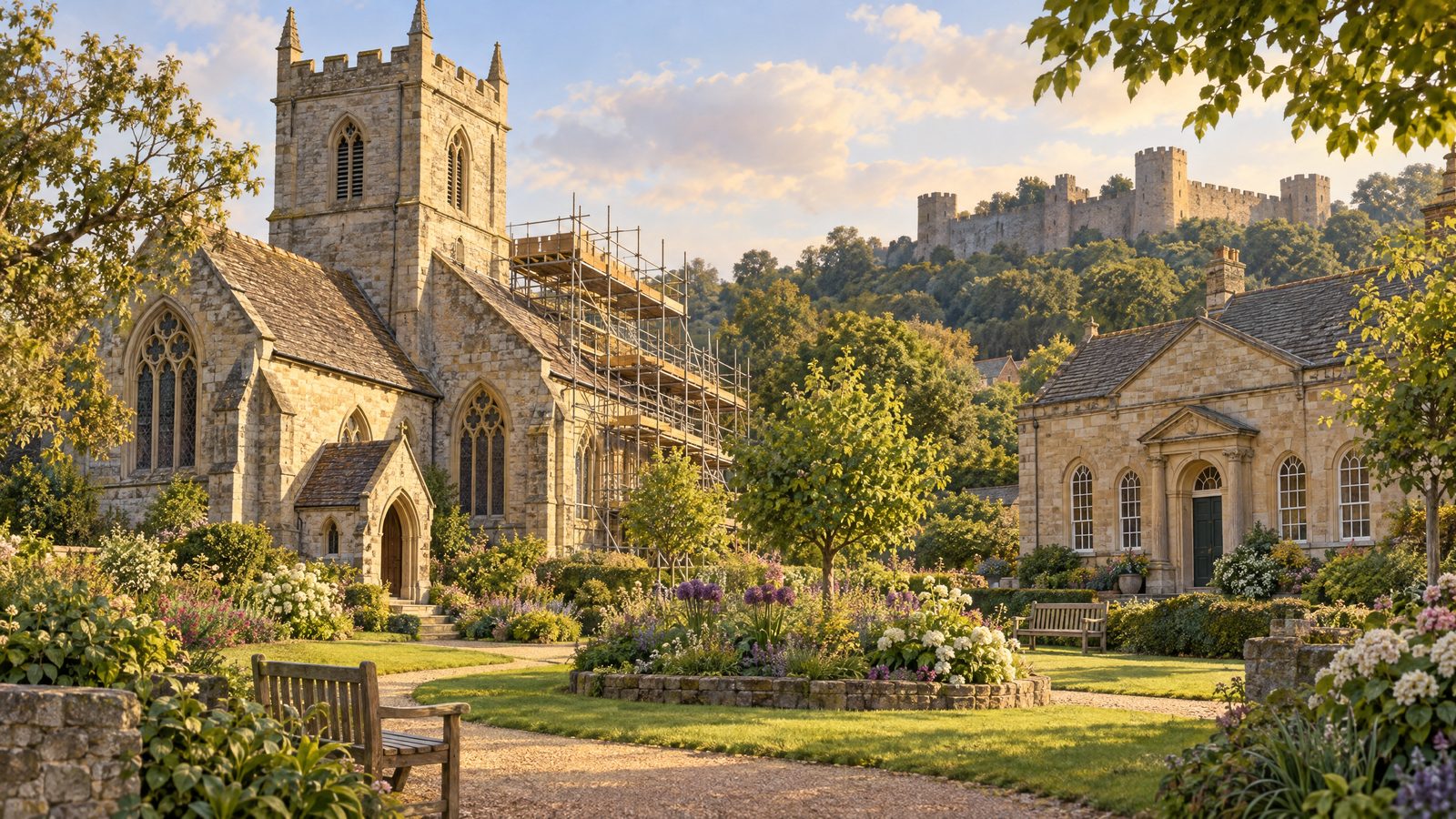

More than £41 million has been awarded to support repair and renewed community use at 74 heritage and faith buildings across England, including three places of worship in London and the South East. The first-round awards come from the Places of Worship Renewal Fund and the Heritage at Risk Capital Fund.
The grants cover a varied group of sites, from churches and a synagogue to historic town halls, market buildings and castles. The announcement brings together two programmes with different remits: one focused on listed places of worship, and another aimed at heritage buildings considered at risk. The funding is intended to enable work, not to signify that repairs are already finished.
Three worship sites in the London and South East list
The Places of Worship Renewal Fund has selected 51 recipients to share more than £18 million. Its London and South East list includes the Church of St George in Ramsgate, Church of All Saints in Hanworth and Church of St Mary’s at Hornsey Rise in London. The first two are in Kent and west London respectively, while St Mary’s is the named London recipient.
Historic England describes the fund as support for urgent repairs and essential improvements at listed places of worship in England. It is open to active places of worship of any faith or denomination. Its broader objectives include keeping buildings safe and in use, strengthening their resilience and supporting their role as community spaces. The awards are therefore directed at building work and continued use, rather than a general grant to religious organisations.
The fund’s four-year allocation is £92 million, with £23 million a year. This first group of 51 recipients shares over £18 million, while a second round for the 2026/27 financial year is expected to be announced later. A later round is not a guarantee that any particular applicant will receive support.
Separate support for heritage at risk
Nearly £13 million from the Heritage at Risk Capital Fund will support 20 recipients. The named projects include structural repairs at Margate Museum and Old Town Hall, work at the former Post Office in Blackpool and improvements to the Kursaal in Southend-on-Sea. The London and South East regional list also includes Hastings Castle, Wymering Manor in Portsmouth, Newport Guildhall on the Isle of Wight and the Margate buildings.
The release separately describes an additional £10 million for three nationally significant sites in the care of English Heritage: Dover Castle, Brodsworth Hall in Doncaster and Osborne on the Isle of Wight. The planned work includes repairs to defensive fortifications at Dover and roof repairs at Brodsworth Hall and Osborne. These are future projects supported by awards, not completed restorations.
In Margate, funding is intended to pay for major structural repairs at the Grade II listed museum and Old Town Hall. The project is also expected to improve public access to the museum and adapt the vacant town hall for a flexible community use. At the former Blackpool post office, the grant is described as the first phase of a wider plan for a community-led cultural and creative hub. That initial work is intended to secure the building and advance plans for a later fit-out, rather than open a finished venue immediately.
Investment aimed at buildings and communities
Both funds prioritise places in greatest need, where raising money can be difficult and public investment is expected to make a difference. Historic England delivers the schemes. The government says the two funds form part of the wider £1.5 billion Arts Everywhere Fund; that wider figure is not the amount awarded in this round.
Across both programmes, the award announcement covers historic buildings with very different uses and repair needs. Places of worship receive support for repairs that can help sustain worship and community activity, while the risk fund backs conservation and potential reuse of significant buildings. The grants provide a route towards that work, but the buildings will still need their projects to be carried out. A second award round is expected later in the financial year, extending the programmes without changing the status of this first set of projects.







