
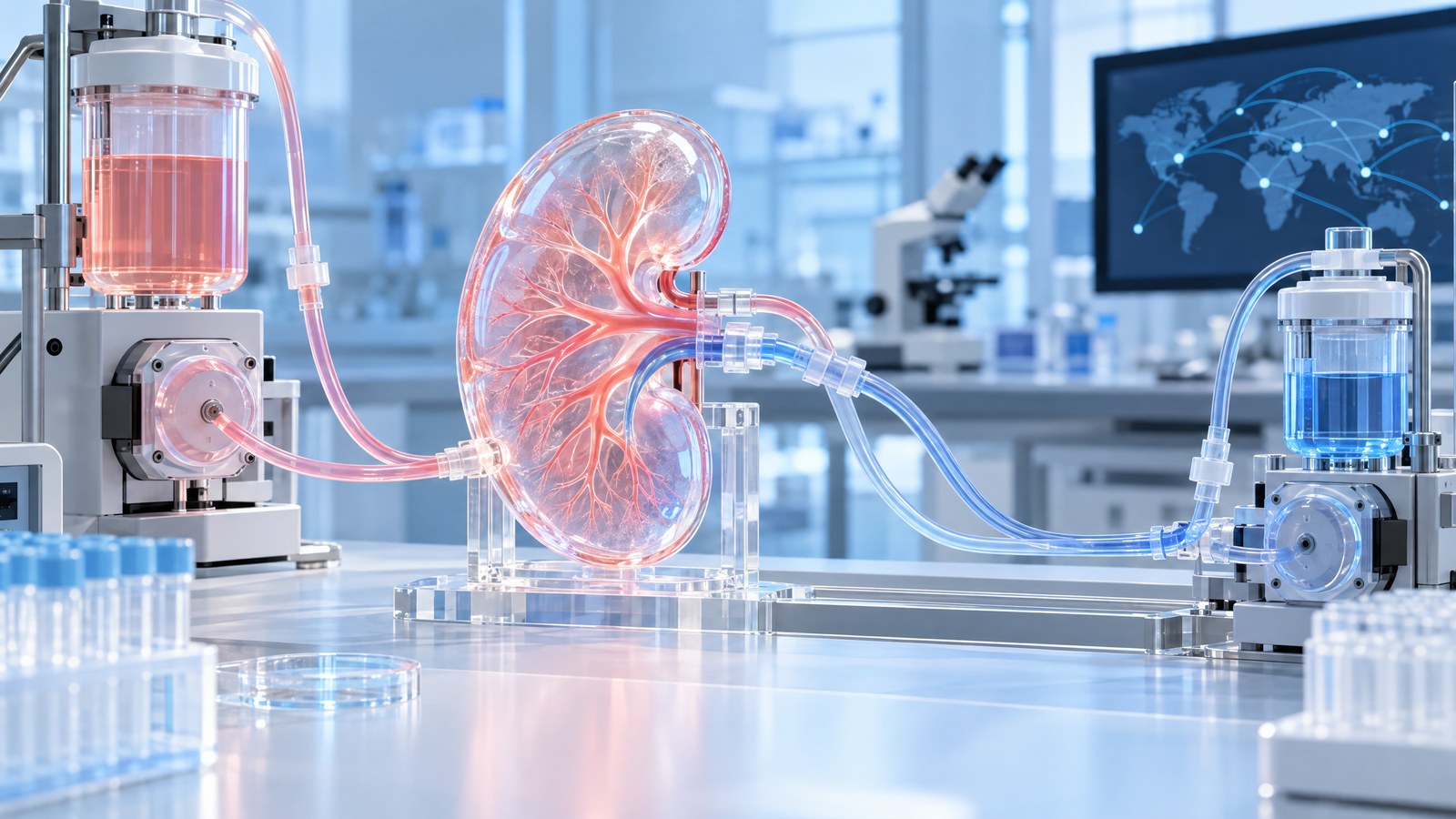

Newcastle transplant specialists are joining a five-centre programme intended to widen the use of a machine-based method for assessing donated kidneys before transplantation.
The £5.2 million PERFUSE-UK programme will run for five years across centres in Cambridge, London, Oxford, Edinburgh and Newcastle. Backed by the Stoneygate Trust, it is intended to help clinical teams use and develop normothermic machine perfusion, or NMP, while working towards national standards for the technique.
For the Newcastle team, the programme creates a role in a national effort that is focused on kidneys from deceased donors. Its immediate purpose is to support assessment and decision-making before a transplant, rather than to announce a new treatment available to patients today.
How kidney perfusion works
Most kidneys from deceased donors are currently kept cold for storage and transport before they are transplanted. NMP uses a pump to circulate warmed, oxygenated fluid through a donated kidney. This can give a surgical team a longer opportunity to examine the organ and assess whether it is suitable for use.
The distinction matters because a kidney can be damaged after blood circulation stops. More information about its condition may help a team make a decision about an organ that would otherwise be difficult to assess. It does not, however, mean that every kidney placed on a perfusion machine will be suitable for transplantation.
A chance to assess, not an assured transplant
The programme estimates that more than 300 kidneys from deceased donors are judged unsuitable for transplant in the UK each year. It also estimates that about 80% of those kidneys could be healthy enough for perfusion treatment. Those figures describe a potential pool for further assessment, not a prediction that all such kidneys can be recovered or used.
PERFUSE-UK hopes that, if the approach is later adopted more widely across the NHS, as many as 70% of perfused kidneys could go on to be transplanted. That is a future ambition rather than a demonstrated outcome of the newly launched network. The five-year work is designed to develop the practice and gather evidence, so any eventual national rollout will depend on results and subsequent clinical decisions.
The focus on assessment may also have practical value for recipients and transplant teams. A clearer picture of an organ’s condition before surgery could support better-informed choices about whether to proceed. The network has not set out a patient timetable or promised that a particular individual will receive a transplant as a result of the programme.
Local work in a national pathway
The Newcastle centre will use the technique on kidneys donated and transplanted at the same hospital site. This differs from the centralised Assessment and Recovery Centre model already being piloted for donated livers, lungs and kidneys, where organs can be processed within a wider distribution arrangement.
Alongside clinical use, the five PERFUSE-UK centres plan to use NMP in research. That could include testing drugs and other therapeutic approaches intended to improve the condition of donated kidneys. The longer-term research aim is to explore whether organs can be optimised or repaired before transplant, and whether future methods might reduce rejection or help transplanted kidneys function for longer. Those possibilities remain subjects for clinical research, not established benefits.
Standards are the longer-term objective
A central goal is to create consistent national standards for kidney NMP and embed the approach within NHS clinical pathways. That means the work will concern more than buying equipment: teams will need to establish how organs are assessed, how findings inform transplant decisions and how the method can be used consistently between centres.
For Newcastle, the announcement places its transplant specialists within a five-year collaboration aimed at improving the information available when a donated kidney is considered for use. The programme’s significance will be measured by the evidence it produces and by whether its standards can later support safe, wider use, rather than by an immediate change to the number of transplants.







