
London’s Frieze-week calendar has a new point of entry for Latin American art. Paraíso, an inaugural fair at Ambika P3, brings galleries and projects from across the region together with London-based exhibitors, placing work from Mexico, Argentina, Colombia, Chile, Peru and Bolivia in a single subterranean venue. Its first edition runs from 15 to 18 October.
A fair built around a missing link
Paraíso’s arrival fills a gap in the capital’s art-market calendar: it is the first Latin American art fair in London since Pinta ended its local edition in 2015. The interval is more than a decade, and the new event is designed to give collectors and visitors a concentrated way to encounter artists and galleries that are often less visible in the UK than their European or North American counterparts.
The fair was founded by Javier Calderón, who also established London’s Somers Gallery with a focus on Latin American art. Organisers say they drew exhibitors through their professional networks and by approaching galleries that had previously shown in London. That route gives the event a community-led character, while also linking a new platform to people already working across the city’s galleries and artist networks.
Mexico takes the first-edition focus
Each edition is intended to concentrate on one country. Mexico anchors the opening year, with a presentation of the late artist Felipe Ehrenberg and video works by Pola Weiss. The fair also includes a wider programme beyond gallery stands: contemporary video art from Central America, editions and publications, talks, performances and workshops. A site-specific installation by Carlos Amorales is part of the VIP area.
Ehrenberg’s presence connects the fair’s contemporary marketplace to a longer history of exchange. One presentation revisits a project conceived for 2016 but cancelled as the artist’s health deteriorated. It brings together mail art, archival material and photography associated with that unrealised exhibition. The works reflect his interest in correspondence and the postal system, developed during time spent in England in the late 1960s and early 1970s.
The programme is not limited to established names. London-based Astéri Contemporary is presenting artists from Brazil, while Bogotá-based consultancy LAACC is showing six Latin American artists who studied at the Royal College of Art. Those local connections make the fair relevant beyond a short-term influx of overseas galleries: they point to artists and organisations already building working relationships between London and the region.
Big works, accessible entry points
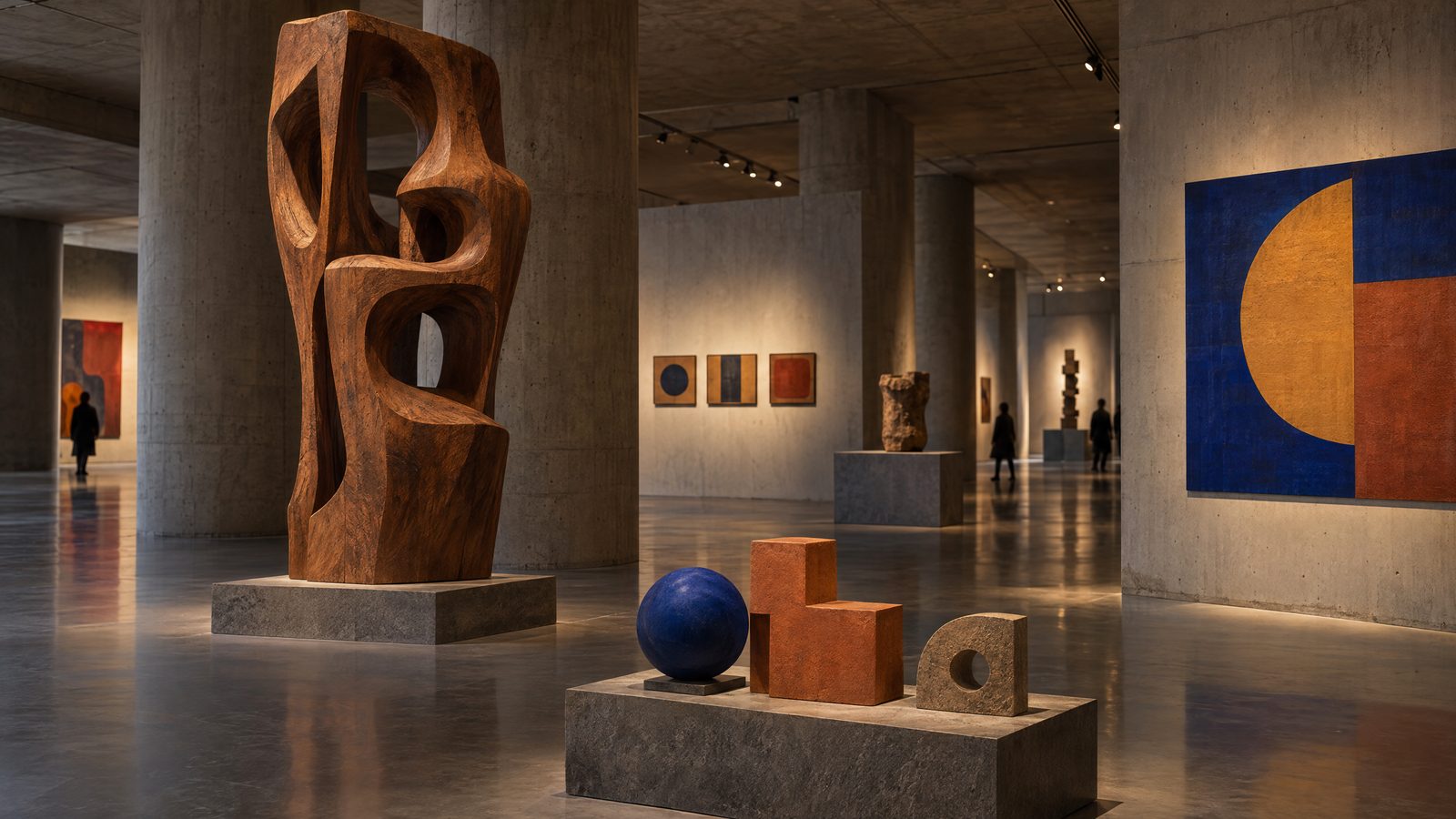
Ambika P3, a former concrete construction hall beneath the University of Westminster, offers an expansive setting rather than the domestic scale of the hotel-room fairs also appearing during Frieze week. It gives exhibitors space for ambitious objects and installations, including a monumental wooden carving by Mexico City’s Acapulco 62, priced at £64,000. At the other end of the market, some works at LAACC are priced at £300; many across the fair carry four-figure prices.
That spread matters for a first edition seeking to introduce audiences as well as court established collectors. Fair prices are not a complete measure of accessibility, but a range from a few hundred pounds to tens of thousands gives visitors different ways to engage with the work. The mix of gallery presentations, publications and public events also creates reasons to attend that do not depend on buying a major piece.
Paraíso describes its first edition as bringing together 22 international galleries and projects, alongside 12 artists’ proposals. Those are distinct parts of the programme rather than interchangeable counts. Its scale is therefore larger than a narrow dealer showcase, while remaining compact enough to foreground a clear regional focus. The London debut arrives as a substantive new cultural event; whether it becomes a lasting fixture will depend on the relationships and audiences it can sustain after this week.