
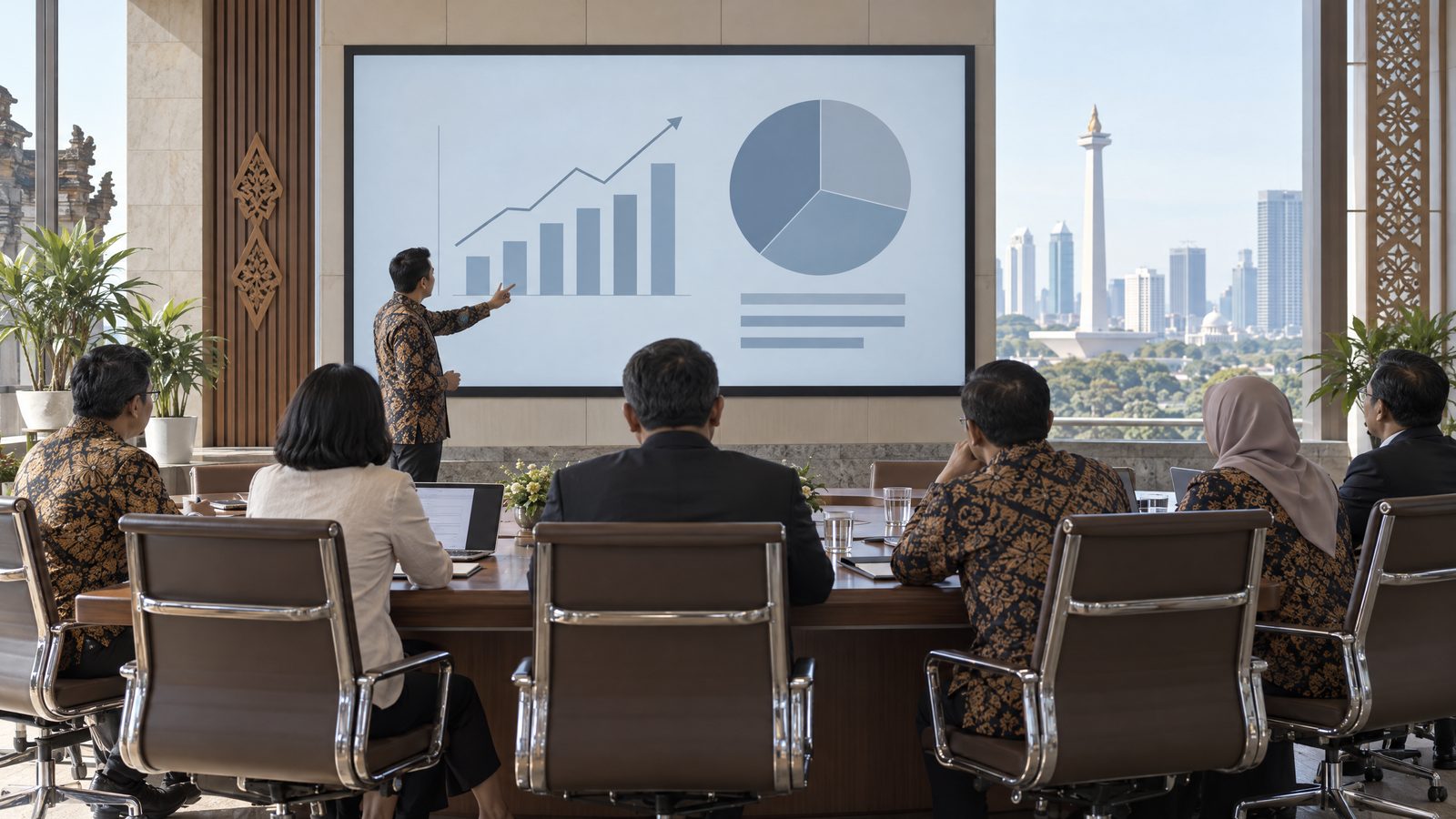

President Prabowo Subianto chaired a limited cabinet meeting in Jakarta on Monday, 2 November, where Coordinating Economic Affairs Minister Airlangga Hartarto presented a set of recent indicators on manufacturing, trade and prices. The figures describe separate parts of the economy and periods; together they provide a snapshot, not a complete measure of household welfare or a forecast of what will happen next.
Hartarto said Indonesia’s manufacturing purchasing managers’ index reached 54 in October, compared with 52.4 in September. He characterised the reading as the sector’s strongest expansion since March 2024. The index is a survey-based indicator of business conditions, and the reported movement points to stronger expansion in the latest month. It does not, on its own, quantify output growth across the whole economy or show how evenly activity is distributed among manufacturers.
The trade figures cover September and the first nine months of 2026. Indonesia recorded a September surplus of US$3.36 billion. A US$5.67 billion surplus in non-oil-and-gas trade more than offset a US$2.31 billion deficit in oil and gas. For January to September, the cumulative surplus was US$10.61 billion, comprising a US$34.21 billion non-oil-and-gas surplus and a US$23.6 billion oil-and-gas deficit. The overall balance therefore combines markedly different results across the two broad trade categories.
Exports over the same nine-month period were reported at US$221.23 billion, an increase of 5.58 per cent year on year. Non-oil-and-gas exports accounted for US$212.27 billion. Those export figures should be kept distinct from the trade surplus: the balance also reflects imports, and the briefing’s separate numbers show why strong exports do not by themselves determine the final balance.
On prices, Hartarto reported October inflation of 3.23 per cent year on year and 0.22 per cent month on month. Year-to-date inflation was 2.4 per cent. He attributed pressure to volatile food, including chillies and fresh fish, as well as transport costs, including air travel. A detailed breakdown of each component’s contribution was not specified. The figures describe overall price changes and do not establish how costs were experienced by different households.
Hartarto said the government was preparing discounts ahead of the Christmas and New Year travel period, linking the proposal to transport-price pressure. The briefing did not specify the full design, eligibility rules, scale or final implementation details of those discounts. They should therefore be understood as a planned response described at the meeting, rather than as a benefit already delivered or a confirmed offset for every traveller.
The meeting’s central message from the minister was that economic fundamentals remained strong. The indicators he cited support a more limited account: manufacturing was in expansion, trade remained in surplus overall, exports had risen year on year, and inflation was positive across the stated measures. Each figure has its own reference period and scope. A manufacturing survey, a trade balance and an inflation rate measure different conditions, so none should be treated as a substitute for the others.
The figures describe recent activity and prices, while the effects of proposed seasonal discounts and the direction of later indicators remain to be seen.







