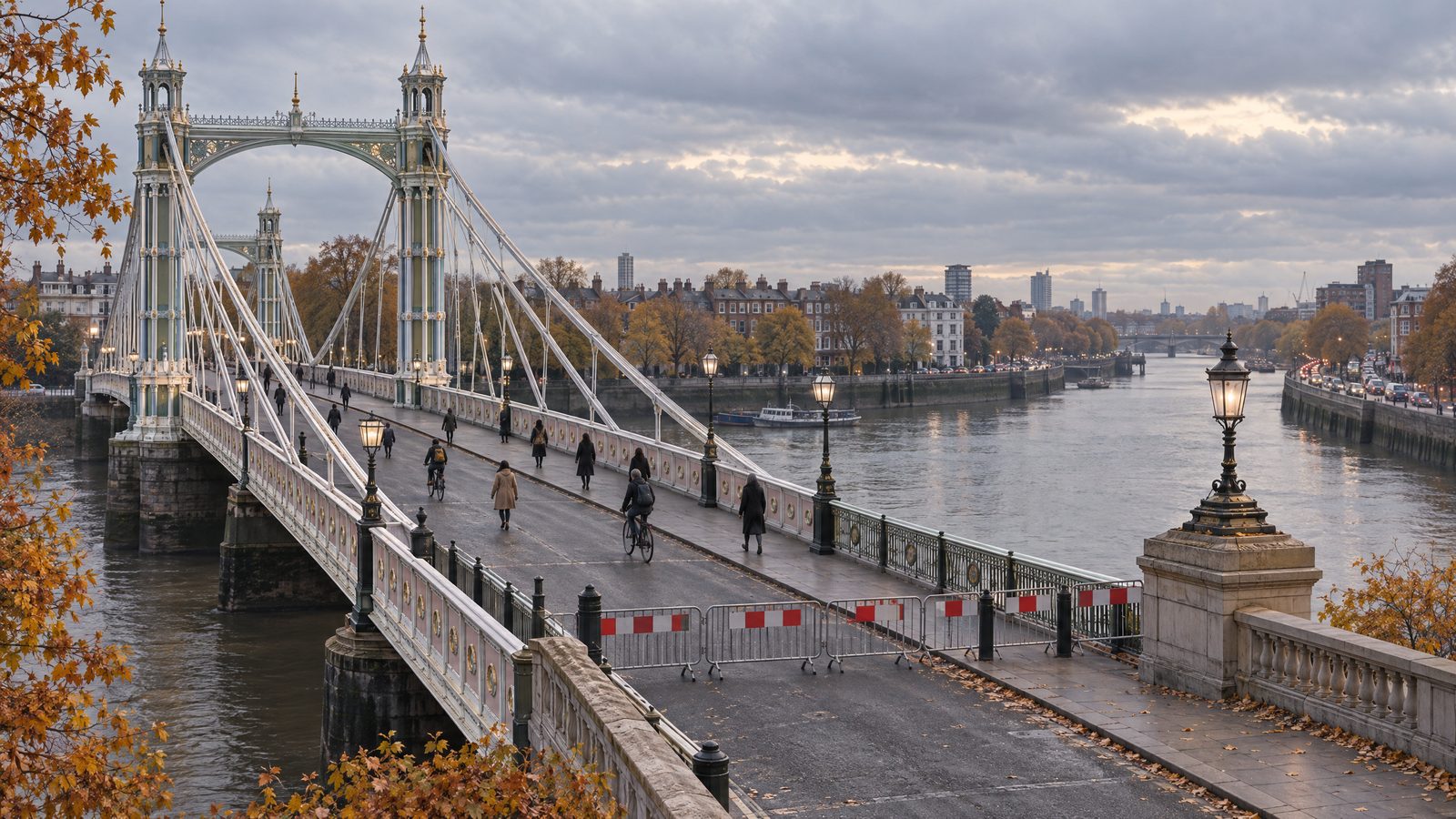

More than 1,100 people have signed an open letter urging authorities to act on traffic disruption around Albert Bridge, where vehicles have been barred since a safety inspection found a crack in February. The crossing remains open to pedestrians and cyclists, but motorists must use other Thames bridges while repairs are prepared.
Residents call for coordinated action
The letter, signed by residents and businesses on both sides of the river, asks Kensington and Chelsea and Wandsworth councils, the Mayor of London and Transport for London to work with urgency, transparency and accountability. Its signatories describe congestion on nearby roads and say journeys that once took minutes now take substantially longer. Those are residents’ reported experiences, not a published borough-wide measurement of journey times.
Organisers say their campaign is not opposed to making the bridge safe. Their requests focus on the management of the closure: clearer information about progress and timescales, more effective coordination between the authorities, and practical steps to limit traffic effects while the work is under way. The open letter represents signatories’ concerns; its claims about gridlock, unreliable buses and knock-on effects have not been independently quantified in the material made public.
Residents’ campaign materials say more than 1,100 people have signed. The figure is a count reported by the organisers and is not a survey of all people living or working in the area. The campaign says it has raised concerns with the Battersea MP and is seeking meetings with transport officials.
Why vehicles cannot cross
Kensington and Chelsea Council, which owns and maintains the bridge, says it closed Albert Bridge to motor traffic on 7 February 2026 after a routine inspection found a crack in a cast-iron component at an abutment. The closure is intended to prevent further damage. A temporary support was installed in April to reduce the risk of needing to close the bridge to pedestrians and cyclists.
The council says the repair needs a specially designed replacement part rather than an off-the-shelf component. Engineers have investigated the structure and modelled its movement; temporary works will be needed to support the bridge while the damaged part is removed. The authority has committed up to £8.5 million to repair the component and carry out wider maintenance, including work on the road surface, lighting and bridge mechanisms.
Physical work is expected to begin before Christmas 2026, according to the council’s latest published update, with reopening to vehicles planned in 2027. No definitive reopening date has been set. The authority says specialist contractors and the complexity of the repair make a firm date impossible at this stage. The expected year is therefore a programme estimate, not a guaranteed opening day.
Measures during the closure
The council says it is coordinating with Transport for London and Wandsworth, rescheduling some planned road works and adjusting traffic-signal timings where possible. Transport for London manages key nearby routes including Chelsea Embankment, Cheyne Walk and Battersea Bridge. Wandsworth previously set out plans for clearer diversion signs south of the river and discussions about temporary signals at selected junctions.
The diversion routes via Chelsea Bridge and Battersea Bridge keep road access available across the river, but they do not replace Albert Bridge’s direct connection between Chelsea and Battersea. Wandsworth has described the crossing as an important route into and out of the borough, particularly while Hammersmith Bridge is also closed to motor traffic. That overlapping restriction helps explain why changes on neighbouring roads matter to people travelling through this part of west and south-west London.
The new letter adds public pressure for a joined-up response; it does not change the engineering condition that prompted the closure or establish that any proposed traffic measure would remove congestion. The bridge authority’s stated priorities are to complete a safe repair and reopen it as soon as possible in 2027. For residents and drivers, the practical questions now are whether traffic management can ease the detours in the meantime, and when the repair programme can be made more precise.