
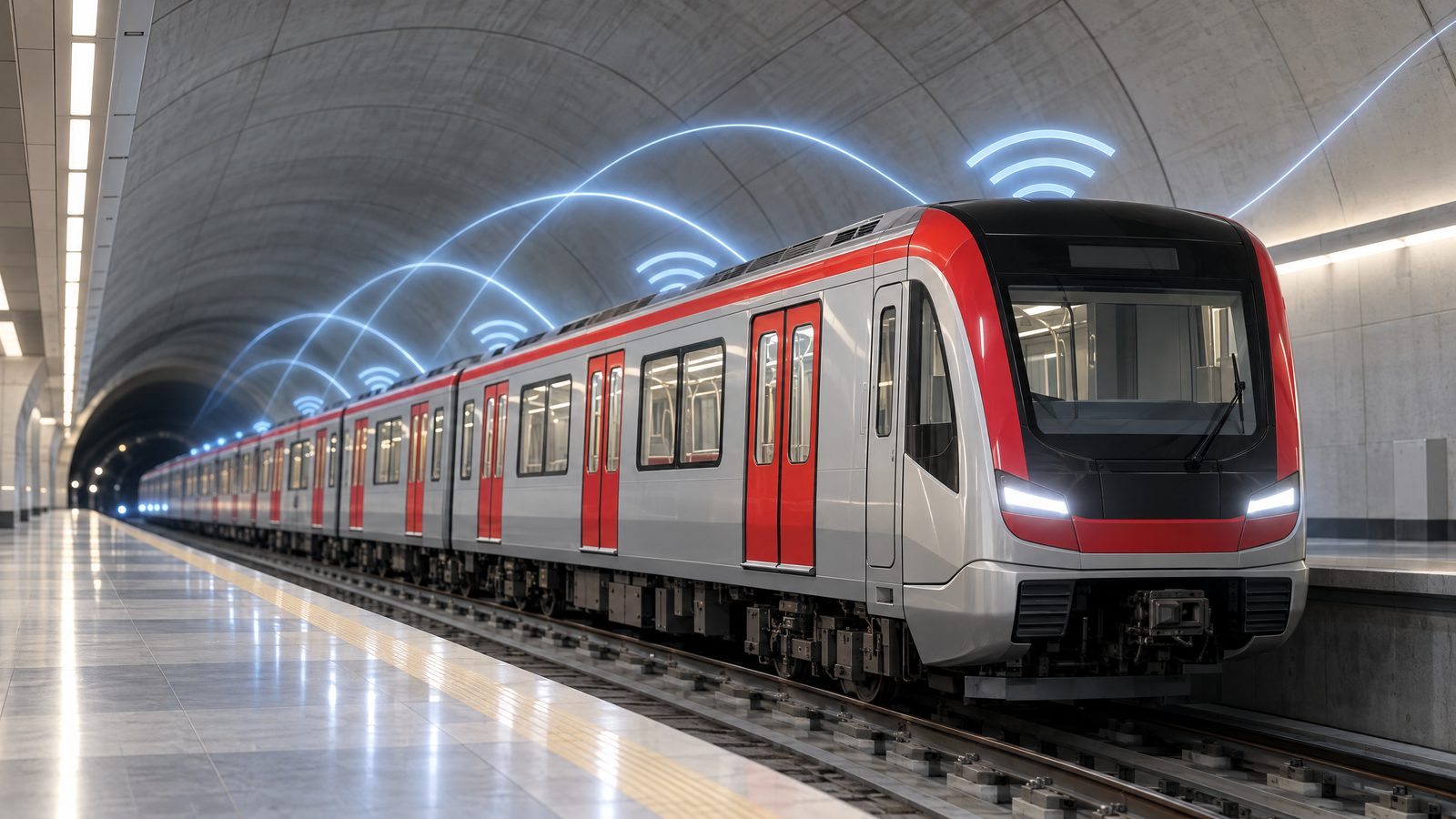

Mobile users travelling on Santiago’s underground railway can now connect to combined fourth- and fifth-generation networks across all seven lines, 143 stations and roughly 150 kilometres of track. The announcement marks the completion of continuous high-speed mobile coverage on platforms and inside tunnels, rather than a claim that every network operator has completed a full 5G rollout.
Chile’s transport and telecommunications authorities said the coverage reaches the entire Metro de Santiago system. The network has 143 stations and 149 kilometres of route, a scale that makes uninterrupted underground connectivity a substantial infrastructure undertaking. The newly reported service is available across the system, but its technology is a mix of 4G and 5G.
One operator’s 5G rollout
Entel is identified as the first operator to complete 5G coverage in every station and tunnel. That is a narrower claim than saying all passengers, whatever their mobile provider, have 5G throughout the railway. The stated national goal is for every operator to provide 5G across the Metro by 2030; until then, the shared system-wide achievement is continuous combined 4G and 5G coverage.
Entel reports peak speeds of up to 400 megabits per second on its network underground, with latency below 20 milliseconds. A peak speed is not a guaranteed rate for each passenger or at every point in the system. Actual performance can vary with location, handset, provider, signal conditions and the number of people using the network at once.
The announcement describes the Santiago system as Latin America’s first underground rail network with continuous, integral high-speed mobile coverage, citing the international metro community CoMET. This regional distinction concerns the completeness of high-speed coverage underground. It should not be read as a claim that Santiago has the world’s fastest mobile network or that every operator has already completed 5G deployment.
Heavy use in a crowded network
Figures supplied about Entel’s network illustrate the demand that the infrastructure must handle. In one reported week, traffic exceeded 524 terabytes, and 54.2 per cent of that data travelled over 5G. The busiest hour was reported at 18:00, when as much as 9,657 gigabytes moved through the network in a single hour. These are measurements of Entel traffic, not a total for all mobile operators or a forecast of future demand.
Interchange stations recorded particularly high data volumes. Tobalaba, which connects Lines 1 and 4, led the listed stations with 15,082 gigabytes over the reporting period. Los Leones, serving Lines 1 and 6, and Baquedano, connecting Lines 1 and 5, followed. Such figures reflect recorded traffic at those locations; they do not by themselves measure passenger numbers or the quality of service experienced by every user.
Social networks accounted for just over half of the traffic in the usage breakdown, with Instagram the largest named service. Web browsing and streaming services made up smaller portions. The data provide a snapshot of one operator’s use underground, rather than a complete picture of how all Metro passengers use mobile connectivity.
Infrastructure beyond passenger browsing
Continuous coverage can support more than calls, messages and internet access during a journey. The authorities have pointed to the possibility of using the network for remote robotic inspection of tunnels and tracks. That is a potential application, not an announcement that robotic inspection is already operating across the system. Better connectivity could help such work be carried out remotely, subject to the equipment, safety procedures and operational arrangements required.
The network was installed while the Metro continued its normal service, a constraint that makes underground work logistically demanding. Entel’s account describes specialised infrastructure, overnight installation planning and the participation of more than 100 people. The announcement frames the project as cooperation between public bodies, the Metro operator and telecommunications providers.
For passengers, the practical change is broader access to high-speed mobile service through the underground journey, including sections where surface signals cannot reach. The precise experience will still depend on a passenger’s provider and the conditions at a particular time. The longer-term test is whether the remaining operators can extend 5G across the full system by the stated 2030 target.







