
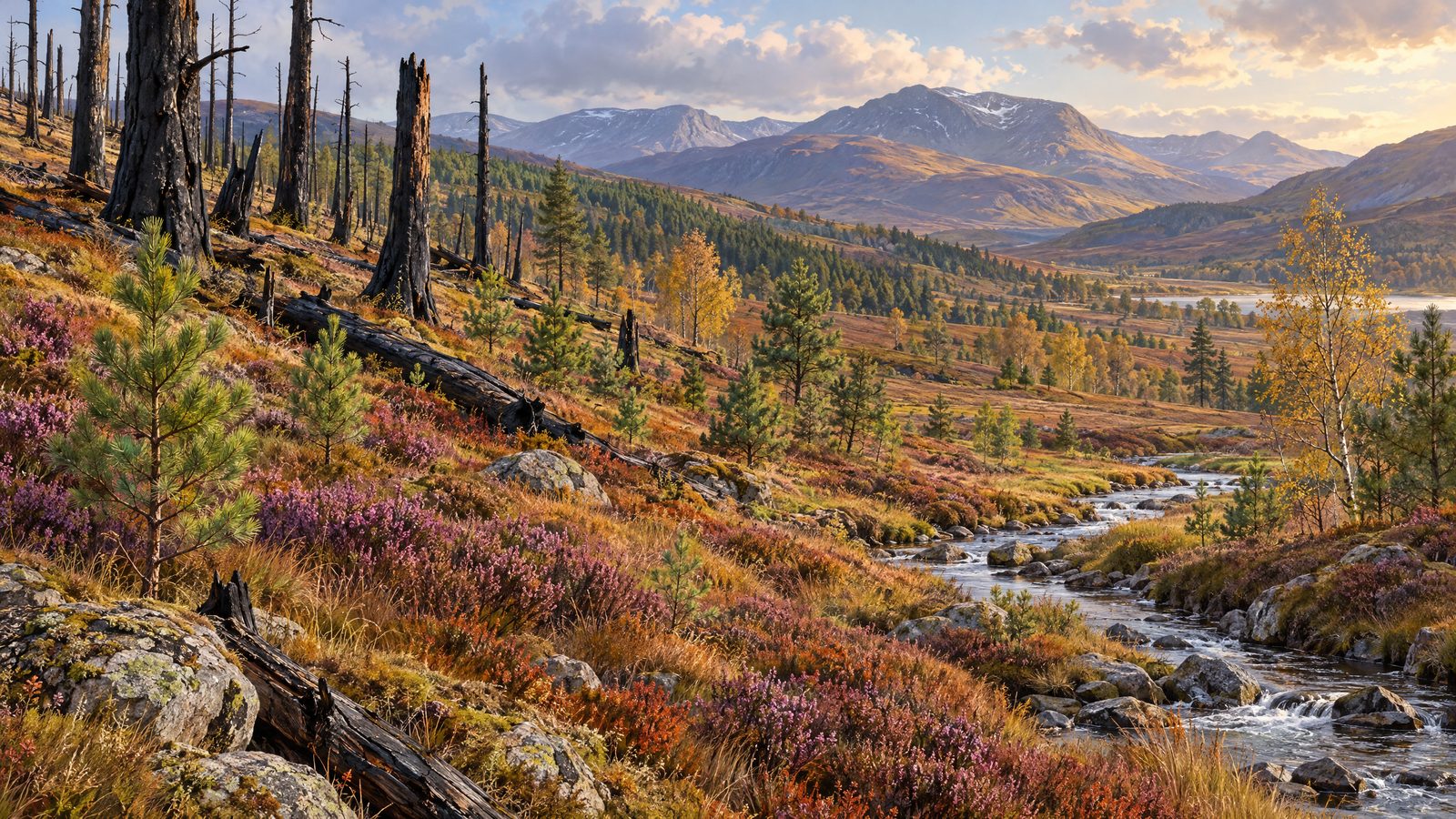

Scotland has announced a £1,347,018 package for nature restoration projects, including a dedicated allocation to help damaged habitats recover after the summer wildfire at Abernethy in the Cairngorms. The funding is an allocation for planned work, not confirmation that recovery has already been completed or that future fires can be prevented.
Abernethy recovery allocation
£150,100 has been earmarked for recovery and nature-restoration work following the Abernethy wildfire. Of that sum, £128,100 is capital funding and £22,000 is resource funding. The work is intended to restore damaged habitats, support wildlife recovery and explore measures that may reduce the risk from future wildfires.
The local programme includes replacing wildlife-monitoring cameras damaged in the blaze and restoring a section of the Duack Burn affected by emergency firebreaks. Those are practical early steps within a landscape that suffered a serious disturbance, rather than a complete plan for every affected area.
Ecological recovery will not follow one timetable. Some habitats may regenerate more quickly than others, while the effects on less mobile species and damaged ground can take much longer to assess. The allocation creates capacity for recovery work, but it does not guarantee a particular ecological outcome or remove the need for further monitoring and land management.
Projects across Scotland
The Cairngorms allocation is one part of a wider package to be delivered through the Cairngorms National Park Authority and NatureScot. A further £150,000 is assigned to the Edendon river restoration project. Elsewhere, £125,000 will support native-oyster restoration and chough habitat work on Islay.
Other elements include £150,000 for deer-management support, £145,000 for priority habitat restoration in four National Nature Reserves, and £138,000 for projects tackling invasive non-native species through control work, training and monitoring. £240,000 is allocated to species-rich grassland funding for urban meadows.
The remaining river work is spread across Polmaddy Burn in Kirkcudbrightshire, Selcoth Burn in Galloway and the River Findhorn near Forres. £248,918 is intended to support improvements to river flow, habitat restoration, floodwater storage, woodland restoration and deer management in those catchments. These activities have different local purposes, but sit within the same effort to improve habitats and strengthen ecological resilience.
How the money will be used
The package forms part of a £23 million nature-restoration budget for 2026/27. Public bodies receiving the money will pass funding to organisations and local contractors delivering the work. It is therefore not a new general application scheme for every project or landowner.
The latest allocation is also separate from the earlier £3 million Cairngorms Fire Recovery Fund for affected businesses. That programme was set up to help eligible local firms deal with income losses and continue trading after the wildfire. The new £150,100 allocation is directed at habitat, wildlife and landscape recovery instead of business compensation.
For the Cairngorms, the immediate significance is that specific recovery tasks can move ahead after a damaging summer fire. The wider package extends that approach to rivers, coasts, grasslands, nature reserves and land management in other parts of Scotland. The grant list does not set a public completion date for every project or establish that the intended results have already been achieved. Progress will depend on the work carried out on the ground, the condition of each site and continued assessment of what recovery requires.







