
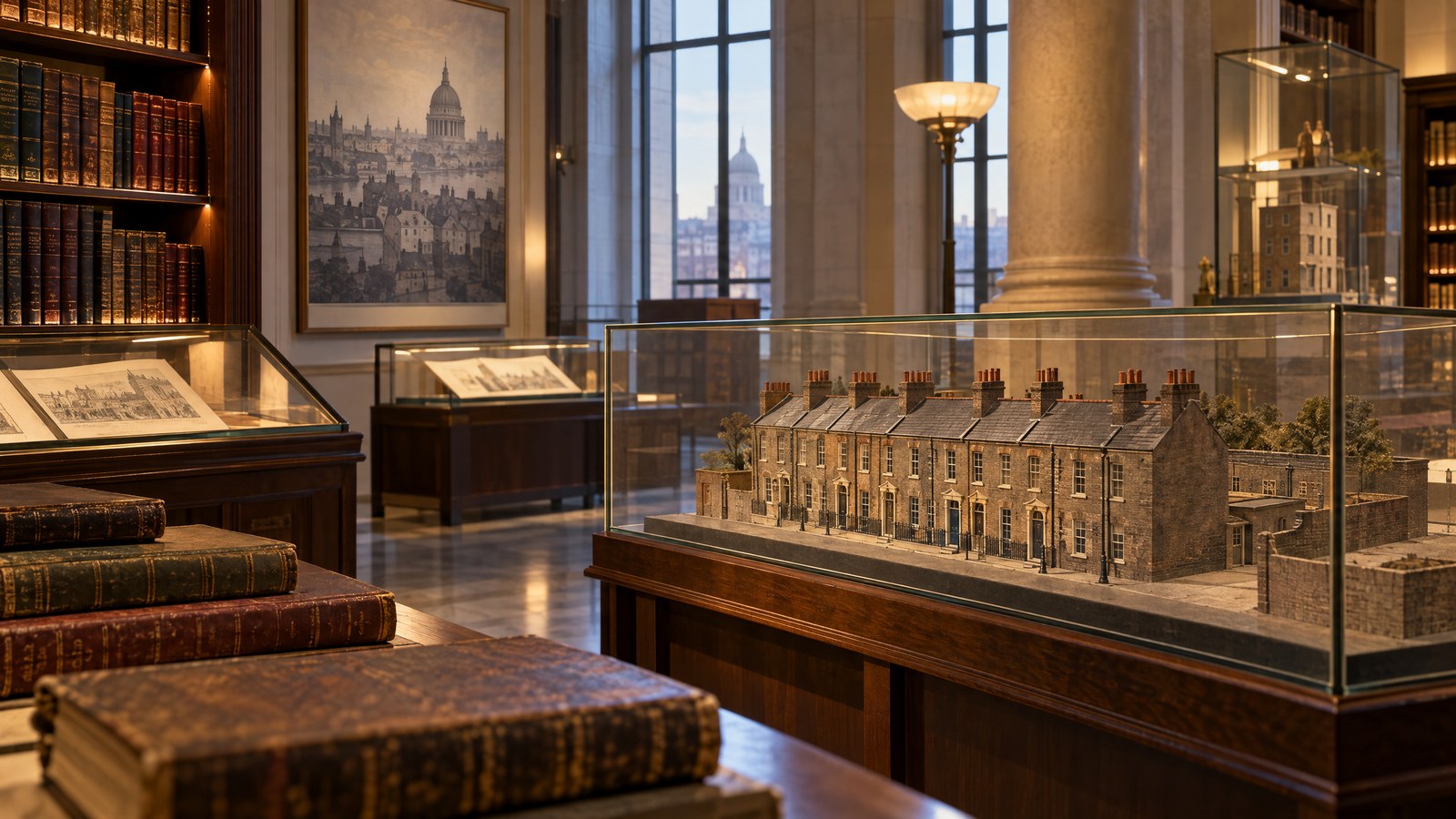

Senate House Library opens exhibition on London housing and poverty
Senate House Library has opened A Place to Call Home: Poverty and Housing in London, a new exhibition examining two centuries of housing, inequality and belonging in the capital.
The exhibition opened to the public on Friday, 23 October, at the University of London’s library on Malet Street in Bloomsbury. It has been developed jointly by Senate House Library and the London School of Economics, and is scheduled to run until 5 March 2027.
Its starting point is a question that remains central to life in the capital: what does it mean to have a secure place to call home? Rather than presenting housing as a single policy issue, the exhibition follows the ways in which homes, neighbourhoods, work and access to security have shaped Londoners’ lives across generations.
Maps, archives and personal accounts
Among the central exhibits are Charles Booth’s poverty maps of London. Produced in the late nineteenth century, the maps used colour to represent the circumstances recorded street by street. They remain a striking historical record of how poverty was distributed across the city, while also showing the limits of looking at housing through statistics alone.
The display combines the maps with archival material, historical records, photographs and personal stories. Photographs by John Thomson, whose work documented some of London’s poorest communities, are included alongside material that considers later experiences of poor housing and homelessness.
That mix gives the exhibition a deliberately broad view of the subject. It traces the cultural, economic and political history of housing in London, but it also brings forward the experiences of people whose lives were often described by others rather than recorded in their own words. The result is intended to connect the past with continuing debates about affordability, inequality, community and the meaning of belonging.
A history seen across the capital
Booth’s maps are a particularly useful entry point because they make visible the relationship between place and circumstance. The exhibition places them in a wider history of research, reform and lived experience. It considers how earlier investigations of deprivation influenced public understanding of conditions in the capital, while recognising that a map cannot capture every part of a person’s life.
The material also shows how the language and measures used to discuss housing have changed. Earlier attention to overcrowding, sanitation and the quality of buildings sits alongside accounts that raise different questions about insecurity, temporary accommodation and the lack of a home altogether. Visitors are invited to consider both the progress made since Victorian London and the challenges that have remained unresolved.
At the launch on 22 October, the project was presented as part of a wider effort to make Senate House Library’s rare and distinctive collections more accessible to students, researchers and the public. The exhibition’s use of documents, images and testimony reflects that aim, bringing material usually held in archives into a public setting.
Public opening follows launch event
About 100 people gathered at the library on the evening before the public opening, including contributors and guests involved in developing the show. The opening gives Londoners an opportunity to see historic documents together with accounts that address the human consequences of housing conditions.
A Place to Call Home: Poverty and Housing in London is now open at Senate House Library. Its run through early March gives visitors several months to explore an exhibition that uses the capital’s past to frame a careful conversation about home, security and community.







