
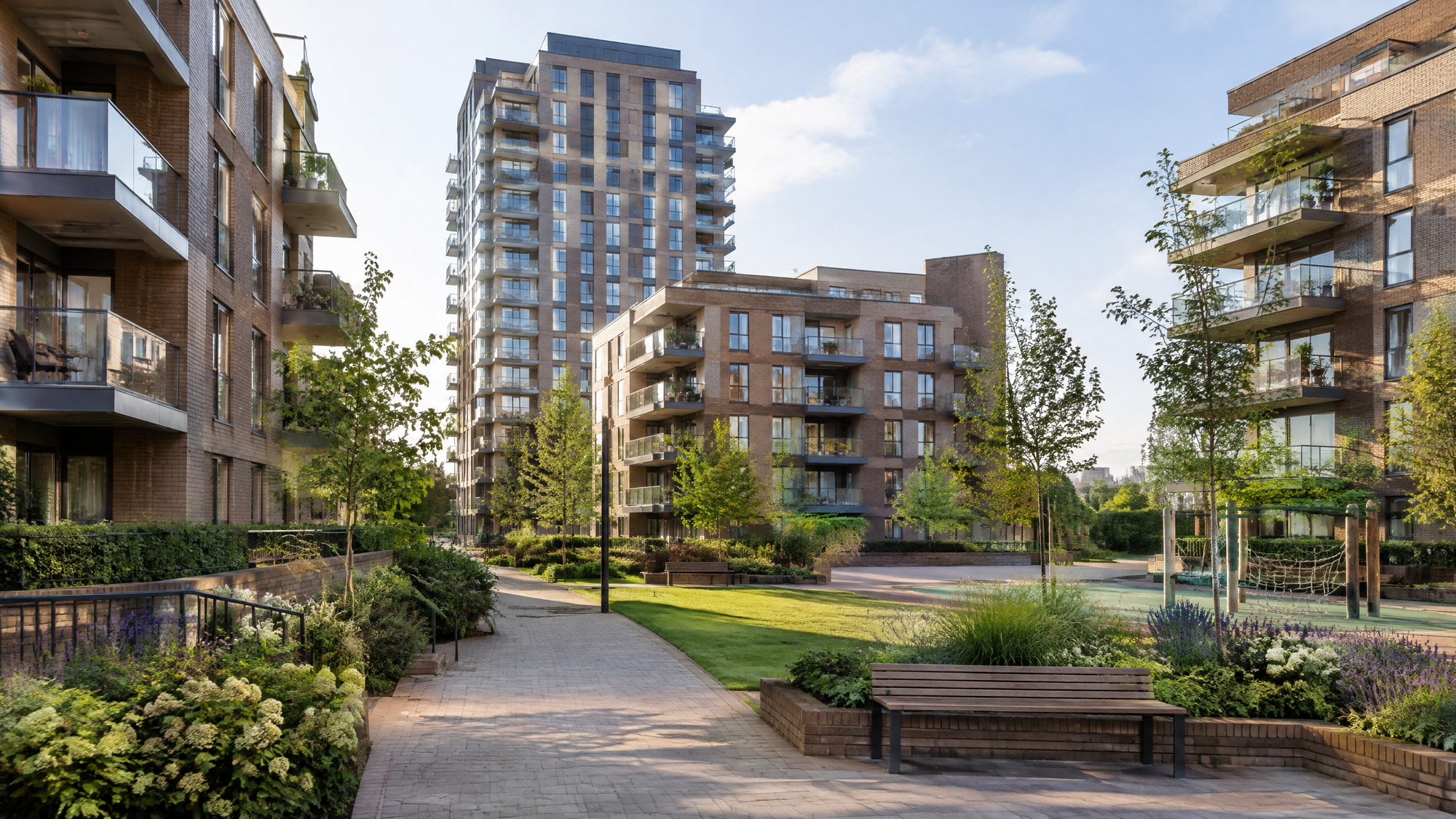

Southwark says 65 homes at the Ledbury Estate in Southwark, London, that had been earmarked for private sale will instead be council homes for social rent. The council places this change within a wider renewal it says will provide 340 affordable homes overall, including 334 council homes. It adds that previously unspent Right to Buy receipts are intended to fund delivery of the 65 homes that are changing tenure.
Change in tenure and how it is presented
The council describes the move of 65 homes from private sale to council homes for social rent as a change in tenure within the Ledbury Estate renewal. In practical terms, that means homes once counted towards private sale are, as set out by the council, now to be treated as part of its social rented stock. This is a classification decision about what the homes are for and who they are meant to serve, and it is expressed as part of the programme rather than as a new build count beyond what the council has already reported.
Southwark says the 65 homes are distributed across different stages of the programme. It reports that 20 of them are already built in Phase 1, and that the remaining 45 are planned for Phase 2. The first of those two statements describes homes that the council says have reached completion within that phase. The second sets out what the council intends to bring forward in the next phase, which is an expression of intention rather than confirmation that construction is complete.
According to the council, a decision by its executive on 15 September 2026 relates to Phase 2. The council presents that decision as a formal step that records what it intends to progress. A decision of this type signals what the authority plans to do next within the programme. It is not the same as saying that the planned homes already exist on site.
By contrast, the council’s account that 20 of the 65 homes are already built in Phase 1 refers to completed construction activity for that specific share of the total. That is a status update describing part of the programme that the council says has moved from intention to delivery.
In this presentation, plans set out what is proposed, decisions mark formal choices taken by the authority, and delivery refers to the point at which homes are built and can move towards occupation. Each term indicates a different stage and should be understood as such when reading the council’s description of the programme.
Phasing, programme totals and what each kind of statement means
Southwark frames the Ledbury Estate renewal through both an overall programme total and phase-by-phase updates. It states that the wider scheme will provide 340 affordable homes, including 334 council homes. This is a programme-level figure that describes the council’s ambition for the full renewal. It indicates the scope that the authority says it is working towards, rather than a tally of homes already complete.
Phase updates, such as the report that 20 of the 65 reallocated homes are already built in Phase 1 and that 45 are planned for Phase 2, show where specific components of the programme sit at a moment in time. A phase plan outlines what the council says it intends to deliver in that particular stage. Completed homes are those the council reports as already built within the phase. Both types of statement sit within the programme framework but do different jobs: one looks ahead to what is proposed, the other describes what is said to have been achieved.
A reported figure is a statement from the council about what is included or expected. A formal decision, such as the one the council cites for Phase 2 on 15 September 2026, records a choice about what to advance. Neither, on its own, amounts to a final outcome. Final outcomes are confirmed when homes are delivered and in use. Until then, the detail remains a description of process and intention.
This distinction matters for understanding the council’s account of progress. Within the 65-home change in tenure, some homes are described as already built, while others are described as planned for a later phase following the executive decision. The council sets these points out to distinguish between what has been delivered and what it proposes to deliver next.
Funding: what it indicates and what it does not
Southwark says that previously unspent Right to Buy receipts will fund delivery of the 65 council homes for social rent. In the council’s account, this identifies the pot of money it intends to use and the route by which the homes are to be paid for. It is a statement about how the council proposes to meet the cost of delivery for these homes.
Identifying funding is not the same as declaring a final outcome. It signals the intended means of finance rather than a conclusion on timing, any future cost changes or other matters that may arise. Funding information shows the council’s chosen approach to underwriting the expense of delivery; it does not, on its own, confirm that every future step has been completed.
In short, the council places funding alongside decisions, plans and delivery as separate parts of the process. Funding sets out the intended financial underpinning. Decisions record the authority’s chosen course of action. Plans describe what is proposed to happen. Delivery is when homes are said to be built and able to move towards being occupied. Each term is used for a specific stage and should be read accordingly.
For the 65 homes at Ledbury Estate, Southwark links the change in tenure to this stated funding approach. The intention to use Right to Buy receipts is presented as the method for paying for delivery of social-rent council housing within that total. It does not introduce any new build figures or dates beyond those the council has already set out.
What the announcement confirms, and the limits of what it implies
Taken together, the council’s update establishes several points. It says a set of 65 homes within the Ledbury Estate renewal will move from private sale to council homes for social rent. It reports that 20 of those are already built within Phase 1 and that 45 are planned for Phase 2, with a cited executive decision on 15 September 2026 relating to that next phase. It also identifies previously unspent Right to Buy receipts as the intended funding route for delivery of the 65 homes. Separately, the council states that the wider programme is set to provide 340 affordable homes, including 334 council homes.
At the same time, the council’s language distinguishes between what has already been delivered and what remains planned. The use of programme totals, phase plans, decisions and funding descriptions presents a structured account of intention and process. It explains how parts of the programme are classified and financed, while making clear that only those homes reported as built count as delivered at this stage.
In summary, the council’s statements describe a change in tenure, identify a funding route, report completed homes in one phase and set out plans for the next. They map out the steps of a programme that is being advanced through defined phases, with clear attributions to what is built, what is planned and how the council says it intends to pay for it.







