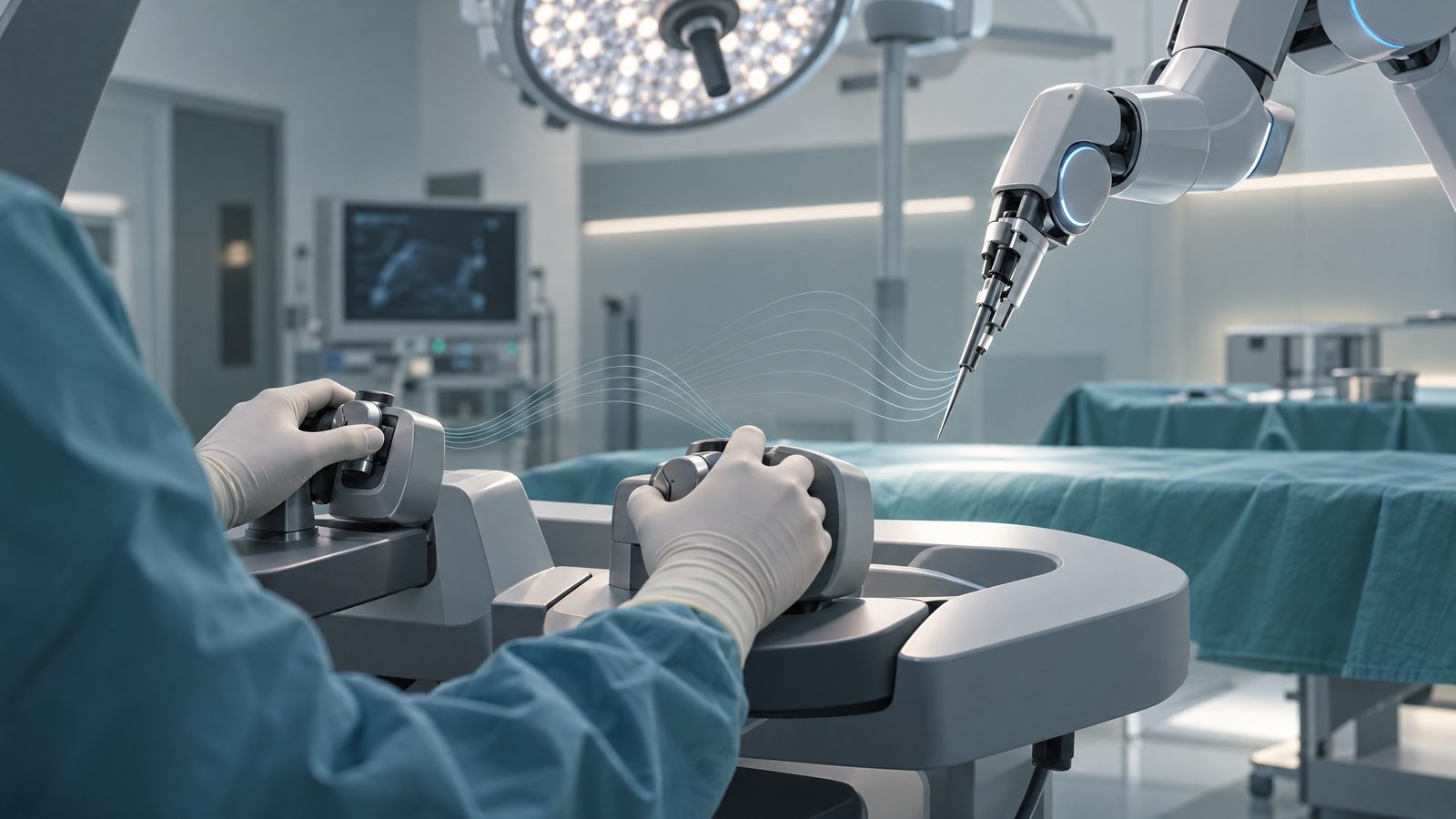

Surgeons at St Thomas’ Hospital have begun using force-feedback instruments with a da Vinci 5 surgical robot, in what Guy’s and St Thomas’ NHS Foundation Trust describes as the first use of the technology in the UK. The trust says the first operations took place on 13 October, and that the instruments are now being used for colorectal, gynaecological and upper gastrointestinal surgery.
The change is intended to give surgeons information that conventional robotic systems largely lack: a tactile sense of resistance when they manipulate tissue. During robot-assisted surgery, a surgeon works from a console and guides instruments inside the patient. The new system transmits push-and-pull forces through the console’s hand controls, while a visual gauge displays force measurements.
What the instruments add
In minimally invasive robotic surgery, the surgeon’s hands control instruments at the operating site, but the hands are not directly touching tissue. The operating team relies on the camera image and the surgeon’s interpretation of what is happening. Force feedback adds another channel of information: resistance can be felt through the controls as the instruments interact with tissue.
The manufacturer says sensors measure push, pull and directional forces in real time at approximately 1,000 times a second. It also describes a screen gauge for relative force and a post-operative tool for reviewing force data. Those are technical descriptions of the system, not proof that every operation will be safer, gentler or more successful.
The trust says the instruments are being used across three broad surgical areas. Its first patient, 57-year-old Bromley resident Nicholas Kokkinos, underwent an operation to repair a hiatus hernia on 13 October. The trust’s account says he was able to get up and move around the following day and reported that his incision pain had reduced. That is an individual patient’s early account, not a measured comparison with other patients or evidence of a typical recovery.
A new capability, not a proven outcome
Consultant surgeon James Gossage, who performed the first operations, said the feedback helps the operator judge the level of pressure being applied. The trust presents reduced tissue trauma and better recovery as hoped-for benefits. It has not published local comparative results showing that the new instruments reduce complications, pain, hospital stays or recovery time.
The distinction matters because robotic surgery already involves several possible benefits and trade-offs, and results depend on the operation, the patient, the surgical team and how outcomes are measured. A surgeon’s improved awareness of applied force is a plausible technical advantage; it does not by itself demonstrate a clinical benefit. Longer-term and procedure-specific evidence would be needed to assess whether patients experience better outcomes.
The trust’s broader figures refer to its robotic surgery programme, not to the new instruments’ performance. It says more than 17,000 patients have benefited from robotic-assisted surgery at the organisation. The trust also reports a fleet of 13 surgical robots and three diagnostic robots across five hospitals, including nine systems made by the instrument manufacturer, two Hugo systems, a Velus orthopaedic knee system and a Versius system at Evelina London Children’s Hospital.
Where the system fits
St Thomas’ began using its da Vinci 5 system in early April, according to the trust. Another system has since been added at Harefield Hospital, but the trust says St Thomas’ is the first UK site to use the new force-feedback instruments. The manufacturer announced European regulatory approval for the instruments in September, alongside other software and system enhancements. That wider availability announcement is separate from the hospital’s report about when its own team first used them.
For patients considering an operation, the immediate development is that a new sensory feature is now in clinical use at one London hospital across several specialties. The trust has not said that the feature changes which procedures are appropriate, nor has it published a new treatment recommendation. Decisions about surgery remain specific to each patient and should be discussed with their clinical team, including the expected benefits, alternatives and risks of the proposed procedure.
As use expands, the practical questions will be whether tactile and force measurements alter surgical technique consistently, whether those changes can be linked to meaningful patient outcomes, and how results compare across procedures. The first-use announcement establishes that the technology has entered operating theatres locally; it does not settle those questions.