
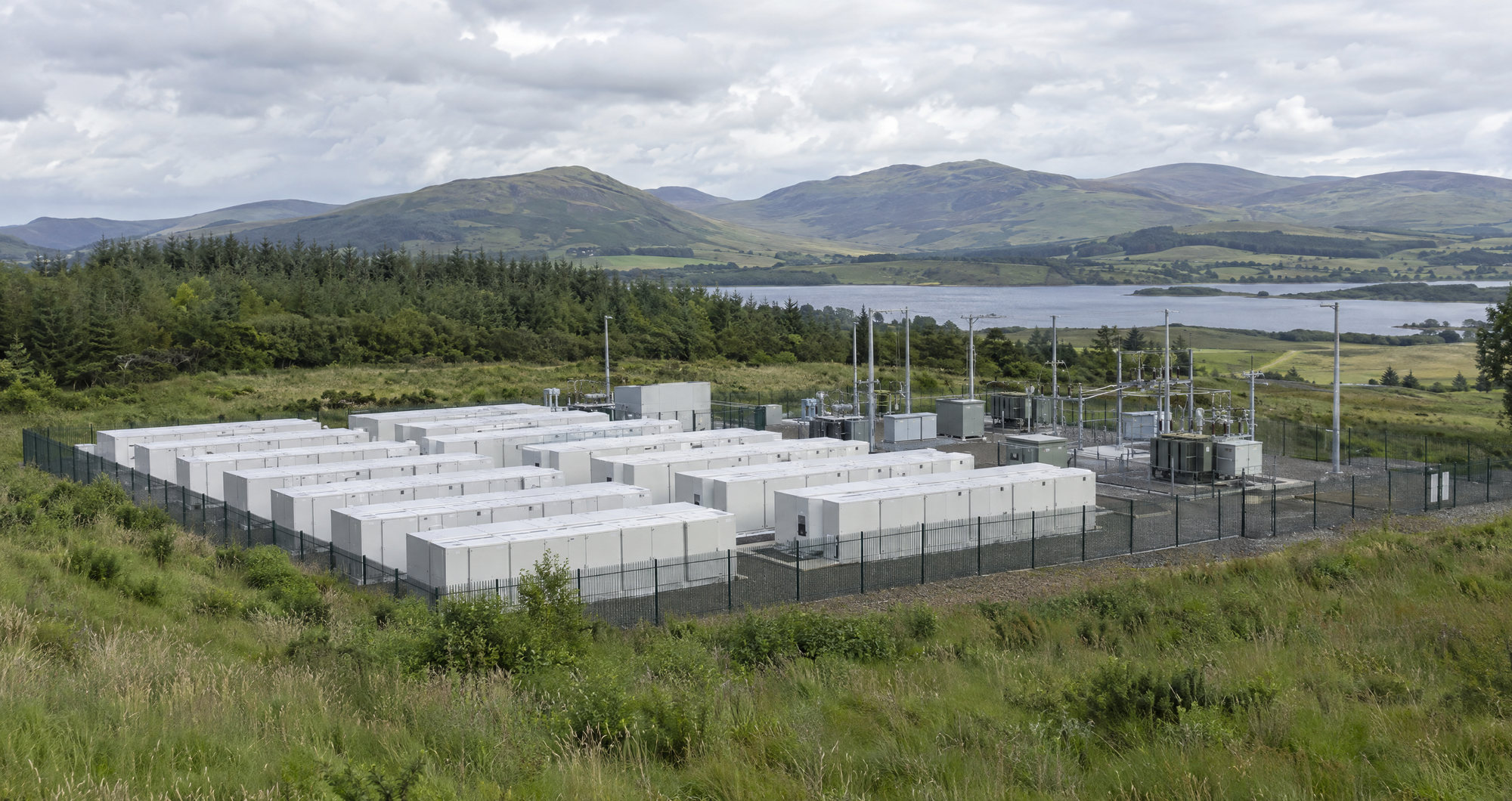

Statkraft’s first grid-forming battery has entered commercial operation at Neilston Greener Grid Park in Scotland, adding a new way to support the stability of the electricity network as more renewable power comes onto the system.
The operational first phase has a power capacity of 50 megawatts and is on Gennifer Road, outside Paisley. Statkraft announced its completion on Friday 13 November. The announcement did not specify the date on which commercial operation began.
The project combines electricity storage with controls designed to help the grid respond to disturbances. That makes it more than a facility for holding power until it is needed: its equipment is also intended to provide services that help the network operate securely.
Why grid-forming matters
Electricity networks need supply and demand to remain in balance, while voltage and frequency stay within acceptable limits. A sudden change in generation or a fault on the network can disturb that balance.
Traditional power stations with large rotating machines have provided characteristics that help stabilise the system. Their inertia, for example, can slow changes in frequency after a disturbance. Wind farms, solar installations and batteries connect differently, so the network needs other ways to obtain those stabilising services as the mix of generation changes.
Grid-forming controls allow suitable batteries to establish a voltage and frequency reference and respond to fluctuations. The controls can make the equipment behave in some respects like a conventional synchronous generator. At Neilston, the intended role includes providing stability services when there is disruption to the electricity network.
The project was awarded under the second phase of the electricity system operator’s Stability Pathfinder programme, which sought new ways to maintain transmission-network stability. Construction of the initial project had begun by August 2023.
Storage and stability are different jobs
The battery can also take in electricity when it is available and release it to the network when needed. That flexibility can help the system use renewable generation, whose output varies with the weather, at times when demand and supply do not match.
Storage does not itself generate additional electricity. Its contribution depends on when it charges, when it discharges and how it is used alongside the rest of the network. The stability role is separate from simply shifting electricity from one time to another, although the same installation can be designed to support both.
The 50-megawatt figure describes the power capacity of the operating phase, not the amount of energy it can store. A storage duration for that phase has not been disclosed, so the figure does not establish how long the battery could deliver electricity at its rated output.
A larger approved site
The first phase received planning consent in 2022. A further phase has also received consent, with an approved operating capacity for the wider park of up to 750 megawatts. The larger figure is not the capacity currently in operation: the completed first phase accounts for 50 megawatts.
Approval for a larger scheme does not mean the additional capacity has been built or connected. No timetable for the expansion was provided alongside the latest announcement.
A community fund associated with the project has £20,000 available each year for eligible local initiatives. It supports community and environmental projects focused on reducing carbon emissions, with projects required to be located in or benefit communities within three kilometres of the park. Eligible groups can apply for grants ranging from £500 to £20,000.
The battery joins a wider portfolio of storage and grid-stability projects that Statkraft has in operation or development across the UK and Ireland. Their combined capacity exceeds two gigawatts, but that total includes projects still being developed as well as those already operating.
For Neilston, the immediate milestone is the completion of the first phase. Its longer-term contribution to network stability and the use of renewable electricity will depend on how the installation is operated within the wider power system.







