


Redefining the London Workspace: Why Static Offices are Obsolete
London’s corporate ecosystem is fiercely competitive, demanding much more than a prime commercial postcode to attract and retain elite talent.
Startup founders and operations managers are realising that traditional, static office layouts actively hinder employee health and restrict daily creative output.
As highlighted in recent coverage on tech startups scaling in London, a dynamic, adaptable workspace is now a non-negotiable asset for high-growth teams.
The shift toward health-centric, “smart” workspaces is rendering the standard immobile desk entirely obsolete in modern corporate architecture.
Today’s workforce expects an environment that adapts to their physical needs throughout the day, mitigating the health risks associated with prolonged sitting.
Consequently, forward-thinking HR directors are overhauling legacy floor plans to integrate flexible, movement-oriented furniture that supports sustained cognitive performance.
The Hidden Mechanics of Modern Ergonomics
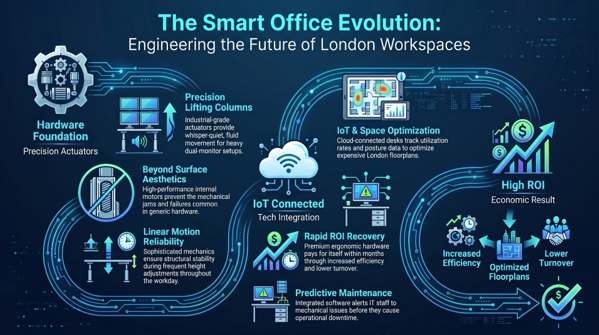
The seamless transition of a premium adjustable workstation doesn’t happen by magic; it relies heavily on sophisticated internal mechanics.
When outfitting modern corporate environments, procurement managers must look beyond the desk’s surface and meticulously evaluate the core technology.
Industry-leading setups increasingly utilise components from a specialised electric actuator and lifting column manufacturer, Hoodland, ensuring high-performance reliability.
This hidden hardware ensures that workstations can handle heavy dual-monitor loads while operating at whisper-quiet decibel levels that won’t disrupt an open-plan office.
If the internal motor is underpowered or poorly engineered, the entire ergonomic investment becomes a liability, leading to jammed desks and frustrated employees.
The Importance of Precision Linear Motion
Moving heavy office equipment smoothly, safely, and quietly is a complex engineering challenge that requires industrial-grade precision.
Generic motors often suffer from high internal friction, leading to loud mechanical grinding and premature hardware failure within the first year of use.
Premium linear motion systems guarantee continuous, fluid adjustments without compromising the structural integrity or stability of the workspace.
Key technical specifications that operations managers must demand for modern workplace hardware include:
- Load Capacity: Capable of safely lifting 100kg to 150kg of tech equipment and peripherals without mechanical strain.
- Acoustic Profile: Operating strictly under 50 decibels (dB) to maintain workplace focus and eliminate noise pollution.
- Lifespan Guarantee: Engineered and rigorously tested for over 30,000 operational cycles to maximise longevity.
- Collision Avoidance: Built-in sensor technology that automatically halts movement to prevent hardware damage or physical injury.
IoT Integration: When Furniture Becomes a Tech Asset
Modern adjustable workstations are evolving past mere furniture, functioning as fully integrated hardware within the smart building ecosystem.
These intelligent desks now sync directly with centralised workplace applications to track user posture data and encourage healthy movement intervals.
By connecting to facility management software, operations teams can monitor desk utilisation rates in real-time and optimise expensive London office space.
Integrating these digital assets aligns perfectly with the growing focus on workplace fitness and well-being, transforming passive furniture into active health tools.
Furthermore, cloud-connected lifting columns can alert IT or maintenance staff of potential mechanical issues before a complete hardware failure occurs.
This predictive maintenance model ensures zero downtime for employees, keeping the operational flow of a tech startup completely uninterrupted.
The Financial Impact: Measuring the ROI of Ergonomic Upgrades
Upgrading office infrastructure is frequently misunderstood as a sunk cost, yet financial data prove it is a highly profitable investment in human capital.
Suboptimal, static workspace setups consistently lead to increased physical fatigue, higher absenteeism, and significantly decreased team efficiency.
In fact, comprehensive market analyses on the impact of workplace ergonomics on employee productivity reveal a direct correlation with long-term corporate profitability.
Businesses that provide adaptable, high-quality office environments experience dramatically lower turnover rates and a measurable boost in daily operational output.
When employees are not distracted by back pain or clunky, failing office equipment, their capacity for deep work and problem-solving scales immensely.
By reducing healthcare-related absences and maximising daily efficiency, the initial premium paid for high-end ergonomic hardware pays for itself within months.
Key Takeaways
| Area | Key Takeaway | Impact/Data |
| Load Capacity | Require industrial-grade lifting columns | Safely lifts 100-150kg |
| Acoustics | Mandate whisper-quiet internal motors | Noise strictly <50dB |
| Durability | Demand rigorous lifecycle testing | Lifespan >30,000 cycles |
| Safety Tech | Implement built-in sensor technology | Halts motion, prevents collisions |
| IoT Integration | Sync desks with facility software | Enables predictive maintenance |
| Financial ROI | Invest in premium ergonomic setups | Dramatically lowers absenteeism |
Conclusion
Building a future-proof London office requires business leaders to look far beyond surface-level aesthetics and trendy interior design.
True workplace innovation is driven by investing in the reliable, underlying motion technology that empowers physical adaptability and smart connectivity.
A smart desk is only as valuable as the electric actuators and lifting columns powering its movement.
By prioritising premium, well-engineered ergonomic hardware, companies can secure a tangible ROI, protect their workforce, and maintain a competitive edge.







