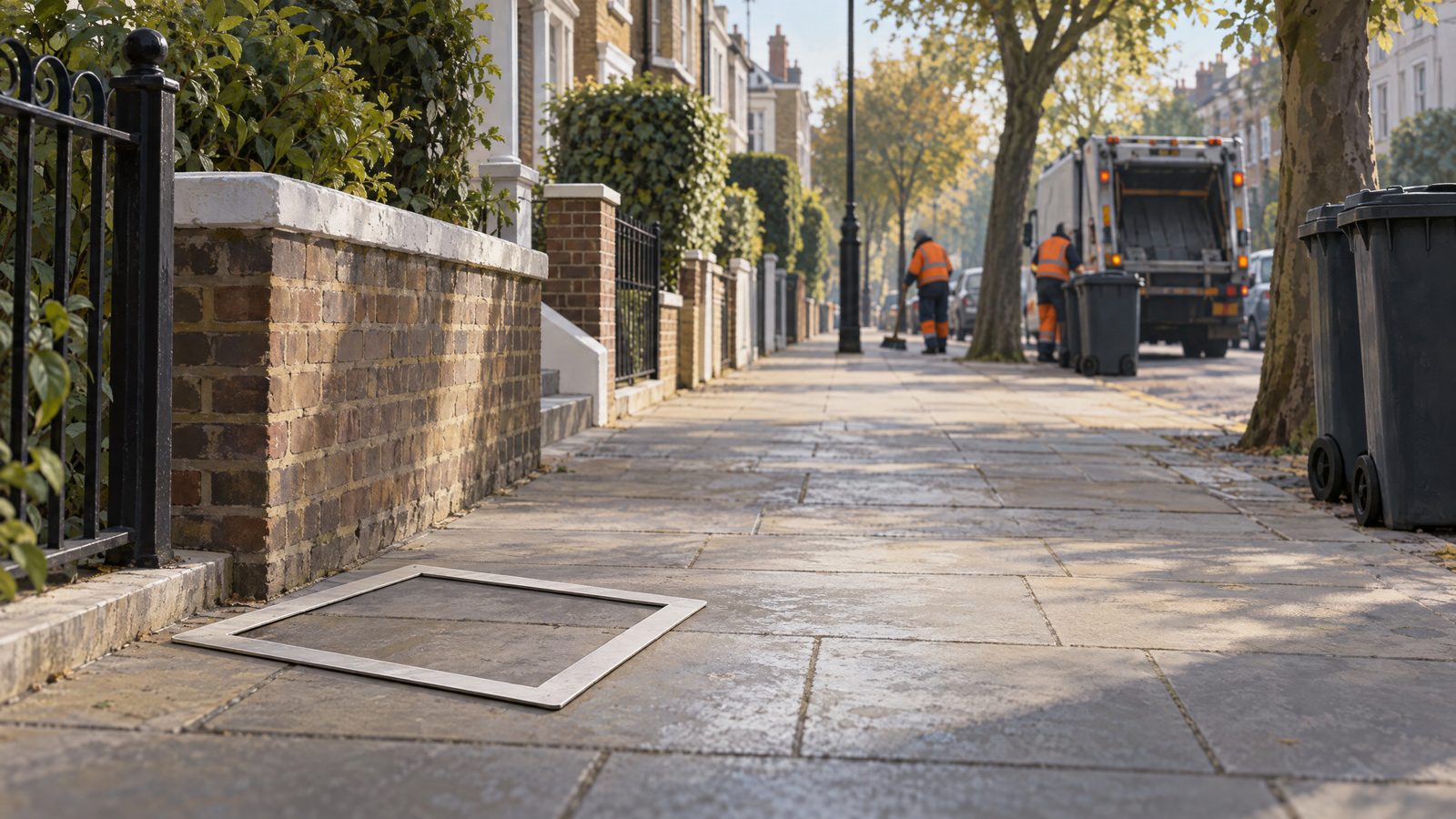

Wandsworth Council plans to test temporary pavement stencils at fly-tipping hotspots as part of a broader package intended to prevent illegal dumping and strengthen enforcement. The council announced the trial on 13 October, but has not said that the markings are already being used.
The proposed markings would be applied after dumped waste has been cleared. They are intended to remind people at a hotspot that fly-tipping can lead to a fine and that offenders may be held to account. The council says the stencils would not be permanent and would not damage the pavement.
The council has not specified how many sites will be included, when the trial will begin or how its effect will be measured. The announcement describes an intended deterrent, rather than evidence that stencil deployment has already reduced dumping. No results from a trial are yet available.
Enforcement examples during October campaign
Alongside the proposed trial, the council says it will share examples of enforcement action on social media during Keep Britain Tidy’s Fly-Tipping Fortnight, which runs from 12 to 25 October nationally. Wandsworth’s announcement describes activity through 27 October, so the borough’s stated schedule extends beyond the national dates given by the campaign organiser.
The council says the examples will show a range of offences that have resulted in people being caught and fined. It also says it continues to investigate reported incidents, issue fixed penalty notices where appropriate and take legal action against persistent offenders. The announcement does not give a count of cases or fines for this campaign period.
A longer-term strategy is in development
The stencils and online case examples are presented as parts of wider work, not as a completed strategy. Wandsworth says it is developing a multi-year plan to coordinate activity across the council and increase the number of enforcement officers. It has not given a timetable for publication, a staffing figure or a budget for that plan.
The proposed strategy is intended to combine prompt removal of dumped waste with prevention. The council says it wants to set objectives for reducing fly-tipping, introduce new interventions and include stronger performance standards and data requirements in future waste-service contracts. Those contract provisions are planned for future arrangements; the announcement does not say that new standards are already in force.
The mix of clearance, deterrence and enforcement is the policy direction the council has outlined. Its statement does not provide a baseline incident total, targets or a monitoring timetable, so the eventual scale and impact of the package cannot yet be assessed. The planned strategy’s objectives and future contract data requirements could provide a framework for measuring progress, but the council has not yet published that framework.
Residents can report fly-tipping to the council. Its announcement asks people to report incidents so they can be investigated, but does not set out a new reporting channel or any response-time commitment. The central immediate development is therefore a proposed local trial, supported by campaign-period enforcement communications, while decisions on the longer-term programme remain in development.