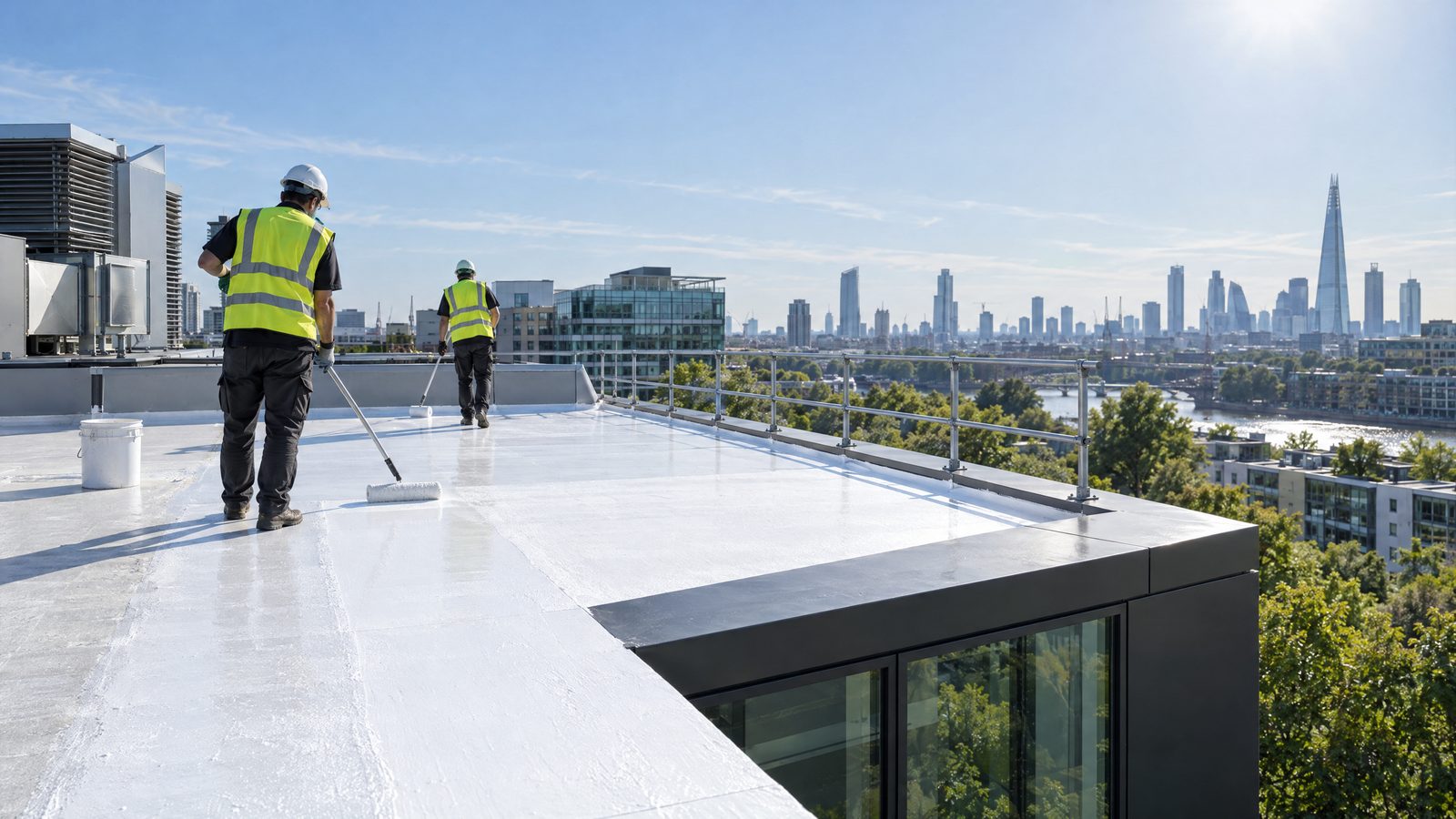

An exterior cooling coating developed by White City start-up Emissiv is being trialled at Townmead Business Centre in Fulham, alongside other local tests examining its performance on buildings.
A council announcement dated 30 October said the first coat at the business centre, on William Morris Way, was applied on Thursday 15 October 2026. The application follows earlier testing at Earls Court.
The announcement also identified commercial office space at the Earls Court Development Company and a Wood Lane campus in White City as local test sites. It did not provide a completion date for the Townmead work, the area coated, details of monitoring arrangements or performance results.
Emissiv was founded by Sandra Go and Nikhil Dawda, who met while studying at Imperial College London. Go studied MSc Cleantech Innovation and Dawda MSc Sustainable Energy Futures. A university account places the team at Royce at Imperial in WestTech London.
The business is an active UK private limited company, incorporated on 28 May 2025. Its registered activities include manufacturing paints and similar coatings, chemical products, scientific and engineering research and development, and environmental consulting.
How the coating works
The product is an exterior radiative-cooling coating designed to reflect incoming sunlight and emit infrared heat at wavelengths that can pass through the atmosphere. Emissiv specifies 95% solar reflectance and 95% thermal emittance, including within the 8–13 micrometre atmospheric window. The council announcement used the broader description that the coating reflects more than 90% of sunlight.
The company markets the product as capable of reducing exterior surface temperatures by up to 30 degrees Celsius and interior cooling costs by up to 20%. Those figures are commercial claims, not verified outcomes from the new Fulham application.
The distinction between roof temperature, indoor temperature and energy consumption matters when assessing the trials. A lower temperature on a coated roof is a different measurement from a reduction in the office below, while predicted energy savings are not the same as measured reductions in electricity use.
Earlier trials and remaining questions
By June, the product was described in a university account as market-ready and being piloted at Earls Court. The team reported more than 30 degrees Celsius of roof-temperature reduction in its first pilot and predicted 20% cooling-energy savings. It intended to collect further roof and indoor data to validate its models and technology.
An Earls Court project account published in July said the coating had been painted on a roof and its impact measured in the office below. It described the findings as early results, again reporting a roof-surface reduction of more than 30 degrees Celsius and predicted cooling-energy savings of about 20%.
In the Earls Court comparison, one section of an office roof was coated and another left bare. Company-recorded readings on one May heatwave day were 25.7 degrees Celsius on the coated surface and 54 degrees Celsius on the uncoated surface. The company’s data also put the office below the coated roof at an average of 2 to 3 degrees Celsius cooler.
Those measurements remain company data rather than an independent validation study. A separate construction-site comparison near White City involved two container units, one coated and one left pale yellow. The company recorded a maximum indoor-temperature difference of 5.5 degrees Celsius over the summer.
Workers said they used air conditioning for about four fewer hours a day, but that statement was anecdotal rather than a metered energy result. It therefore does not establish a measured percentage saving in cooling energy.
Emissiv has quoted a paint price of about £6 per square metre and said it made its first sale to a London council. That does not establish that the sale was for Townmead, or provide a contract value or independently audited installation cost.
The local pilots are a real-world testing stage. They do not establish that the same cooling or savings will be achieved across different roofs, weather conditions, seasons or building types. The Townmead announcement confirms an application date, but provides no outcome data for the Fulham installation.