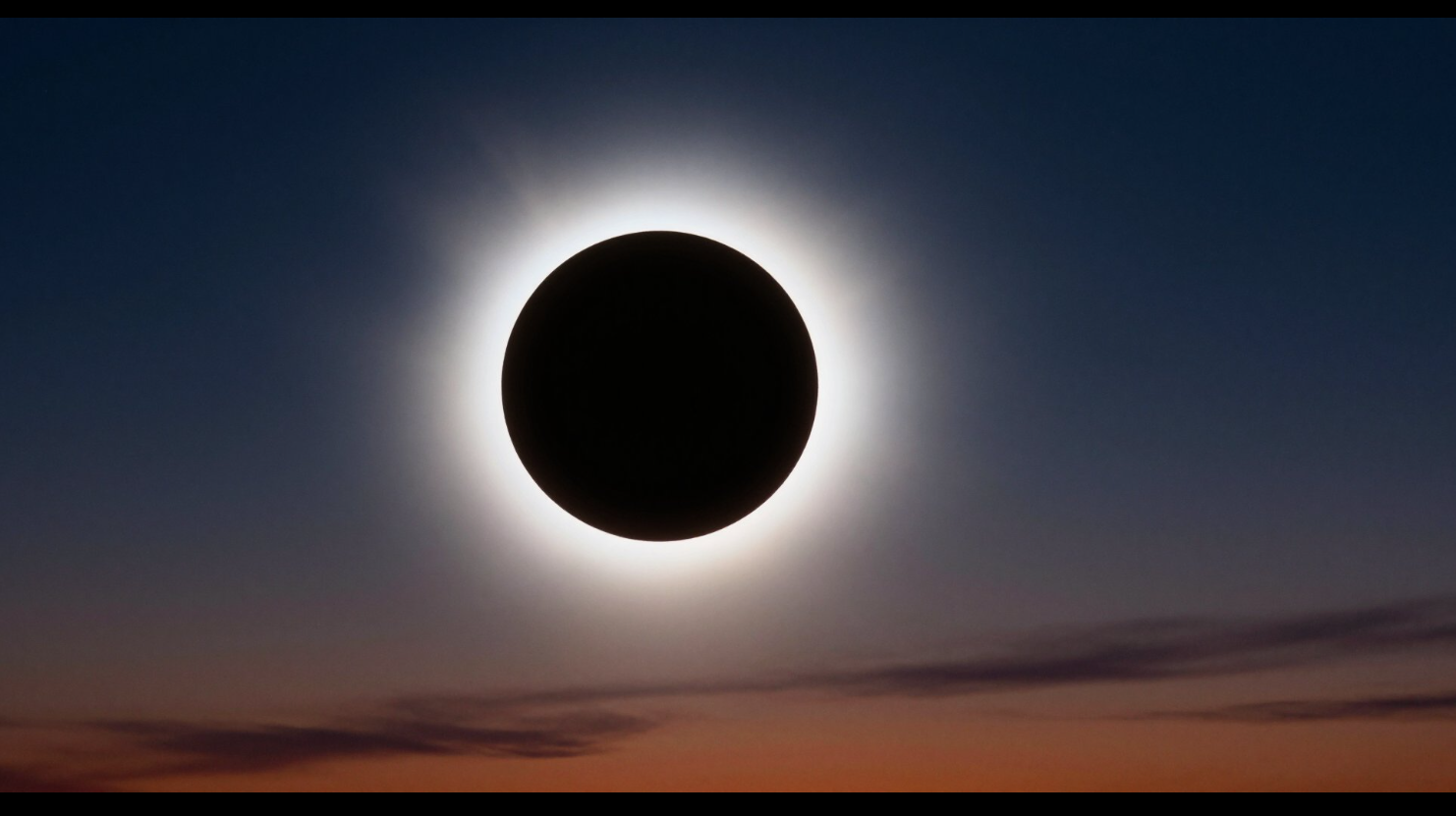

A solar eclipse is one of the most awe-inspiring sights in nature. For a short time, daylight dims, the temperature drops, and the Sun appears to vanish from the sky. While ancient cultures often viewed eclipses as omens or warnings, modern science gives us a clear and fascinating explanation of why they happen.
At its core, a solar eclipse is all about alignment.
The Basic Science Behind a Solar Eclipse
A solar eclipse occurs when the Moon passes between the Earth and the Sun, temporarily blocking the Sun’s light from reaching part of the Earth. This can only happen during a new Moon, when the Moon is positioned on the same side of Earth as the Sun.
However, a new Moon does not automatically mean an eclipse. The reason is that the Moon’s orbit is slightly tilted — about 5 degrees — compared to Earth’s orbit around the Sun. Most of the time, the Moon passes above or below the Sun from our point of view.
A solar eclipse only occurs when the Moon crosses the ecliptic plane — the imaginary line representing Earth’s orbital path — at exactly the right time.
Why Don’t Solar Eclipses Happen Every Month?
If the Moon orbits Earth once every 29.5 days, why don’t we see solar eclipses monthly?
The answer lies in the orbital tilt. Because the Moon’s orbit is angled, its shadow usually misses Earth. Only when the Moon reaches one of two points called nodes — where its orbit crosses Earth’s orbital plane — can a solar eclipse occur.
When a new Moon happens near one of these nodes, the geometry aligns perfectly, allowing the Moon to cast its shadow onto Earth. These periods are known as eclipse seasons, which occur roughly every six months.
The Moon’s Shadow: Umbra and Penumbra
During a solar eclipse, the Moon casts two types of shadow onto Earth:
-
Umbra – the darkest, central part of the shadow where the Sun is completely blocked
-
Penumbra – the lighter outer shadow where the Sun is only partially covered
People standing in the Moon’s umbra experience a total solar eclipse, while those in the penumbra see a partial eclipse.
Because the Moon is much smaller than Earth, its umbra only covers a narrow path across the planet. This is why total solar eclipses are visible from specific locations and for only a few minutes at most.
Different Types of Solar Eclipses
Not all solar eclipses look the same. There are three main types:
Total Solar Eclipse
The Moon completely covers the Sun, revealing the Sun’s outer atmosphere, known as the corona. This is the most dramatic and rare type.
Partial Solar Eclipse
Only part of the Sun is obscured, making it look as though a bite has been taken out of it.
Annular Solar Eclipse
The Moon is slightly farther from Earth and appears too small to fully cover the Sun, creating a glowing “ring of fire.”
Why Solar Eclipses Are So Rare and Special
The remarkable thing about solar eclipses is how perfectly sized everything is. The Sun is about 400 times larger than the Moon, but also about 400 times farther away, making them appear nearly the same size in our sky. This cosmic coincidence allows total solar eclipses to exist at all.
Solar eclipses remind us that our universe runs on precise timing and motion. They are predictable, scientific events — yet they still inspire wonder, curiosity, and a sense of connection to the cosmos.
And that’s why, when the Sun disappears in the middle of the day, people still stop, look up, and marvel.