


Enterprise procurement teams are rapidly adopting AI-powered tools for sourcing, spend analysis, supplier management, purchasing, and inventory planning. According to a 2026 study from Ardent Partners, more than 80% of the respondents plan to introduce AI agents for sourcing, purchasing requests, and accounts payable within three years.
AI procurement tools can classify purchases, identify optimal spending opportunities, recommend suppliers, detect unusual spending, and automate routine procurement decisions. However, these tools cannot solve one of the oldest problems in maintenance, repair, and operations procurement: inconsistent MRO data. According to the same Ardent Partners study, only 11% of procurement organisations have a unified data model across the full source-to-pay process.
The same bearing may appear under several descriptions. Manufacturer names may be abbreviated differently across plants. Part numbers can include spaces, hyphens, or legacy identifiers. Units of measure (UOM) can be inconsistent across suppliers. Duplicate records can remain active for years. Important specifications can be included in unstructured descriptions instead of structured fields.
When this fragmented information feeds an AI procurement tool, you can’t expect it to make decisions based on records that cannot be reliably determined to be the same, different, compatible, or comparable. To reduce this friction, you must prioritise standardised MRO data before intelligent procurement automation.
Why MRO Data is Particularly Difficult for AI Procurement Systems
MRO catalogues differ significantly from conventional product catalogues. A retailer may manage products through relatively predictable categories, attributes, SKUs, and descriptions. Industrial organisations often manage legacy material records created by different plants, suppliers, ERP systems, and maintenance teams.
For example, consider a sealed deep groove ball bearing with a 25 mm bore. One plant records it as “BRG BALL 6205 2RS”, and a second as “BEARING DEEP GROOVE 25X52X15.” A third stores only the manufacturer part number. NSK designates the dimensionally interchangeable bearing as “6205DDU,” and NTN designates it as “6205LLU,” so purchases from alternate brands create further fragmented records. As a result, a single organization’s MRO master data ends up with duplicate and inconsistent records:
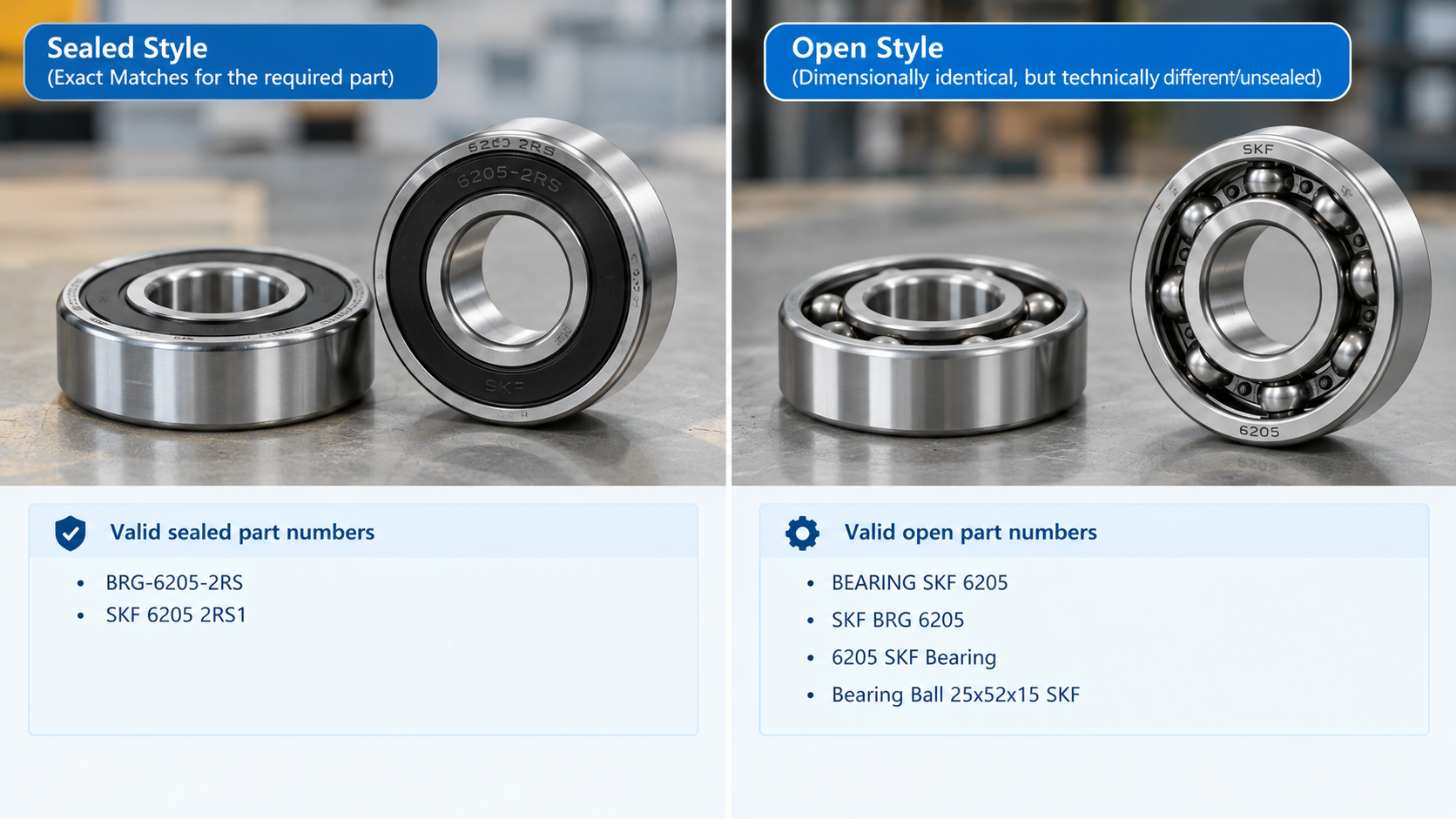
This pattern is routine at enterprise scale. ECCMA, a not-for-profit association for data quality standards, reports that 25% to 30% duplication is common in material master. Experienced procurement teams familiar with the equipment can often recognise those duplicates. AI procurement tools cannot reliably infer them when descriptions, identifiers, and attributes are inconsistent.
How Each MRO Data Inconsistency Creates Friction for AI Procurement Tools
AI-powered procurement tools have several separate functions. Each function depends on different fields in the material master, so an inconsistency that doesn’t affect search can still affect price comparison or reorder recommendations. A field-level diagnosis is more useful than a single data quality score.
Duplicate Material Records Affect Demand Forecasting, Reorder Recommendation, and Spend Analysis
Duplicate material records are one of the most common consequences of inconsistent MRO master data. The same item may exist under separate internal material numbers across plants or business units. Suppliers may also describe the product differently on invoices and catalogues.
As a result, an AI spend analytics engine may treat these records as separate purchases. Instead of identifying that the business bought 12,000 units of the same component from six suppliers, the system may see dozens of unrelated items. This weakens supplier consolidation analysis, volume-based negotiation opportunities, and category-level spend visibility.
MRO data standardisation resolves this problem by normalising descriptions, matching manufacturer and part numbers, and establishing authoritative, consistent material records. An AI procurement tool can then analyse aggregated demand rather than fragmented transactions.
Inconsistent Descriptions Prevent Reliable Item Matching
Material descriptions are often the primary source of information within legacy MRO catalogues. Unfortunately, they are often written inconsistently. One plant may describe a component using manufacturer terminology. Another may use an internal naming convention. Procurement teams may focus on commercial information, while engineers describe technical characteristics.
AI-based item matching becomes complicated when the system must infer meaning from thousands of unstructured naming conventions. MRO data standardisation can convert these descriptions into a controlled vocabulary structure.
For example:
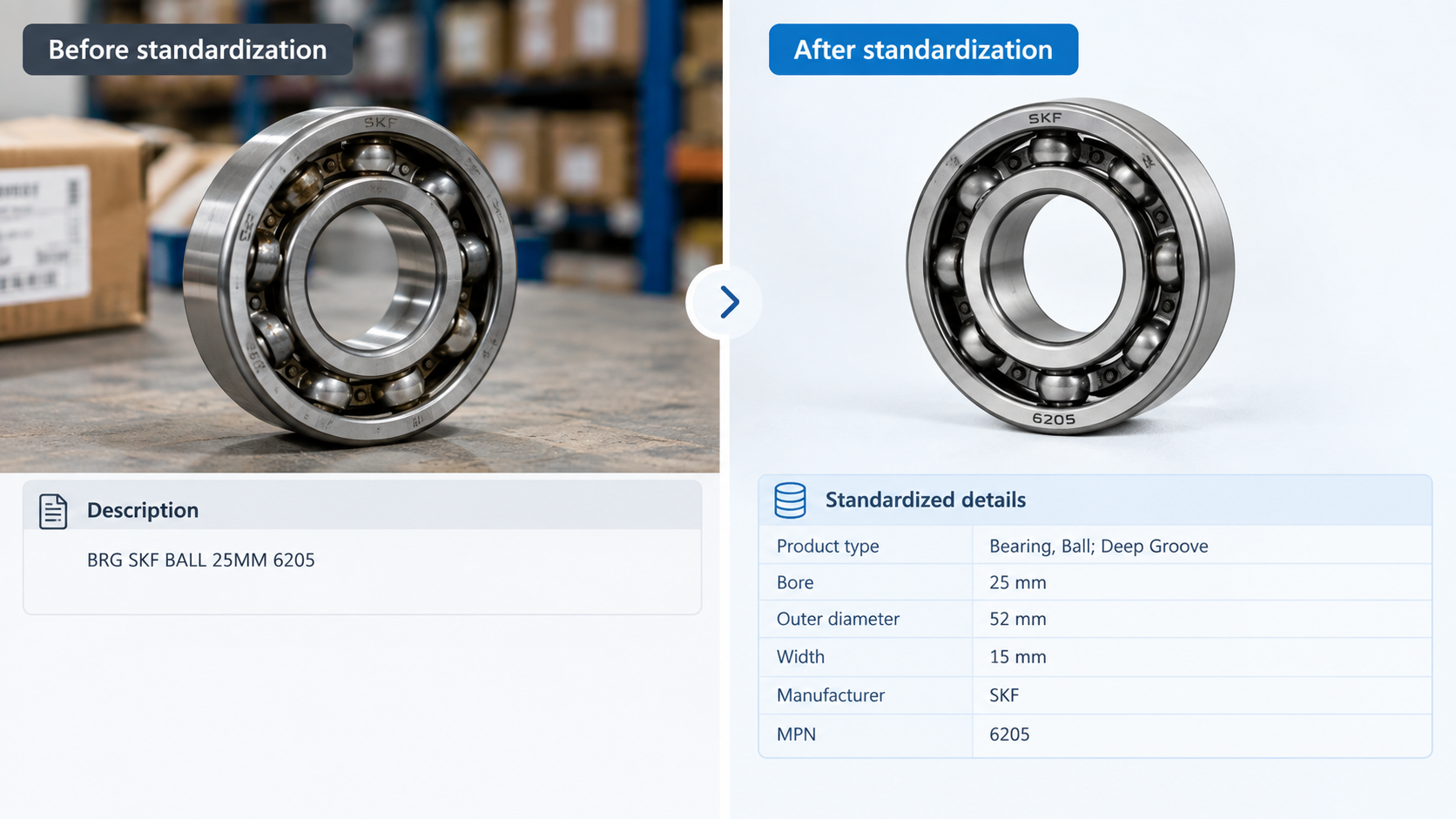
The standardised record gives AI-powered procurement tools complete attributes they can compare, search, classify, and validate. The improvement is more than just cosmetic. It turns human-readable text-based MRO data into structured information that AI tools can use consistently.
Missing Attributes Weaken AI Recommendations
AI procurement tools increasingly recommend alternative products, suppliers, contracts, or sourcing strategies. For MRO materials, however, recommendations frequently depend on technical attributes.
You can’t substitute one motor for another simply because it has a similar description. Voltage, horsepower, RPM, frame size, mounting configuration, enclosure type, efficiency class, and other specifications may determine whether the alternative is usable. The same problem applies to valves, bearings, seals, fasteners, filters, electrical components, lubricants, and thousands of other industrial categories.
Without these specifications, an AI tool may lack the context needed to make dependable comparisons. MRO data enrichment therefore becomes crucial. Existing records can be supplemented with manufacturer details, part numbers, dimensions, material specifications, technical attributes, UNSPSC or other classification codes, and supplier information. The resulting material master gives these tools a richer baseline for matching products and supporting sourcing decisions.
Poor Classification Distorts Category Intelligence
Procurement intelligence depends heavily on classification. Organisations need to understand how much they spend on bearings, valves, electrical equipment, PPE, fasteners, tools, and other MRO categories.
Legacy material masters often contain inconsistent or incomplete category assignments. Similar products may appear under different HS (Harmonised System) codes, while generic categories such as “miscellaneous” accumulate thousands of unrelated materials. AI classification can help, but using it on inconsistent source data can still produce uncertain results. A stronger approach combines automated classification with MRO data standardisation.
First, normalise material descriptions and extract key attributes. Then map records to an approved taxonomy such as UNSPSC, ECLASS, or an enterprise-specific classification hierarchy. Once categories are reliable, an AI procurement tool can do better spend analysis, supplier comparisons, sourcing prioritisation, and category opportunity identification.
The Order of Work for Standardised MRO Data for AI Procurement Tools
Standardising inconsistent MRO data is sequential work. Deduplicating MRO records separately can be repetitive, and enriching unnormalized descriptions can produce attributes in inconsistent formats. A structured MRO master data management framework must therefore operate in a fixed order, with each stage supplying input for the next.
- Audit material master across ERP (Enterprise Resource Planning) systems, EAM (Enterprise Asset Management) systems, and CMMS (Computerised Maintenance Management System) for duplicates, obsolete items, missing fields, and conflicting values to identify MRO data gaps.
- Cleanse and deduplicate MRO data by merging duplicate material records into one master record and cross-referencing obsolete parts to protect open orders and the asset registry.
- Normalise descriptions and units of measure, applying a noun-modifier naming convention, expanding abbreviations, formatting part numbers consistently, and setting units of measure with conversion factors.
- Enrich technical specifications by adding the manufacturer name, part number, and class-specific attributes from manufacturer databases and supplier catalogues.
- Classify every record by assigning each material to an identifier taxonomy and HS code so that the catalogue hierarchy is harmonised across plants and systems.
Governance further determines database readiness for new MRO data. Plants add materials every day, so the governed material master has to synchronise with the procurement catalogue and the search index on a defined schedule.
AI Can Also Help Standardise MRO Data, but Human Validation Still Matters
LLMs can also help in getting standardised MRO data. Machine learning and language models can accelerate description normalisation, attribute extraction, duplicate identification, taxonomy mapping, and product matching across vast material catalogues.
However, industrial data contains technical distinctions that text similarity alone cannot always resolve. Two spare parts may look almost identical while differing in pressure rating, tolerance, material grade, certification, or equipment compatibility. For that reason, a human-in-the-loop approach remains important.
AI can identify likely matches and anomalies at scale. Data specialists and domain experts can validate uncertain records, manage exceptions, and establish rules that improve subsequent processing. The objective is not simply cleaner descriptions. It is a unified material master that both AI procurement tools and procurement professionals can trust.
MRO Data Standardisation Turns Procurement AI into a Decision Tool
Enterprise AI procurement tools promise substantial improvements in sourcing, supplier management, spend visibility, and purchasing automation. But these capabilities depend on the quality of the underlying data.
If an organisation cannot consistently identify its materials, consolidate duplicates, compare supplier records, or structure technical specifications, AI has no stable foundation for making procurement decisions.
By normalising descriptions, standardising UOM, enriching technical attributes, removing duplicates, harmonising supplier information, and applying consistent classifications, organisations create a controlled vocabulary for their material master. The success of enterprise AI procurement tools therefore begins well before their deployment; it begins with reliable, standardised MRO data.







