


Shares of the largest memory manufacturers fell sharply after investors began factoring the risk of future overproduction into their valuations. Over five days, SK Hynix lost 26%, Samsung Electronics fell 22%, and Micron Technology dropped 11%. The main reasons were both the technological progress of Chinese competitors and the expectation that new factories currently under construction around the world could turn the current memory shortage into an oversupply by the end of the decade.
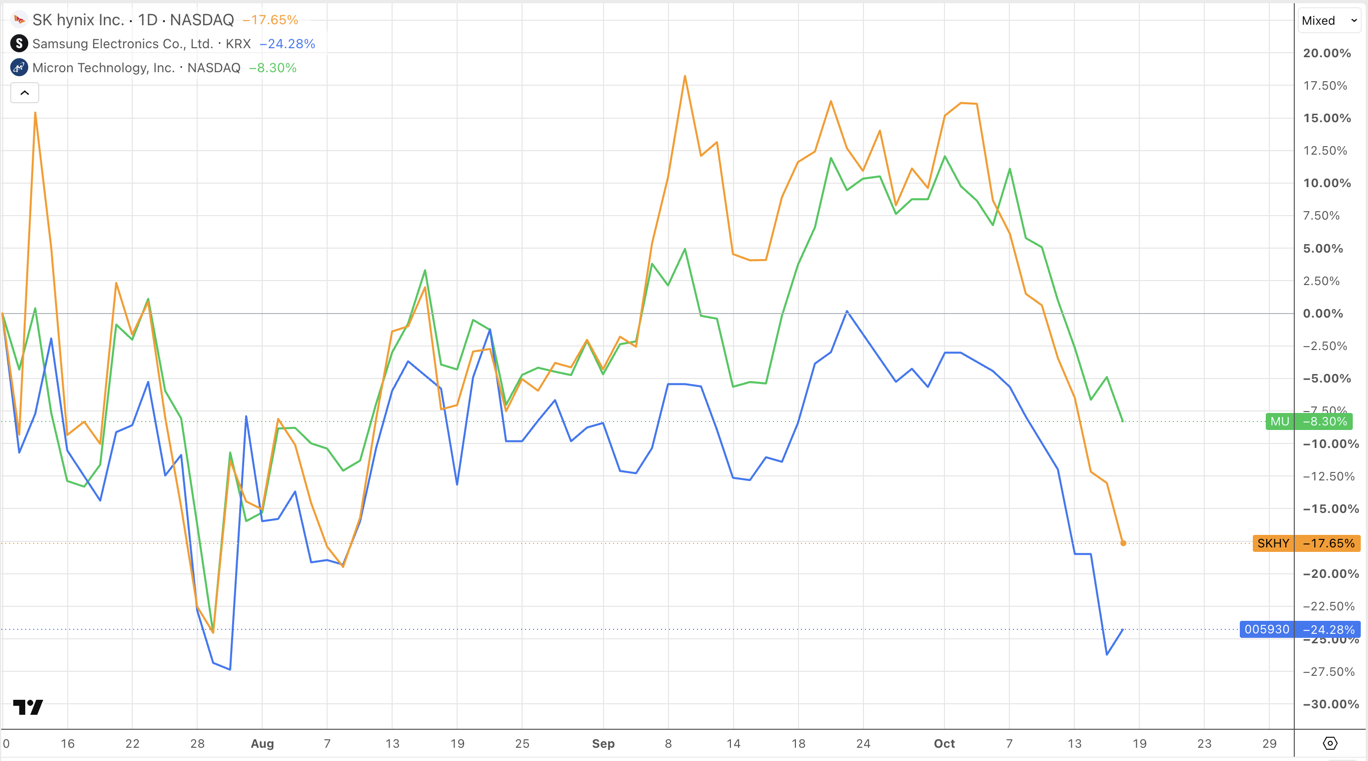
This reassessment is taking place against the backdrop of a broader correction across the AI sector. Investors are simultaneously revising their expectations regarding the Anthropic IPO — where the company’s potential valuation has dropped from $2 trillion to approximately $1.5 trillion — and becoming more cautious about capital-intensive stories, a shift that has weighed on the broader market and brought US futures — Nasdaq futures, Emini futures, and Dow futures — lower. But will future revenue be able to justify the hundreds of billions of dollars in planned investments?
An additional cause for concern among memory manufacturers has been the progress made by China’s CXMT. The company is set to become the first to begin serial shipments of DDR5 with vertical transistors, which the market interpreted as confirmation that the technological gap between Chinese and Western manufacturers is narrowing.
The technological breakthrough itself does not yet mean an immediate increase in supply. New production processes are usually characterised by low yields of usable crystals, so CXMT will need time to bring the technology to an economically viable scale. However, for investors, the long-term signal that matters is that China is gradually building its own production base capable of increasing DRAM supply independently of Western companies.
In the meantime, the memory market remains in short supply, and manufacturers are earning exceptionally high profits. New facilities require three to five years to build and launch, so a significant increase in supply will only begin closer to 2028-2029. Until then, strong demand from AI infrastructure will continue to support prices.
That is why the potential downturn looks more deferred than immediate. It is projected that the cost of DRAM will decrease by approximately 23% in 2028 compared to 2027. Even after this, prices will remain roughly 230% higher than the 2025 level. Moreover, the market is increasingly shifting to multi-year contracts that fix supply volumes and terms in advance, which can smooth out future industry cyclicality.
Nevertheless, the stock market is already starting to discount these risks. Over the past week, the 20 largest companies related to AI and semiconductors have lost more than $1 trillion in market capitalisation. Nvidia, AMD, Micron, TSMC, ASML, CoreWeave, and other participants in the infrastructure chain have all come under pressure.
The problem is not just about the future supply of chips. Leaders at Intel and Broadcom are already warning that, as we approach the end of the decade, the cost of capital will become a new constraint. If the Federal Reserve is forced to raise interest rates due to inflation, financing for new data centres and factories will become even more expensive. As a result, the industry risks simultaneously facing rising financial costs and the introduction of a massive volume of new capacity.
A similar logic can be seen in the valuation of Anthropic itself. The company’s revenue in the third quarter grew by 45% to $16.8 billion, but after more than doubling the quarter before, investors considered the slowdown significant. At the same time, Anthropic plans to allocate at least $518 billion to computing infrastructure and cloud capacity rentals over ten years.
Thus, the current correction reflects not an expectation of an imminent end to the AI boom, but a shift in investor focus. The market is increasingly unwilling to pay solely for scarcity and rapid growth, more frequently demanding proof of sustainable capital returns. For memory manufacturers, the next few years may still be exceptionally profitable, but the more actively they expand production today, the higher the likelihood that these investments will shape the next industry downturn by the end of the decade.







