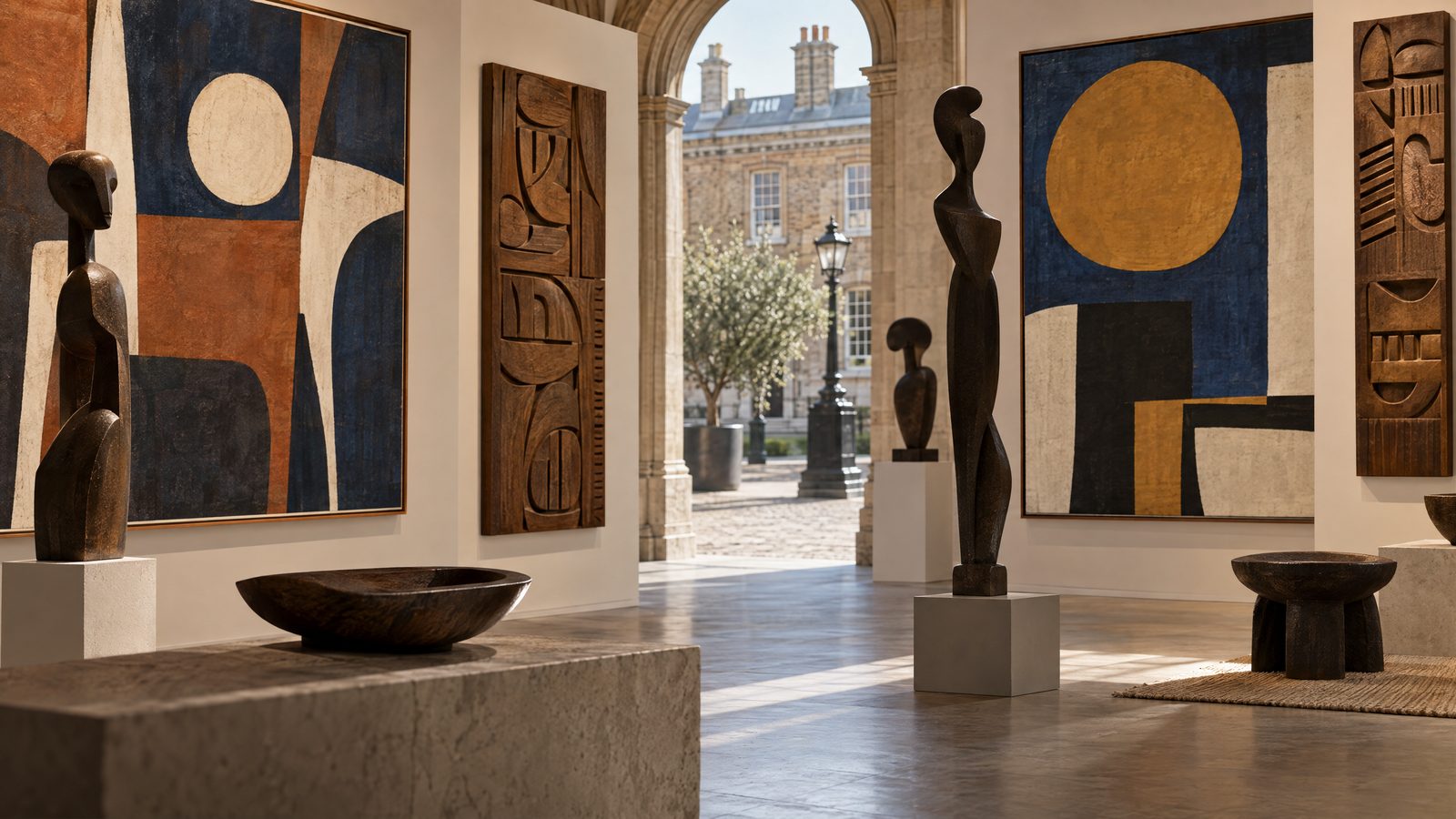

The 14th London edition of 1-54 has introduced a dedicated historical strand for Modern artists from Africa and its diaspora, placing works from several mid-20th-century practices alongside the fair’s contemporary programme at Somerset House. The expansion centres on West Wind, a curated exhibition bringing together ten artists whose careers crossed national borders and whose work emerged amid the continent’s political and cultural transformations.
A distinct strand, not a separate fair
The fair runs from 15 to 18 October across Somerset House’s East, West and South Wings and Terrace Rooms. The Modern focus is integrated into its existing format through gallery presentations as well as the exhibition. That distinction matters: it is not a new standalone event, but a change in how the London edition frames its wider programme, connecting historical work with the contemporary art on view.
Curated by South African-Portuguese art historian Nancy Dantas, West Wind draws its name from a 1966 song by Miriam Makeba. It features work by Sam Joseph Ntiro, Gerard Sekoto, Bertina Lopes, Skunder Boghossian, Kofi Antubam, Papa Ibra Tall, Ibrahim El-Salahi, Rafik El Kamel, Baya Mahieddine and Uzo Egonu. The works are presented through three galleries: Hannah O’Leary Fine Art, Selma Feriani Gallery and Vigo Gallery.
The group does not represent a single national school or a uniform style. It spans artists from different countries and generations, working across painting, sculpture and other forms. Several were active during the decades around independence and decolonisation, while others developed careers through movement between African cities and European cultural centres. The exhibition’s premise is that these histories belong within accounts of modern art, rather than being treated as a footnote to movements defined elsewhere.
Works shaped by movement and exchange
The chosen works offer a practical way into that history. A relief by Ghanaian artist Kofi Antubam centres on musicians and daily life; a painting by Ethiopian artist Skunder Boghossian reflects his time in Paris and exposure to international artistic circles. Gerard Sekoto’s Paris Métro turns to commuters, while works by Senegalese artist Papa Ibra Tall connect modern visual practice with a deliberate reworking of artistic conventions. Together, the pieces show how artists negotiated local references, migration and the pressures of inherited art-historical categories.
Some artists’ routes were shaped by exile or relocation. Lopes, born in what is now Maputo, settled in Rome; Sekoto left South Africa for Paris; Egonu moved to England as a young student. These biographies should not be reduced to a story of artists simply travelling towards European recognition. Their work reflects choices, debates and cultural affiliations that were formed across more than one place.
El-Salahi’s inclusion also broadens the exhibition’s range beyond the mid-century dates implied by its historical framing. His bronze Meditation Tree is dated 2018, while his longstanding exploration of the acacia tree draws on imagery connected to the Nile. The presence of a later work makes the strand less like a sealed period display and more like an invitation to consider how modernist legacies persist and are revisited.
Why the addition matters
Fair director Touria El Glaoui has described the programme as placing African artists within modern and contemporary art history. The claim is an institutional ambition, not evidence that long-standing gaps in collections, scholarship or public attention have been resolved. Yet giving historical work a dedicated presence within a major commercial fair creates a visible point of encounter for visitors who may arrive primarily for contemporary artists.
That setting also brings a useful tension. The works are being shown through gallery presentations within an art market, while the exhibition’s historical emphasis raises questions about how artists become studied, collected and remembered. A fair can introduce visitors to artists and provide context, but its short duration cannot substitute for sustained research, museum acquisition or teaching. The programme’s significance will depend partly on whether attention continues after the stalls close.
For visitors, West Wind offers a route through the strands rather than a comprehensive survey: ten artists, selected works and a curator’s frame. The broader Modernist spotlight extends beyond that exhibition into participating galleries’ presentations. Seen together, these elements make this London edition a shift in emphasis—one that asks audiences to look at the contemporary programme with a deeper historical timeline in view.