
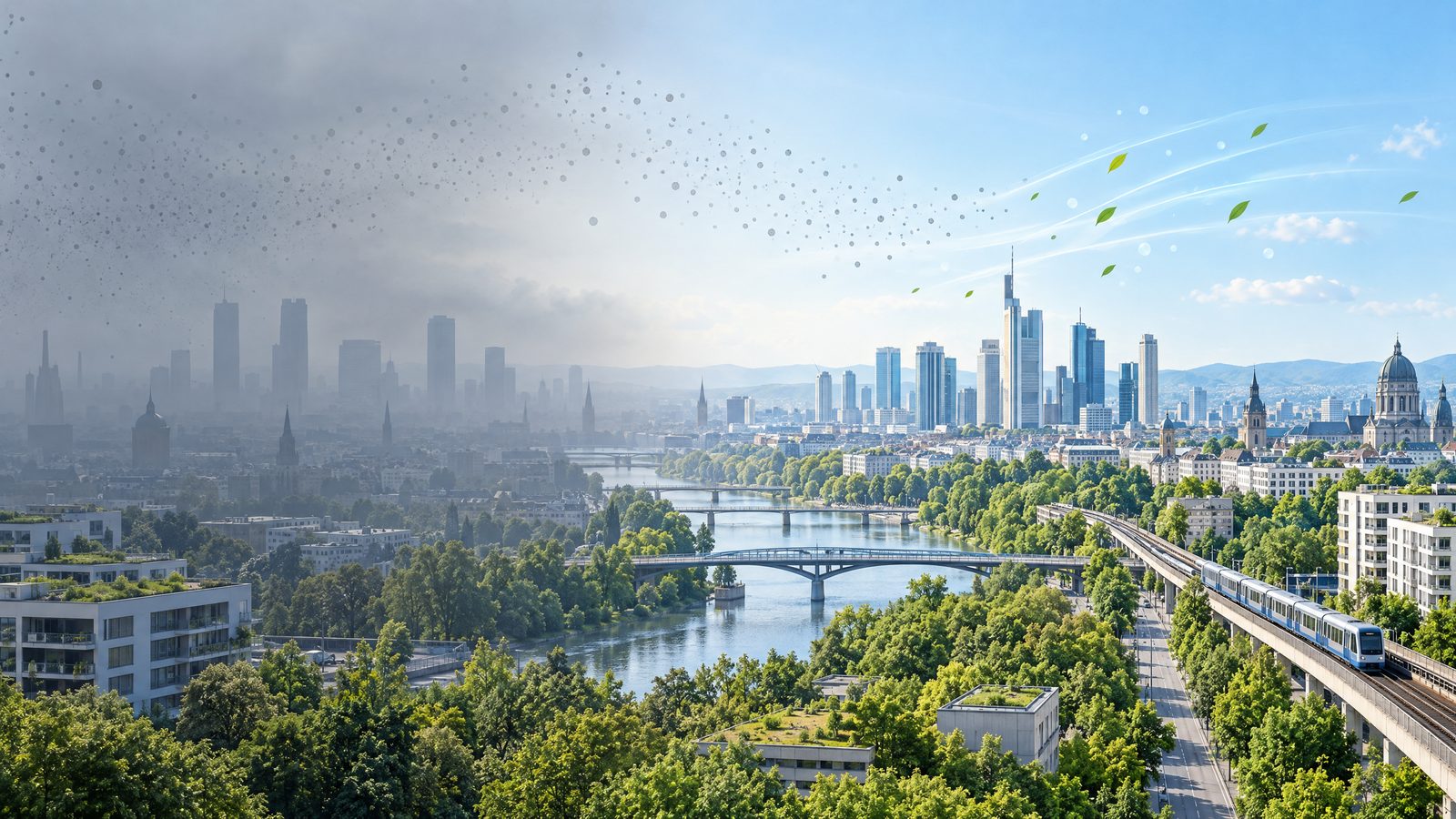

Nearly half of the European Union cities assessed against an incoming annual limit for fine-particle pollution were above that level in 2024, underlining the scale of the work ahead before the stricter standard takes effect in 2030.
The assessment covered 394 cities and found that 181, or 46 per cent, were above the new annual threshold for PM2.5. These particles are 2.5 micrometres across or smaller and can be produced directly by activities including domestic heating, industry and transport. They can also form in the atmosphere from other emissions, including ammonia from agriculture.
A benchmark for the 2030 rules
The result is a comparison with the standard that will apply from 2030, rather than a finding that the cities were already in breach of that future limit in 2024. The revised EU air-quality rules came into force in December 2024 and set a lower annual PM2.5 limit of 10 micrograms per cubic metre from 2030. The previous annual EU limit was 25 micrograms per cubic metre.
That distinction matters. The 2024 figures provide a baseline showing how far many urban areas may need to travel, not a real-time map of the air people are breathing today. They do not show conditions on a particular street, hour or day, and they do not by themselves identify the source of pollution in any individual city.
Even so, the comparison is significant because it places the incoming requirement beside the most recent validated annual data used in the assessment. A city that was above the future limit in 2024 may still make progress before 2030, while a city below it will still need to maintain that position as weather, heating demand, traffic and industrial activity change from year to year.
City action has limits
Local decisions can affect some of the most visible sources of pollution. Measures such as better walking and cycling infrastructure, cleaner public transport, lower-traffic neighbourhoods and action on non-exhaust emissions from tyres and brakes can all form part of an urban response.
But fine-particle pollution does not stop at a city boundary. On average, two-thirds of the PM2.5 measured in cities comes from outside their boundaries. That means progress may depend on national and cross-border action as well as local transport or planning policies. Emissions from agriculture, ports, airports, energy systems and domestic heating can all be relevant, depending on the location and conditions.
The revised framework is designed to make air quality a wider responsibility than a single council department or city authority. Where pollutant levels exceed the relevant limits or targets, member states are expected to prepare roadmaps and plans and to take measures aimed at shortening the period of exceedance. Monitoring and modelling are also intended to improve the ability to identify pollution sources and judge which interventions are likely to work.
What the figures do and do not say
The 181-city figure should not be read as a count of every city in the EU, nor as a measure of all air pollutants. It concerns the cities included in this assessment and one fine-particle standard. Other pollutants have different sources, monitoring patterns and legal thresholds. The PM2.5 figures also sit alongside a World Health Organisation annual guideline of 5 micrograms per cubic metre, which is lower than the EU’s incoming 2030 limit.
The assessment therefore offers a clear warning about the challenge of meeting the 2030 standard without claiming that the outcome is fixed. The next four years will be shaped by decisions across transport, energy, heating, agriculture and urban development, as well as by cooperation between authorities whose boundaries do not match the movement of polluted air.
For residents, the immediate message is less about a single ranking than about whether governments can turn a 2024 benchmark into sustained reductions. The incoming limit provides a common target. The result shows that many cities will need coordinated action beyond their own streets to reach it.







