
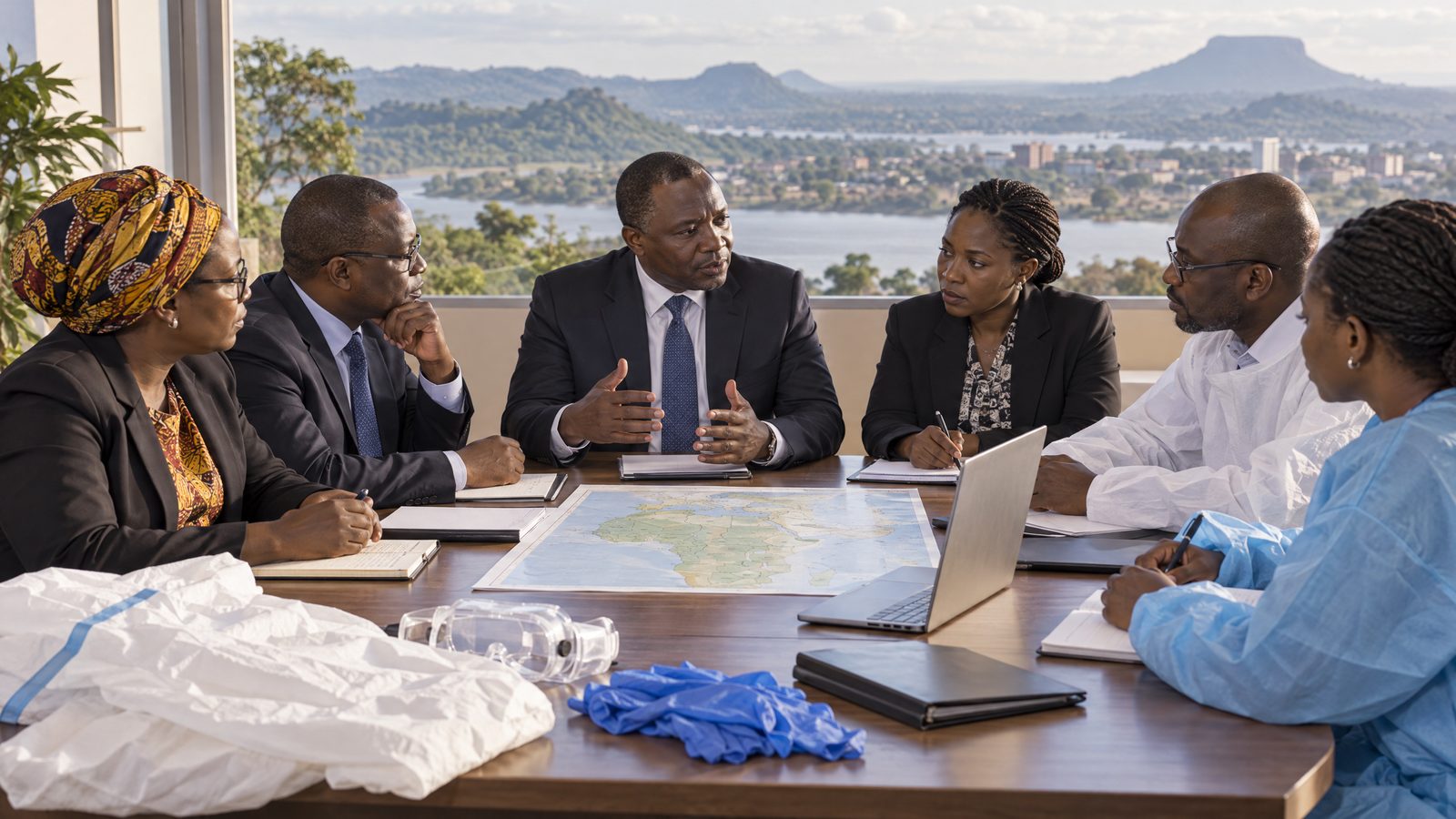

Africa’s health ministers are due to meet virtually on 28 October to assess the continuing Bundibugyo-virus Ebola outbreak and coordinate cross-border action. The Africa Centres for Disease Control and Prevention announced the meeting on 21 October from Addis Ababa. It has not yet taken place, and no decisions or outcomes can be reported.
The agency said the gathering would give ministers an opportunity to review the situation, strengthen cooperation between countries, accelerate support for affected states and reinforce preparedness across the continent. It is also intended to inform preparations for a later summit of African heads of state and government under Burundi’s President Évariste Ndayishimiye, the African Union chairperson.
The announcement describes a regional coordination decision, not a declaration that the outbreak has been contained or a new case count. Africa CDC says Bundibugyo virus disease continues in the Democratic Republic of the Congo, with cases also reported in Kenya and Nigeria. It says the disease’s appearance across Central, Eastern and Western Africa calls for renewed political commitment and a faster, joined-up response.
A cross-border response under pressure
The outbreak was declared a Public Health Emergency of Continental Security by Africa CDC on 18 May. The agency’s statement says five months of response work by member states, frontline health workers and partners have not ended transmission. It calls for stronger solidarity, surveillance, cross-border cooperation, community engagement and protection for health workers.
Recent national updates illustrate why that coordination matters, while also showing why the details must be kept distinct. The World Health Organization reported that Nigeria confirmed one imported Bundibugyo-virus case in its Federal Capital Territory on 20 October. The patient was in isolation and receiving care; 44 contacts had been identified for monitoring, and investigators were still establishing the likely source and reconstructing travel and exposure history. A travel history involving Uganda does not, by itself, establish where infection occurred.
Kenya has separately reported cases linked to an imported infection. A World Health Organization update published on 8 October described Kenya’s first confirmed imported case and its response; later information on the organisation’s Nigeria page said Kenya had reported nine cases linked to that importation. These figures are snapshots from dated reporting, not a live regional total. They should not be combined with Nigeria’s single confirmed case or treated as evidence that the investigation into any individual’s exposure is complete.
For the Democratic Republic of the Congo, the World Health Organization’s 8 October situation report recorded ongoing transmission and substantial case and death totals as of 6 October. Those figures are time-bounded and should not be presented as the current total on 22 October. The report also described pressure on contact follow-up and ongoing response operations. Such context underlines the scale of the challenge, but the ministerial meeting announcement itself does not provide a fresh epidemiological count.
What the meeting can—and cannot—show
The announced agenda is practical: assess the outbreak, improve coordination between borders, support affected countries and strengthen readiness elsewhere. Ministers’ participation may help align national planning, but the public announcement does not specify a funding commitment, new travel policy, operational targets or a timetable for subsequent decisions. Nor does it set a date for the proposed heads-of-state summit.
That distinction matters in a fast-moving health emergency. Convening political leaders is a step towards coordination; it is not proof that surveillance gaps have been closed, contacts have all been traced or transmission has been interrupted. Africa CDC’s appeal to member states focuses on vigilance, rapid information-sharing, community engagement and protection of frontline teams. The value of the 28 October discussion will depend on what participating governments agree and how any commitments are carried through.
Bundibugyo virus disease is a distinct Ebola disease caused by Bundibugyo virus. The World Health Organization says there are no licensed vaccines or approved therapeutics specifically targeting it. Public-health authorities therefore rely on measures including rapid detection, testing, isolation and care, contact follow-up and infection prevention in health facilities. The current announcement does not change that status; it signals an effort to coordinate those responses across national boundaries.
For now, the confirmed development is that Africa CDC has called ministers to a virtual meeting on 28 October and expects it to feed into preparations for a wider leaders’ summit. Until the meeting is held and any decisions are made public, its outcomes remain unknown.







