
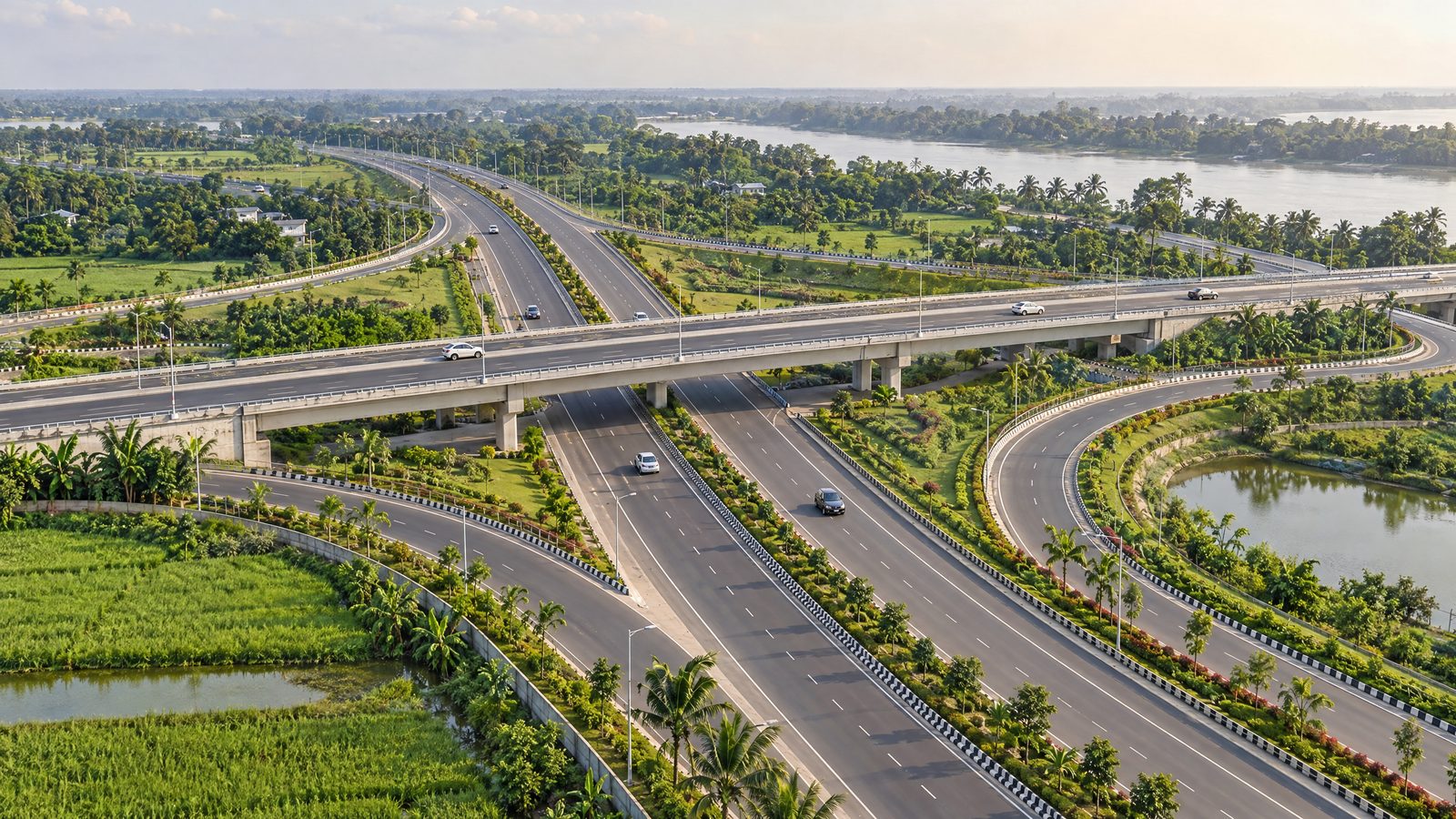

Bangladesh has set out a data-led road-safety programme intended to reshape locations where crashes recur, including hazardous junctions at which regional roads meet major highways.
The plans were outlined at a National Road Safety Day meeting in Dhaka on 28 October. The observance was held later than its usual 22 October date because that day fell on a holiday. The announcement describes work that is under way rather than completed construction, and it does not show that crash rates have already fallen.
Officials say crash information is now being examined through a database to identify places with repeated incidents and to understand the factors associated with them. The proposed response is to alter road layouts at those locations, rather than apply a single measure across the entire network. At some highway intersections, the work is expected to include diversions where regional roads join the main route at right angles.
Road Transport and Bridges Minister Shaikh Rabiul Alam said the changes could reduce crashes by around 20 per cent. That figure is an estimate, not a guaranteed outcome or a result already measured on completed schemes. No list of locations, construction timetable, overall budget or method for calculating the possible reduction was set out with the announcement.
Road design is one part of a wider programme
The redesign work is being presented alongside other road-safety measures. These include efforts to manage vehicle speeds, enforce helmet rules, improve care after collisions, construct underpasses, add left-side lanes on highways and strengthen the collection of road-safety data. Support for work at high-risk locations is also expected to involve the World Bank.
The emphasis on data matters because recurring crashes can have different causes at different sites. A junction may require a changed turning movement or clearer separation of traffic. Elsewhere, the important issue may be speed, visibility, pedestrian movement, vehicle condition or driver behaviour. Identifying a location as high risk does not by itself establish which intervention will work there. Any design should be assessed against the particular hazards found at that site.
The minister also pointed to responsibilities beyond road engineering. Unsafe or careless driving, unfit vehicles, pedestrian behaviour, faults in road design and failures by other parts of the transport system were all identified as factors that can contribute to crashes. That means the proposed redesigns should be understood as one element of a broader safety effort, not as a substitute for enforcement, training or safe vehicles.
Targets need a clear baseline
Bangladesh has committed to seek a halving of road-crash deaths and injuries by 2030. The government also says it is working towards a comprehensive road-safety law by December 2027. A draft legal framework has been described as including measures on emergency treatment for crash victims, protection for people who provide assistance, a demerit-point system for traffic violations and tougher penalties for repeat offenders. The proposed law has not yet been enacted.
Reliable data will be central to judging progress. A World Health Organization estimate has placed annual road-crash deaths in Bangladesh at about 31,578, while national road-transport data recorded 5,490 deaths in 2025. The figures are sharply different, so an assessment of any 20 per cent reduction will need to state which dataset, time period and definition of a crash or death is being used.
The immediate test for the road-redesign programme will be whether the authorities publish the locations selected, the changes planned for each one and the evidence used to measure their effect. A falling number of crashes at a treated junction would be important, but it would also need to be considered alongside changes in traffic volume, reporting practices and the movement of risk to nearby roads.
For now, the development is a statement of direction: use information about recurring crashes to guide changes to the road network, while pairing those changes with safer driving, enforcement and better care after collisions. Its practical value will depend on the designs that are delivered and on transparent evidence of whether they make journeys safer.







