
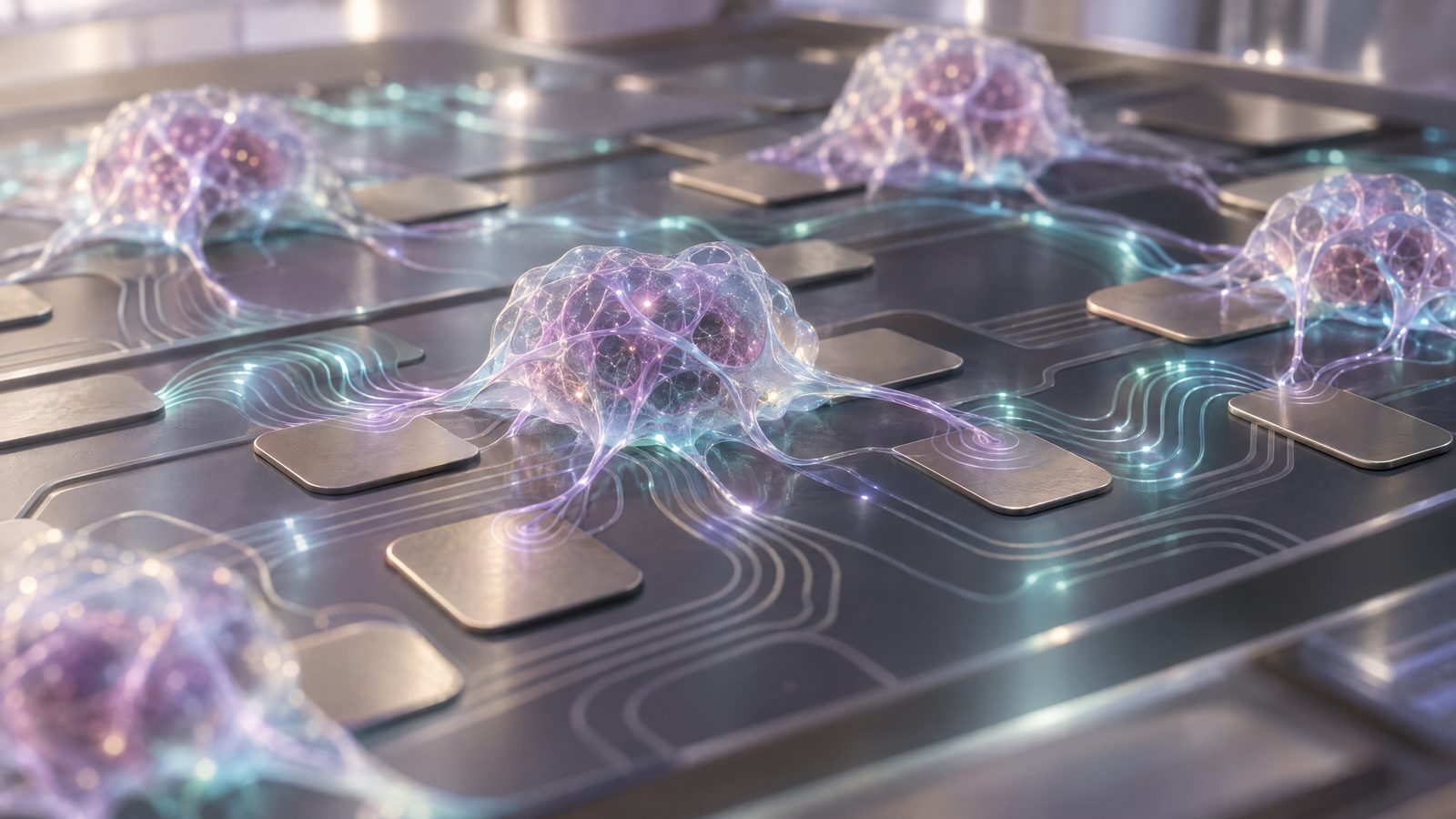

Three lab-grown brain organoids working together classified tactile signals corresponding to Braille letters more accurately than a single organoid in a new experiment, reaching 83 per cent accuracy compared with 61 per cent. The Bristol-led study tested whether neural tissue could receive and relay information from an artificial touch sensor, not whether it could read Braille or learn independently.
The research, published on 16 October in Frontiers in Artificial Intelligence, converted tactile data recorded from the 26-letter Braille alphabet into electrical stimulation patterns. The signals were delivered to human forebrain organoids grown on microelectrode arrays, which both stimulated the tissue and recorded its neural activity. A support vector machine then classified the response patterns.
How the test worked
The organoids were smaller than one millimetre across and contained about 10,000 neurons alongside supporting cells. They lack several structures found in a complete human brain. In the experiment, they were kept alive in a system that monitored their responses to electrical input.
The team first characterised how different stimulation parameters affected the organoids. It then used an event-based tactile sensor to record patterns associated with Braille letters and encoded those inputs as electrical pulses. Researchers measured neural activity and used the machine-learning classifier to determine which letter each response represented.
Responses from one organoid produced an average classification accuracy of 61 per cent. Combining outputs from three organoids raised that figure to 83 per cent. The researchers do not yet know why the ensemble performed better. They suggest that differences in network connections, developmental state and ongoing activity may mean that separate organoids contribute complementary information. Such variation could also make a system harder to standardise.
The team additionally tested robustness by adding artificial noise to the letter signals. In comparisons using the same classifier, decoding from organoid responses was less easily disrupted than direct decoding of the deliberately obscured input signals. This was a test of resistance to those experimental noise filters, not evidence that organoids outperform conventional computing across practical tasks.
A limited early-stage demonstration
The study describes an open-loop task: the organoids received encoded signals and their responses were analysed, but the system did not return feedback to them. The researchers explicitly state that the work did not show learning over time or long-term changes in the tissue. It used one tactile task, a fixed encoding scheme and a relatively simple measure of neural activity.
That distinction matters because the results demonstrate information transfer and classification in a controlled setup, rather than a self-training biological computer. The measured accuracy relates to this particular Braille-signal experiment; it should not be read as the ability of the tissue to understand language, interpret ordinary touch or perform independently.
The researchers identify further work on textures, edges and other forms of touch, followed eventually by closed-loop experiments in which feedback could be provided. Those steps could allow questions about adaptation to be tested, but they have not yet been demonstrated. The current result is a foundational experiment in connecting artificial sensors with living neural networks.
The research was conducted by Tianyi Liu, Hemma Philamore and Benjamin Ward-Cherrier. It presents biohybrid computing as a possible route for future investigation, including potential energy-efficiency benefits, but this experiment did not measure energy savings or establish a usable computing application.







