

By Paul Rekhi, Head of Carbon Services at Advantage Utilities
Climate change is the single biggest threat that businesses face over the next few years. Between 2011 and 2020, annual average carbon dioxide (CO2) emissions totalled 38.8 billion tons, but land and ocean sinks which convert this CO2 can only support 21.7 billion tons annually. This emissions shortfall should concern all businesses as it is the root cause of atmospheric CO2 which in turn causes global warming and climate change. This is why progress towards a more sustainable future is so important and businesses must ensure their operations are net-zero by 2050. But seven in ten people in the UK do not believe the country will meet this target mandated by the UK government, so what can be done to ensure businesses of all sizes meet their net-zero obligations? Carbon reporting is inseparable from this progress towards net zero.
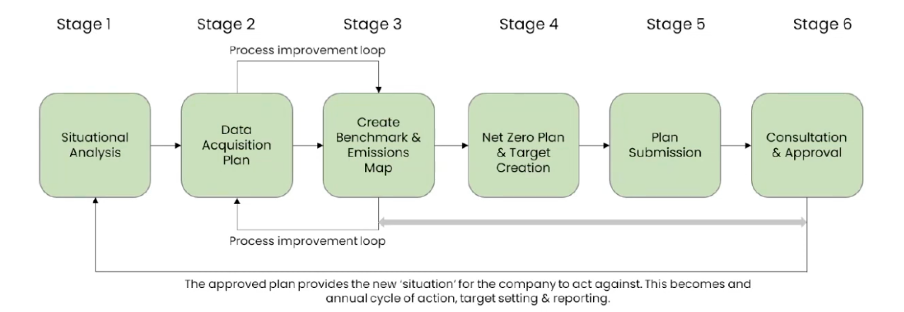
During a recent webinar I hosted, I discussed this very point, revealing that a credible plan to achieve net zero is possible through a stepped, collaborative process, such as the carbon-ethics process flow which details how businesses can implement carbon reporting. In this article, I will set out how businesses can use carbon reporting to their benefit. First, however, I will provide context as to why carbon reporting has become so important for progress to take place today.
The trajectory of carbon and corporate guidance
Intergovernmental organisations have begun to respond to the need to reduce emissions by setting out what needs to be done to address climate change and its anthropogenic causes. For instance, the United Nations (UN) established the Intergovernmental Panel on Climate Change (IPCC) in 1988, an acknowledgement of the imperative to limit annual carbon concentrations. The IPCC then developed guidance documents to assist businesses in accounting for their carbon footprint. As the UN endorsed and amplified these plans, governments then developed compliance across six key systems outlined by the United Nations Environment Programme (UNEP): energy, building and cities, transport, nature-based solutions, agriculture, food and waste, and industry. So essential systems such as energy generation or procurement, integral to how businesses power their operations and transport goods and services, must undergo changes to achieve carbon neutrality and improve atmospheric CO2 concentrations. This strategic shift also plays a crucial role in the broader framework of environmental, social, and governance (ESG).
Differentiating between net zero and carbon neutrality
But when we talk about ‘net-zero’ and ‘carbon neutral’, it’s important to differentiate what we mean. Net zero refers to the calculation of emissions, followed by the organic removal of these emissions from the business. Carbon neutrality, on the other hand, adheres to the same greenhouse gas (GHG) accounting principle but incorporates accredited carbon offsets to counterbalance released GHGs. However, achieving true net zero requires comprehensive accounting – carbon reporting – necessitating oversight into scope 1, 2, and 3 emissions.
These scope emissions can be broken down into the following categories; scope 1, encompassing direct emissions from company facilities and vehicles and scope 2 emissions, mainly involving indirect emissions related to purchased electricity, heating, and cooling. Finally, Scope 3 emissions involves all other aspects of business activities, spanning upstream activities occurring before your organisation (‘from cradle to gate’), including purchased goods, employee commuting, and leased assets, to downstream activities occurring after (‘from gate to grave’), such as the processing of
 solid products, transportation, and investments.
The Carbon-Ethics Process Flow
A stepped, collaborative process is required to ensure that the carbon reporting process and progress towards net zero is as easy as possible. Through a six-stage process, businesses can ensure all relevant data is captured, analysed and aligned to the relevant scope (1, 2 or 3), that data gaps are fully identified with a data improvement plan and that ongoing measurement, tracking and reporting processes are embedded into the process.
Stage 1 begins with a situational analysis of the business; creating a plan consisting of a benchmark and a map to net-zero. This plan is submitted to the board of the organisation for approval. Stage 2 involves establishing a data acquisition plan to give a business an accurate insight into the carbon they produce. This work informs stage 3 which consists of creating further benchmarks and an emissions map to track carbon over time.
Through a process improvement loop between stages 2 and 3, the data available to businesses should continually be refined, becoming more accurate and complete over each consecutive year. However, it may take large organisations up to two years to fully understand this type of data across the whole of their business. This work is further aided when using an online portal to make information tracking as easy as possible, with a bureau service also being used to keep note of bills, flagging any discrepancies to ensure you only pay the right amount for how much you use, and also preventing large underestimated bills. Through this, the average two-year saving for businesses is approximately £700.
Next, stage 4 is where businesses create their updated plans, with any targets achieved factoring into their marketing, winning new business. Improvements in carbon reduction are noted and used in further target creation, with this leading to stage 5 – plan submission – with the final step being consultation and approval on the results over the year. This process ensures that a streamlined, ongoing annual cycle is embedded into business practices, supporting them on the road to net zero. Throughout this process, benchmark certificates and carbon neutrality certificates are also issued where appropriate.
To summarise, the need to track carbon and reach net zero is already clear, but businesses can achieve a streamlined road to net zero through carbon reporting, meaning they can measure, manage and then reduce their emissions more effectively. By incorporating a clear process to measure carbon across every department, businesses will see laudable results through a stepped, collaborative carbon reporting process that is essential if organisations are to meet their carbon reduction targets and ultimately reach net zero.
By Paul Rekhi, Head of Carbon Services at Advantage Utilities
Photo by Pavel Danilyuk on Pexels