
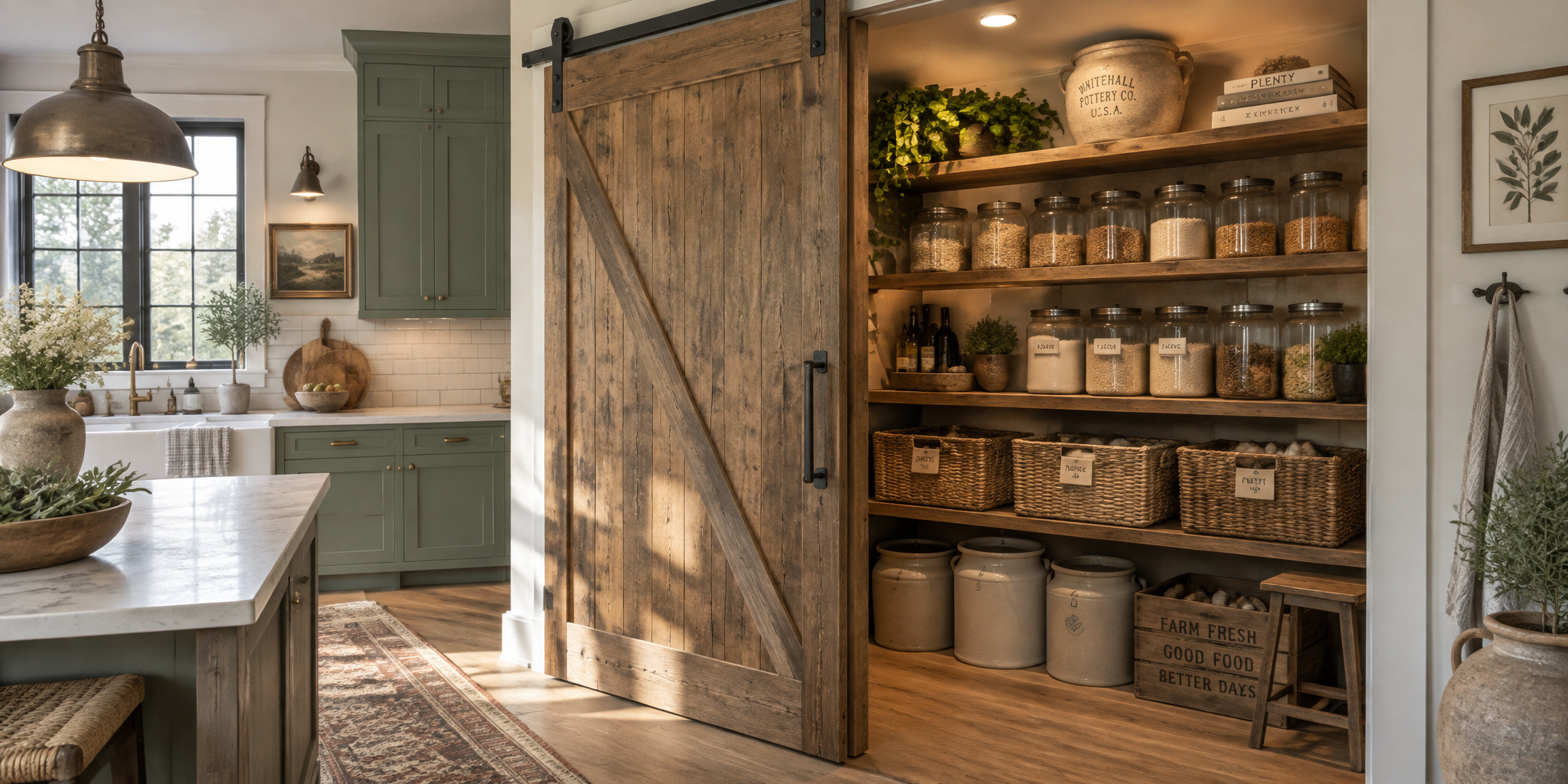

Before the refrigerator, there was the walk in larder. A small, north-facing room, often tucked against an exterior wall, where butter stayed firm, vegetables kept for weeks, and milk did not sour overnight. It was not a luxury. It was how a house worked.
The arrival of the electric fridge made the larder seem redundant, and across Britain thousands were ripped out, blocked up, or converted into cloakrooms and cupboards. A generation grew up without one. Now they are coming back, and the reasons are more interesting than nostalgia.
What a Larder Actually Does
A larder is a cold room, not a cold appliance. That distinction is the whole point.
It relies on shade, thermal mass, and ventilation rather than a compressor. A well-built larder stays several degrees cooler than the rest of the kitchen throughout the year, with the greatest advantage in autumn and winter. It provides dry, dark, well-ventilated storage for the things that do not need refrigeration but suffer in a warm kitchen: root vegetables, onions, garlic, flour, bread, preserves, wine, and cheese.
The modern fridge, by contrast, is a small, cold, humid box designed for short-term storage. It does not improve with age, and it does not hold a season’s worth of anything.
Why They Are Returning
Several forces have converged.
The first is a shift in how people shop. Weekly supermarket trips are giving way, for many households, to a mix of bulk buying, farmers’ markets, box schemes, and growing at home. All of these produce quantities that a fridge cannot accommodate and a kitchen cupboard cannot organise.
The second is a concern about food waste. A larder keeps produce in conditions where it lasts, rather than in a fridge where it is forgotten behind the milk. Visible, accessible storage encourages use.
The third is energy. A larder uses none, and in a well-designed house it can reduce reliance on a second fridge or a larger one. That matters as running costs concentrate attention.
The fourth is design. The larder has become a desirable feature in its own right, a marker of a considered kitchen rather than a merely expensive one.
Building or Restoring One
Many period homes still have the shell of a larder, often disguised as a cupboard or filled with shelving. Restoring one is usually simpler than expected.
The essentials are straightforward. Insulate the walls and ceiling if possible, but leave the floor uninsulated so that the ground provides some cooling. Fit a vent low on one wall and another high on the opposite side, allowing cool air to enter and warm air to escape. Keep the door well fitted but not airtight. Add slate, stone, or tiled shelves, which stay cold and are easy to clean.
In a new build, a larder can be designed into the kitchen from the outset, ideally on a north or east wall and away from ovens and radiators. Even a large cupboard with proper ventilation will function as a larder if it is planned well.
What to Store, and How
A larder rewards organisation.
Root vegetables keep best in the dark, in paper sacks or wooden crates, and should be checked regularly for rot. Onions and garlic need air and should hang or sit in open baskets. Flour and grains should be kept in sealed containers, away from moisture. Bread keeps well in a cotton bag or a wooden bin. Preserves and pickles belong on shelves where they can be seen. Wine prefers a steady, cool temperature, which a larder provides better than a kitchen cupboard.
What should not go in a larder? Anything that needs consistent refrigeration: fresh meat, fish, dairy in warm weather, and cooked leftovers. A larder is not a fridge, and treating it as one is how they acquire a bad reputation.
The Practical Realities
Honesty matters here. A larder is not a fridge replacement, and in a modern, well-heated house it will not stay as cold as a Victorian one did. Insulation, ventilation, and siting all affect performance, and in a heatwave even the best larder will struggle.
Space is the other constraint. A walk-in larder requires a room, and many homes do not have one to spare. In a flat or a small kitchen, the answer is a larder cupboard: a tall, ventilated unit with slatted shelves and a solid door. It does not deliver the full benefit, but it delivers a good deal of it.
Maintenance is modest but real. Larders need cleaning, checking, and occasional airing. They attract mice if not properly sealed. They are not a fit-and-forget solution.







