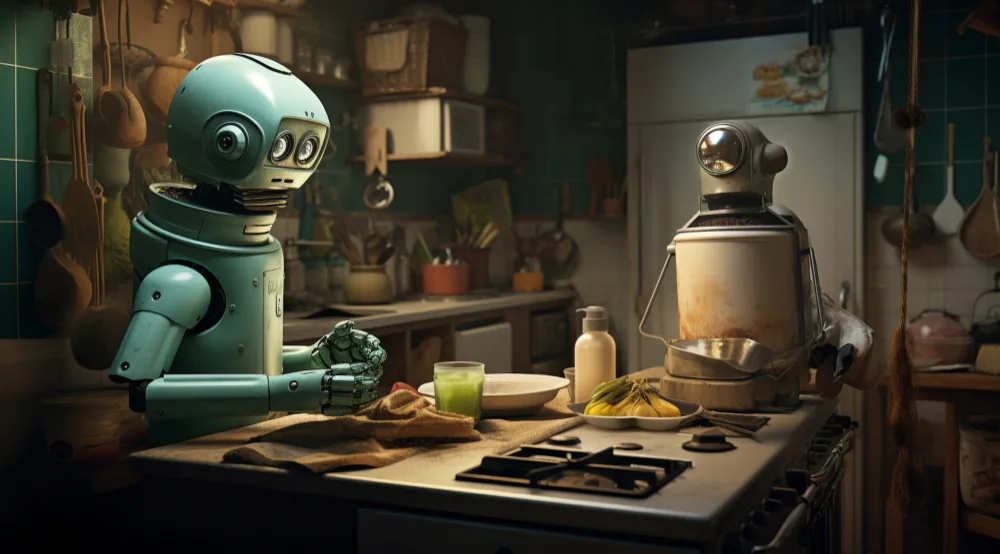

Technology has made its mark on just about everything, and the world of food is no exception. The advent of automation, AI, and robots have brought us cooking robots which are advanced innovations that are set to revolutionise how we make food. Not only do they have to be able to make the job of chefs and home cooks easier, but they also promise to change the way we all make food in the future, providing levels of speed, consistency and precision previously unheard of.
What is a cooking robot?
A cooking robot is a high-tech robot that integrates robotics technology, AI and sensors to automate several steps of a cooking process. These robots can complete a variety of cooking tasks from chopping ingredients to stirring and sautéing and even plating. In an imitation of a human chef’s movements, cooking robots can follow recipes almost perfectly, resulting in a more efficient and time-saving cuisine experience.
Types of cooking robots
Robot chefs: With technology like this nothing is impossible and that certainly holds true for the kitchen as full meals are prepared by these bodies from start to finish. Some of them use chop, baking, steam, prepare/, mixing/, Fried and so on Many functions in one. Robot chefs are especially helpful in restaurants where large amounts of food must be prepared consistently and quickly.
Robot kitchen helpers: These robots are designed to work alongside human chefs. They do repetitive or laborious work: pressure washing vegetables or greens, chopping, stirring. It frees up the human chef to do something more creative while the robot handles the grunt work.
Robot cooking kits: These kits are usually integrated in kitchens, which provide full autonomy in cooking. They are commonly used in industrial applications for cooking large batches of food that need little human guidance.
Personal cooking robots: Developed for home use, personal cooking robots assist people in easily cooking their own food at home. These robots can cook recipes, measure ingredients, and even make meals to a certain user’s preference, making life a little easier for some very busy families and single people.
Advantages of cooking robots
Cooking robots have various advantages, and they are considered as a revolution for commercial and domestic kitchens. Among these benefits are:
Efficiency and timesaving
Cooking robots are also fun and the advantage of using them is time saving. Robots can prepare meals more quickly than humans. They save on cooking time, cutting down the amount of kitchen work in restaurant kitchens or at home.
Consistency and precision
Robots never get tired, side-tracked or take a miss-shot, unlike humans. Hence, they can cook from recipes with fantastic accuracy. Cooking bots are able to measure ingredients, maintain cooking temperatures, and time cooking processes to guarantee the same outcome each time.
Improved food quality
Since robots can cook, the quality of your food will never change – no more overcooked or undercooked meals. The robots also guarantee recipes are followed down to the exact letter, taking one more source of human error out of the equation for variation in taste.
Labour cost reduction
In a professional kitchen, employees can be a huge cost. Robots that cook can mean less dependence on a big staff to do most of the cooking. This is particularly advantageous in the food service business, as rapid and efficient production is vital.
Customisation
Some robot-cooks are customisable, which can be helpful if you have dietary requirements or other preferences. Vegan, gluten-free, keto: you name it and a robot can prepare food to your specifications.
Sustainability
Cooking robots who work in kitchens also help trim waste. These robots calculate portion size more precisely — wasting less food as a result. In addition, when tasks are automated, robots also help conserve energy and ingredients.
A market for robot chefs grows in Silicon Valley
The market for cooking robots is burgeoning, causing an increase in commercial and household usage. As per Roots Analysis, the market of cooking robots size is estimated at USD 4.01 Bn in 2025, anticipated to register a CAGR of 11.92% during the period of 2025-2035. This dramatic growth is attributed to the growing need for automation in food production, robot technology capacity enhancement, and preference for an automated cooking process for consistent cooking quality.
The growing popularity of fast, convenient, and consistent food, and adoption of automation technology in multiple sectors are estimated to drive the cooking robot market growth. In addition, with the decreasing cost of cooking robots, these robots are anticipated to be adopted in commercial kitchens and home.
Key players operating in the cooking robot market
A few companies are pioneers in the field of cooking robots. These companies are working to develop robots that not only automate the cooking process but also leverage AI and machine learning to make them smarter and more multifunctional.
Moley robotics
Moley Robotics is a frontrunner in the cooking robot industry. Their robotic home kitchen can make sophisticated dishes with robot arms and AI-driven software. Moley’s robotic chef is intended for use in the home kitchen, to mimic the movements of a human chef with exactitude.
XRobots
XRobots is an expert in the field of robotics for the foodservice business. Their robots can automate different tasks of cooking, from handling ingredients to cooking itself. The company’s products are committed to delivering professional and household robotic products which are easy, practical and reliable.
RoboChef
RoboChef is a total solution for cooking that uses robotics and AI to cook food autonomously. Their robots can do countless cooking tasks and learn to do new recipes, so they can be used in both professional and home kitchens.
Robotic kitchen
Robotic Kitchen offers fully automated kitchens for commercial food service operators. The systems can cook anything from basic fare to fancy feasts, simplifying kitchen operations and cutting down on the manpower required.
Perspective: Next-generation cooking robots
Cooking robots have a bright future ahead, technological progress is giving rise to increasingly performant, cheap, and useful solutions. With the advancing stage of AI, and developing capacities emerging within machine learning techniques, cooking robots will be able to not only acquire and apply new recipes and cope in diverse kitchen environments, but also tailor dishes to personal tastes.
Besides, as there is rising public awareness about erasing food waste and excessive energy consumption, cooking robots can come in handy to optimise food production and eradicate food wastage reduction. These robots can help lead to a more sustainable, environmentally friendly food system by cutting down on human cooking time.
Potential challenges
Very good, but there are a few hurdles the robo-cooking market still needs to overcome:
- Expensive to start: Cooking robots are expensive to buy and set up for use by small businesses and homeowners. But as technology goes mainstream, the costs will drop with time.
- Consumer side: Nevertheless, some consumers may not be seriously considering the idea of cooking robots, at least for replacing the traditional way of cooking and human cooking. Resisting the dystopian wave and the challenge of demonstrating what robots have to offer will be key in the market’s acceptance.
- Regulatory: As the cooking machine is becoming popular, there will be established a regulatory framework for its usage for reasons of safety, hygiene and maintenance.
Conclusion
Robots that Cook Are the Future of Food Preparation. When it comes to meal preparation, the robots are in and they’re here to stay. The benefits are endless, including, but not limited to, efficiency, precision, and personalisation. Thanks to the latest advances in technology and a surge in the demand for automated appliances, cooking robots with their potential to change kitchens across the globe have already invaded the market, with new models constantly popping up. Despite the hurdles, the work-bot could test the potential of cooking robots to save time, work with fewer employees and improve quality. As we move forward, it is evident that cooking robots will fundamentally alter the culinary industry, in that cooking will become a more intelligent, faster and sustainable activity.
The cooking robot market is predicted to rise dramatically in the years to come, so we can all anticipate even more advancements in this area, bringing these intelligent machines to commercial and home kitchens alike. Cooking is the future of robotics.