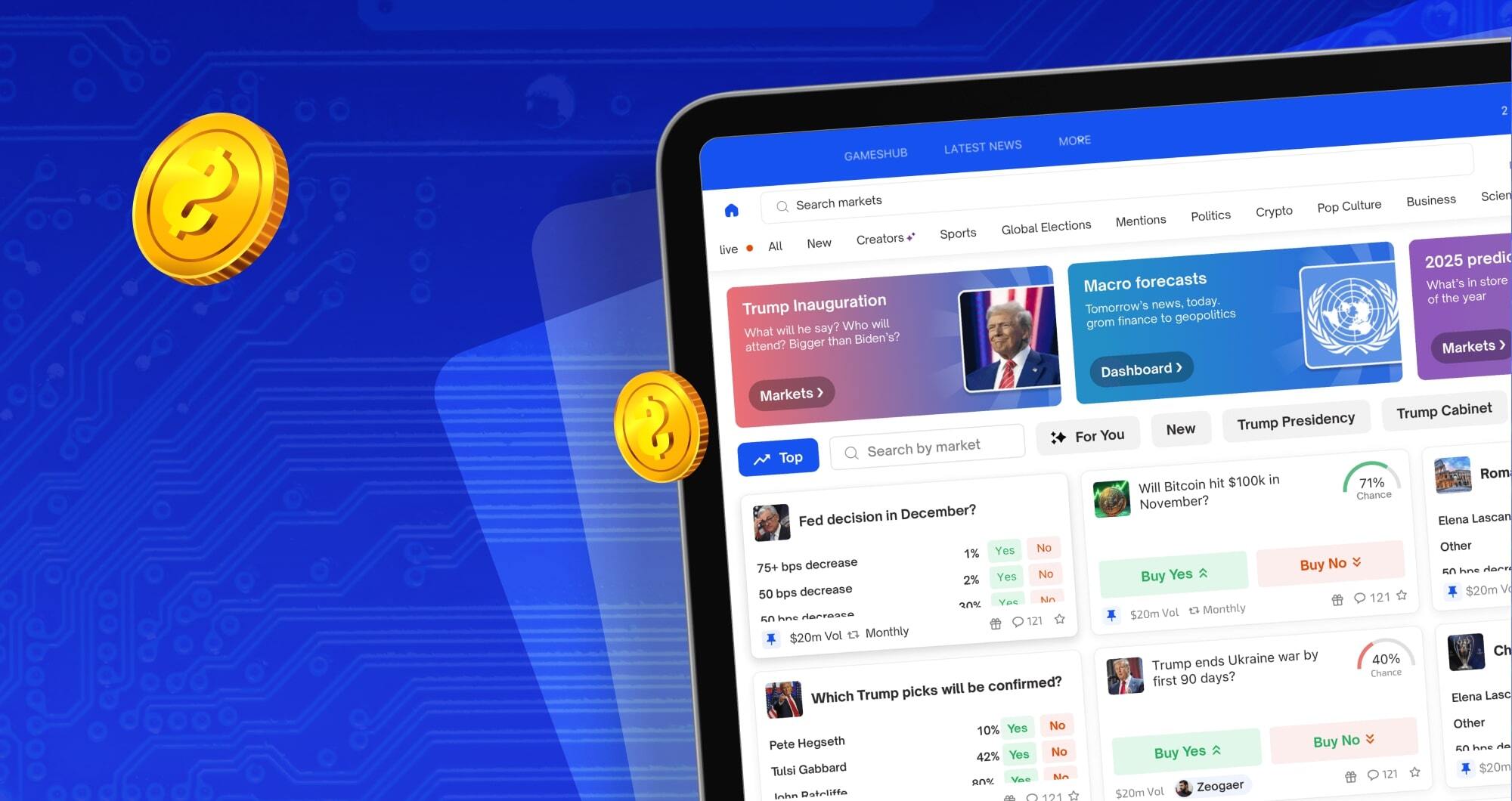

Crypto prediction markets have gone from being experimental DeFi primitives to structured financial instruments that can be used to anticipate elections, interest rate decisions, crypto values, and big events throughout the world. As 2026 gets closer, each crypto prediction market platform is no longer examined solely by its promises of decentralisation. They are also judged by how effectively they manage liquidity, settlement accuracy, regulatory risk, and user confidence.
A prediction market lets people bet on how likely it is that something will happen in the future. The side that wins gets the dividend if the result of the event matches the market position. The idea is simple, but current crypto-based systems use smart contracts, automated market makers (AMMs), and oracle networks to function without centralised custodians.
This article looks at the top crypto prediction markets that will shape 2026. It explains how they function behind the scenes and what trade-offs each strategy has.
How Prediction Markets Work Today?
A prediction market transforms a future occurrence into a contract that can be bought and sold. For instance, “Will a certain asset close above a certain price on a certain date?” Each result is given a token value between 0 and 1 and exchanged until the deal is done.
Most crypto prediction markets employ smart contracts that are set up on certain blockchains. AMMs, not conventional order books, usually handle liquidity. This keeps prices stable but costs money up front. Settlement relies on oracles, which are outside data sources that check the real-world result.
Every design decision comes with trade-offs. AMMs make things easier to get to, yet they may waste money. Oracles automate settlement, yet they may also cause delays or disputes. These trade-offs are what really make a platform reliable, not the brand.
Top Crypto Prediction Markets
Polymarket
Polymarket has become one of the most well-known crypto prediction markets. It mostly runs on the Polygon network, which was selected to save transaction costs and make settling easier. USDC is used as collateral for markets, which makes pricing easier and lowers the risk of price changes for traders.
Polymarket depends on Oracle resolution using outside data sources and people checking for occurrences that are not clear. This mixed method makes things more accurate, but it also adds a layer of operational control. The platform’s strengths include its deep market and wide range of events, but access restrictions and geofencing are still very important for compliance management.
Kalshi
Kalshi is different from other platforms since it is a controlled event-based trading platform instead of a completely decentralised DeFi protocol. It looks at macroeconomic data, interest rate choices, and the effects of policies.
Kalshi employs a centralised matching engine instead of AMMs, which makes better use of capital and cuts down on slippage. Settlement is certain and based on data sources that are publicly released. The trade-off is that DeFi ecosystems are less composable, but the law is clearer, and institutions can use it better.
Kalshi’s model shows how compliance-first design may work with prediction markets when infrastructure decisions are made on purpose.
Augur
One of the first decentralised prediction markets, Augur, was first created on Ethereum. It employs REP tokens to settle oracle disputes, which lets token holders contest wrong results.
Augur is entirely decentralised, but its architecture makes things more complicated. Settlement may take a long time because of dispute periods, and historically high gas prices on Ethereum made it hard for others to join. The platform shows how much decentralisation costs: great security comes at the cost of speed and user experience.
Azuro and New Protocols
Azuro and other newer protocols are more focused on modular prediction market infrastructure than on platforms that consumers may use. These solutions are built on EVM-compatible chains and let operators create unique markets utilising shared liquidity pools and oracle connectors.
Azuro usually employs stablecoin as collateral and automated settlement logic. The good thing is that it is flexible and ready to be branded. The negative is that liquidity and trust rely on each individual deployment instead of a unified global marketplace.
These protocols show that prediction markets are moving toward infrastructure-as-a-service approaches.
Important Technical Trade-Offs to Keep an Eye On in 2026
The future generation of crypto prediction markets is being shaped by a number of technological trends:
AMM-based liquidity keeps prices stable, but it needs a lot of cash to be locked up. Order-book systems make things run more smoothly, but they need more throughput and better control over the infrastructure.
Choosing Oracle is still very important. Faster oracles cut down on settlement time, but they also raise the chance of making a mistake. Combining data from several sources into an oracle makes it more accurate, but it also makes things more complicated.
You have to follow the rules now. Geofencing, KYC, and AML checks are becoming routine criteria for platforms that want to stay around for a long time. No matter how good the technology is, systems that don’t take these limits into account are at danger of not being able to keep going.
What Platform Builders Do?
As prediction markets grow, the need is changing from platforms that just do one thing to systems that can be changed to serve other kinds of markets, asset classes, and rules.
This is where specialist development providers come in, not as operators, but as people who make infrastructure possible. From the start, modern prediction market software must enable modular AMMs, adjustable oracle logic, risk controls, and compliance tools.
What TRUEiGTECH Does for Prediction Market Infrastructure?
TRUEiGTECH helps firms that want to establish or grow prediction market platforms by providing them with production-ready software architecture in this changing environment. The emphasis is on backend technologies that create markets, automate settlement logic, set up liquidity, and manage controls.
Instead of running markets themselves, TRUEiGTECH provides systems that can be customised so that operators may choose their own blockchain, oracle providers, and compliance methodology. This method fits with the trend in the industry toward infrastructure that can be changed to match different needs instead of solutions that work for everyone.
TRUEiGTECH helps prediction market projects get from idea to implementation without losing technical integrity by focusing on system stability, scalability, and compliance with regulations.
Looking Ahead
As we go into 2026, crypto prediction markets are more organised, better regulated, and more technically advanced than the first ones. Platforms are no longer only competing on how decentralised they are; they are also competing on how well they work, how accurate their settlements are, and how well they can stay compliant in the long run.
The most successful prediction markets will be those established on flexible, well-engineered systems that can handle changes in both technology and rules as the field grows.