

Applications opened on 12 October for a €26 million cross-border fund intended to help manufacturers trial first-of-a-kind ways to cut emissions and resource use at industrial sites. The Shared Island Sustainability Challenge Fund makes €13 million available in each jurisdiction, bringing firms in Northern Ireland and Ireland into one programme while retaining separate funding routes on either side of the border.
Enterprise Ireland, Invest Northern Ireland and InterTradeIreland deliver the fund through the wider Shared Island Enterprise scheme. The application call was launched by Taoiseach Micheál Martin, Ireland’s enterprise minister Peter Burke and Northern Ireland Economy Minister Caoimhe Archibald. The practical development is the opening of applications; the fund itself had been announced in June.
Where the money comes from
The €26 million is divided equally between the two jurisdictions. In each, €10 million comes from the Irish Government’s Shared Island Fund, while the relevant enterprise agency contributes a further €3 million: Enterprise Ireland in Ireland and Invest NI in Northern Ireland. That makes a €13 million allocation on each side. InterTradeIreland is one of the three delivery partners, alongside the two jurisdictional agencies.
The agencies describe the fund as support for collaborative innovation projects at industrial manufacturing businesses. The aim is not simply to encourage general environmental awareness, but to help companies install and demonstrate new approaches in operating production settings. Its focus on first-of-a-kind projects means the programme is designed around solutions that have not yet been deployed in the same way, rather than routine upgrades alone.
Four industrial challenges
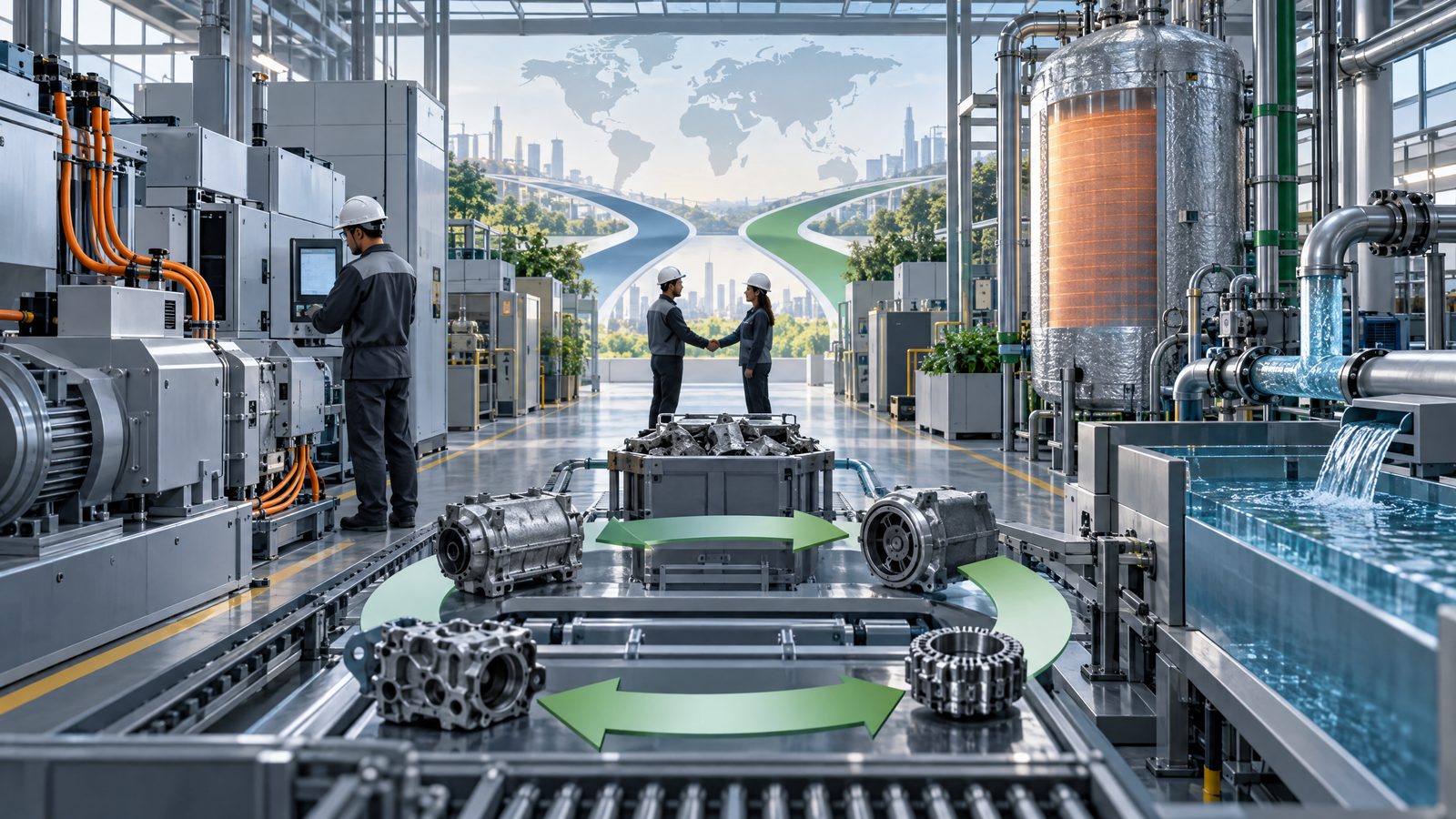
Eligible themes include flexible industrial electrification, technologies for industries that are difficult to decarbonise, water efficiency, and circularity, resource efficiency and the bioeconomy. Together, these areas address different parts of an industrial site’s environmental footprint: the energy used to make products, processes for which emissions are harder to eliminate, water consumed in production, and materials or by-products that might be recovered and reused.
For manufacturers, the significance is that the call covers more than switching a single machine. Electrification projects may need to work with a site’s existing production demands; hard-to-abate technologies must be suited to processes that cannot readily move away from conventional fuels; and water or circularity projects need to function within industrial operations. The published challenge areas provide a route for companies and cross-border partners to frame such proposals, although the announcement does not promise that any particular technology or application will receive funding.
Capital projects and a predecessor scheme
Invest NI’s programme information describes the challenge fund as supporting innovative capital projects valued above £5 million. That threshold points towards substantial site investment rather than small advisory assignments. It is a project-value threshold, not a statement that every applicant will receive a grant of that size or that the full project cost will be reimbursed. Businesses need to check the applicable application route and current detailed criteria with the relevant agency before committing expenditure.
The new call follows the €20 million Shared Island Sustainability Capital Grant awards made in December 2025. The agencies say those awards had leveraged €63.5 million in private-sector funding for decarbonisation capital investment. That figure is a reported amount of private finance associated with the earlier scheme; it is not an outcome already achieved by the newly opened challenge fund. The two programmes should not be confused: the current fund is a distinct application call focused on collaborative, first-of-a-kind projects.
A cross-border model for industrial investment
The arrangement combines equal jurisdictional allocations with joint delivery, while the contribution structure leaves each side’s national enterprise agency responsible for its own €3 million element. It creates an incentive for businesses to develop projects with relevance beyond one site or one market, but the all-island purpose does not remove the need to meet the rules of the relevant funding route. Potential applicants should establish which agency handles their application, what evidence it requires and how project costs must be treated.
For the wider economy, the test will be whether funded demonstrations can show measurable environmental improvements while remaining workable for production businesses. The call identifies decarbonisation, water use, resource efficiency and bioeconomy applications, alongside a requirement for innovative industrial projects. Its contribution is therefore both financial and practical: helping firms address the capital burden of testing new methods under real operating conditions, with the prospect that successful approaches could inform wider industrial practice across the island.







