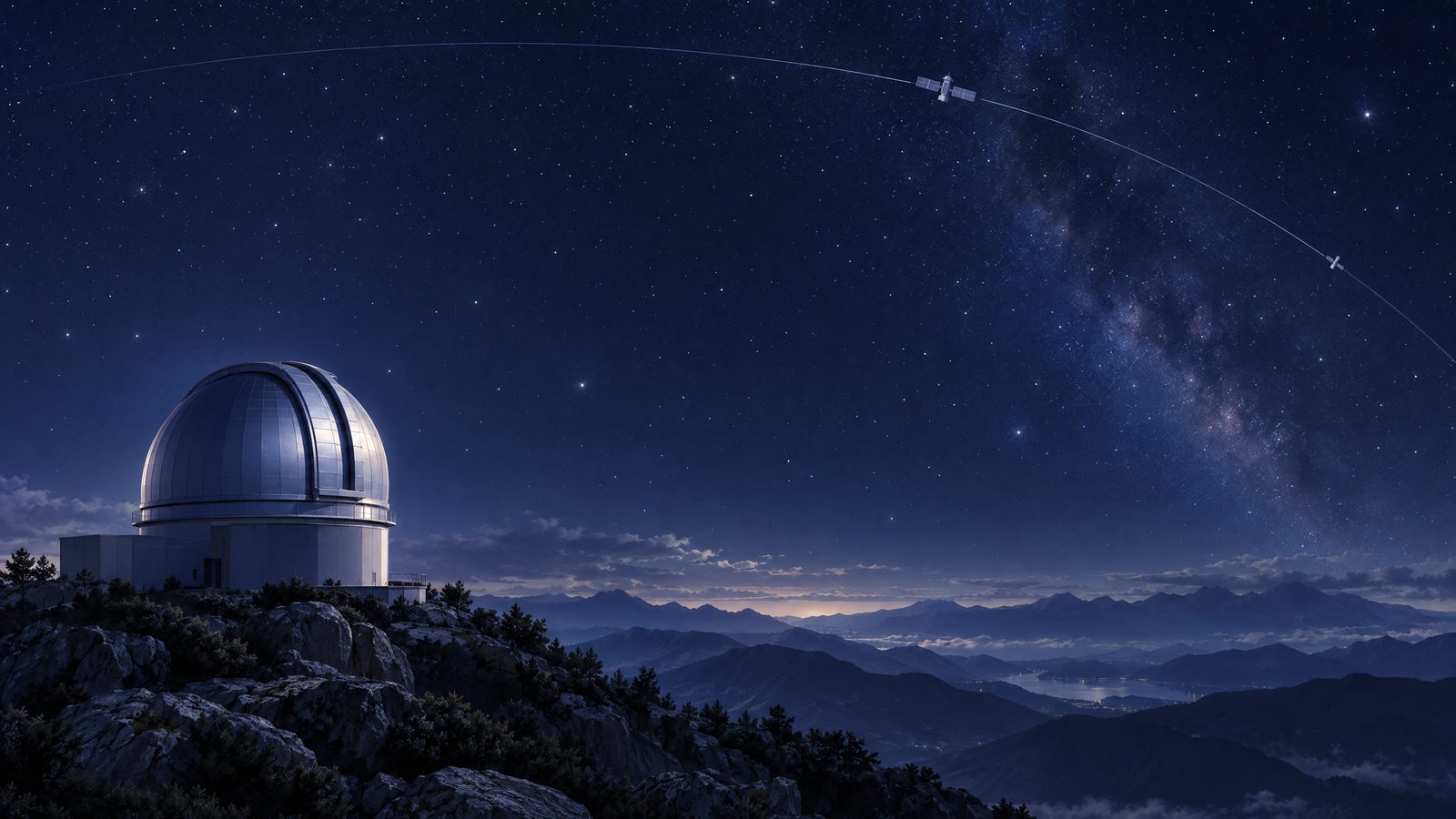

The European Space Agency and the International Astronomical Union’s Centre for the Protection of the Dark and Quiet Sky from Satellite Constellation Interference have signed an agreement to work together on reducing the effects of satellites on astronomy.
The agreement was signed during the third day of the International Astronautical Congress in Antalya, Türkiye. ESA’s account of the day describes it as a Memorandum of Understanding. A separate ESA explainer calls it a Memorandum of Intent; the public announcement does not set out the instrument’s detailed terms, so the practical scope described by the agencies is clearer than its formal label.
What the cooperation is intended to address
The agencies identify two principal sources of interference as satellite numbers in orbit grow: sunlight reflected from spacecraft and radio-frequency emissions from satellite electronics. Reflected light can leave bright trails across telescope images, disrupting observations of faint, distant objects. Radio emissions can interfere with the sensitive receivers used by radio astronomers.
These effects matter across different kinds of astronomical observation. Optical telescopes can be affected by visible streaks, while radio observatories seek signals across the electromagnetic spectrum. The agreement is intended to help the two organisations identify practical solutions that allow scientific observations and space activity to continue alongside one another.
ESA says it will contribute technical expertise and strengthen engagement with industry. The stated areas of work include developing technologies, encouraging dialogue between astronomers and satellite operators, and promoting practices that could reduce interference. The announcement does not specify a timetable, binding requirements for satellite operators, funding, or numerical targets for reducing brightness or radio emissions.
Design choices on Earth can affect observations in orbit
ESA’s technical account places part of the response at the spacecraft design stage, before launch. It identifies darker exterior surfaces as one possible way to reduce unwanted reflections. Radio-quiet electronics and modelling tools that help engineers anticipate how a satellite will appear to telescopes are also cited as areas for development.
Those measures address different problems and are not presented as a single fix. A less reflective surface could reduce the light reaching a telescope, while changes to onboard electronics could limit unintended radio emissions. Modelling could help designers assess potential effects in advance. The agency’s description leaves open which approaches will be taken forward, and does not claim that the cooperation has already delivered technical changes.
The IAU centre brings together astronomical institutions, observatories, researchers, companies and members of the public concerned with satellite interference. ESA’s contribution, as described in its account, is to add engineering expertise and work more closely with industry. The partnership is therefore framed as coordination between the astronomy and space-operations communities rather than as a newly announced regulatory regime.
A growing challenge for astronomy
Large satellite constellations have increased the number of spacecraft visible from the ground, particularly around twilight when sunlight can illuminate satellites above the observer’s horizon. For astronomers, a bright moving object can cross an exposure and obscure or complicate the measurement of a much fainter source. Radio astronomy faces a separate challenge because receivers are designed to detect weak signals.
The consequences extend beyond research images. ESA says astronomers use uninterrupted observations to investigate the origins of the Universe, search for potentially habitable worlds and track near-Earth asteroids. The agency also describes dark skies as cultural and natural heritage, noting that some animal species depend on natural night-time conditions for navigation.
The stated aim of the agreement is to balance expanding use of space with continued access to the night sky for science and public enjoyment. Its practical value will depend on the solutions developed and adopted through the cooperation. The announcement establishes that ESA and the IAU centre have agreed to work together; it does not announce an immediate change to satellite operations or guarantee that interference will be eliminated.