


Introduction
Across the UK, from bustling food markets to Michelin-starred dining rooms, one clear trend is reshaping the foodservice industry: the rapid adoption of compostable tableware. As both regulators and diners demand more sustainable, toxin-free solutions, compostable packaging and utensils are becoming the new standard—transforming everything from street food bites to elegant restaurant experiences.
1. UK’s changing food culture: The rise of on-the-go and premium experiences
The British food scene has always celebrated diversity, creativity, and innovation. In recent years, two trends have dominated:
-
Street food and pop-up markets have surged in popularity, making quick, convenient, and authentic bites part of everyday life.
-
Fine dining and premium casual have elevated the standards of presentation and sustainability, even for takeaway and delivery.
With busy lifestyles and a growing focus on convenience, packaging has become central to how food is consumed. Today’s British consumers expect more than just great taste—they want food served in packaging that matches their values of health, ethics, and environmental care.
2. The sustainability imperative: Policy, public pressure, and market trends
Regulation is leading the charge. The UK’s 2024 single-use plastics ban has forced both small and large foodservice operators to rethink their approach to packaging. European Union green directives and Scotland’s pioneering single-use ban have set further benchmarks.
But regulation is only part of the story.
-
Surveys show over 70% of UK consumers prefer restaurants and food brands with a clear sustainability commitment.
-
Social media campaigns such as #PlasticFree and #EcoDining are amplifying the conversation and raising consumer expectations.
-
Leading supermarkets and food delivery giants are now requiring suppliers and restaurant partners to use compostable or recyclable packaging.
The message is clear: sustainability is no longer a marketing slogan—it’s a business imperative.
3. Compostable tableware 101: What, how, and why
3.1 What counts as compostable?
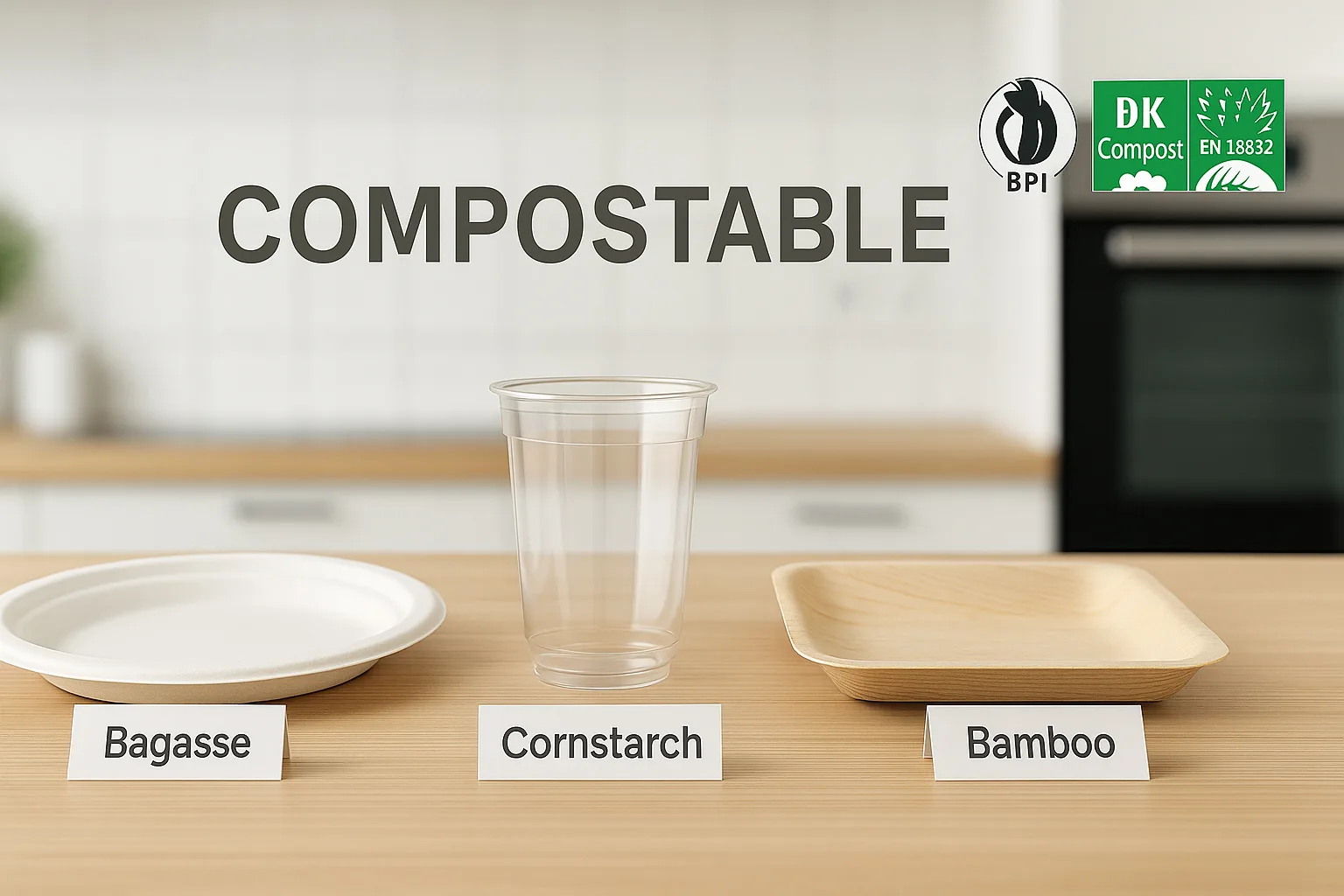
Compostable tableware refers to items made from plant-based materials—such as bagasse (sugarcane fibre), cornstarch, bamboo, or palm leaf—that break down into natural elements under the right composting conditions.
-
Key certifications include BPI, OK Compost, EN13432, and ASTM D6400.
-
Unlike “biodegradable” (which can be vague), compostable means products disintegrate and decompose safely and fully, leaving no toxic residues.
3.2 Material advantages
Compostable tableware brings clear benefits:
-
Food safety: Free from BPA, PFAS, heavy metals, and other toxins.
-
Environmental impact: Low carbon footprint, rapid decomposition, supports circular economy.
-
Versatility: Suitable for both hot and cold foods, resistant to oils and liquids, microwave and freezer friendly.
-
Custom branding: Supports stylish presentation and bespoke logo printing, aligning with modern brand standards.
4. From markets to Michelin: Real-world adoption across the spectrum
4.1 Street food pioneers
London’s Borough Market, Manchester’s Food Festival, and other iconic venues have seen vendors embrace compostable packaging en masse.
-
Street food traders report that green packaging attracts younger, eco-aware customers and improves their brand image.
4.2 Fine dining innovators
High-end restaurants, including several Michelin-starred venues and groups like Dishoom and Dabbous, now serve takeaway and delivery meals in compostable containers—proving that sustainability and quality can coexist.
-
Chef testimonials confirm: “Sustainability is not just a value add—it’s a core part of our competitive advantage and customer promise.”
4.3 Major delivery & retail adopters
Brands such as Deliveroo, Just Eat, Waitrose, and Tesco have all launched initiatives to make compostable tableware the norm for their partners.
-
These programs offer bulk purchasing, supplier partnerships, and customer education to ensure smooth adoption across the industry.
5. The role of leading suppliers: Bioleader® and industry innovators
Companies like Bioleader® from China, a biodegradable tableware manufacturer, are at the forefront, supplying restaurants, caterers, and retailers with:
-
Compostable trays and cups

All products meet strict food safety and compostability standards, and many carry international and UK certifications.
Bioleader® and other innovators also offer custom branding, bulk order support, and compliance consulting, helping restaurants of all sizes make a seamless switch.
6. Overcoming challenges: Cost, supply, and consumer education
Despite its advantages, compostable tableware adoption faces some hurdles:
-
Higher initial cost compared to traditional plastics
-
Supply chain integration—securing reliable sources of certified products
-
Consumer awareness—educating customers on how to dispose of compostable items properly
Successful operators are overcoming these barriers by:
-
Forming buying co-ops to achieve better pricing
-
Working with suppliers to ensure quality and reliable delivery
-
Implementing clear labelling and in-store signage to guide customers
7. What’s next: The future of compostable tableware in the UK
The future looks bright:
-
New innovations are making compostable materials even more functional—offering better heat resistance, water resistance, and visual appeal.
-
Regulations are expected to tighten further, making sustainable choices even more necessary.
-
Industry leaders, consumers, and policy-makers are working together to build infrastructure for composting and recycling, closing the loop for truly circular foodservice.
Conclusion
From bustling food trucks to elegant dining rooms, compostable tableware is fast becoming the gold standard in the UK.
It reflects a new era of British food culture—one where convenience, quality, and environmental responsibility go hand in hand.
As more brands and consumers embrace this change, the UK is poised to lead the world in green dining innovation.
FAQ
1. What is compostable tableware and how is it different from biodegradable products?
Compostable tableware is made from plant-based materials that break down fully into natural components in composting conditions, leaving no toxic residue. “Biodegradable” can be less specific and may not guarantee complete or safe decomposition.
2. Which materials are most common for compostable tableware in the UK?
The most popular materials include bagasse (sugarcane fiber), cornstarch-based bioplastics (such as PLA), bamboo, and palm leaf. All are plant-derived and certified for food safety and compostability.
3. Are compostable plates and cutlery safe for hot foods and liquids?
Yes, most certified compostable tableware is designed to handle hot and cold foods, as well as oils and sauces, without breaking down or leaching harmful chemicals.
4. How do I know if packaging is genuinely compostable?
Look for certifications such as BPI, OK Compost, EN13432, or ASTM D6400. Reputable suppliers and brands will display these labels and provide information on correct disposal.
5. Does switching to compostable tableware help reduce environmental impact?
Absolutely. Compostable tableware significantly lowers landfill waste, reduces carbon emissions, and helps close the loop through composting and soil regeneration.
6. Why are both street food vendors and fine dining restaurants adopting compostable solutions?
Both segments face regulatory pressure and changing consumer expectations, and both see compostable tableware as a way to enhance brand image, comply with the law, and serve food responsibly.
7. What are some challenges when moving to compostable packaging, and how can they be solved?
Common challenges include higher costs and supply logistics. Solutions include bulk buying, choosing trusted suppliers, clear customer education, and government support or incentives.
References
-
Wrap UK (2024), “The UK Plastics Pact: Annual Report.” https://wrap.org.uk/resources/report/uk-plastics-pact-annual-report
-
Ellen MacArthur Foundation, “Circular Economy in the Food Sector.” https://ellenmacarthurfoundation.org/topics/food/overview
-
Defra (2024), “Single-use Plastics Ban Guidance for Businesses.” https://www.gov.uk/guidance/single-use-plastics-ban-2024
-
BBC News (Reporter: Helen Briggs), “Single-Use Plastic Ban Comes into Force in England.” https://www.bbc.com/news/science-environment-66908758
-
The Guardian (Author: Sarah Butler), “Waitrose Launches Reusable and Compostable Packaging.” https://www.theguardian.com/business/2024/jan/12/waitrose-reusable-compostable-packaging
-
Foodservice Footprint (Writer: Nick Hughes), “How Foodservice is Tackling Packaging Waste.” https://www.foodservicefootprint.com/foodservice-tackling-packaging-waste/
-
Packaging Europe (Author: Tim Sykes), “Bagasse: The Future of Compostable Packaging?” https://packagingeurope.com/features/bagasse-the-future-of-compostable-packaging/6732.article
-
Soil Association, “Compostable Packaging: Pros and Cons.” https://www.soilassociation.org/take-action/organic-living/compostable-packaging/
-
Bioleader®, “About Us: Compostable Food Packaging.” https://www.bioleaderpack.com/about-us/
-
BPI Certification, “Find Certified Compostable Products.” https://bpiworld.org/Find-Certified-Products
-
EN13432 Standard (European Bioplastics), “Compostability Certification.” https://www.european-bioplastics.org/standards/certification/







