
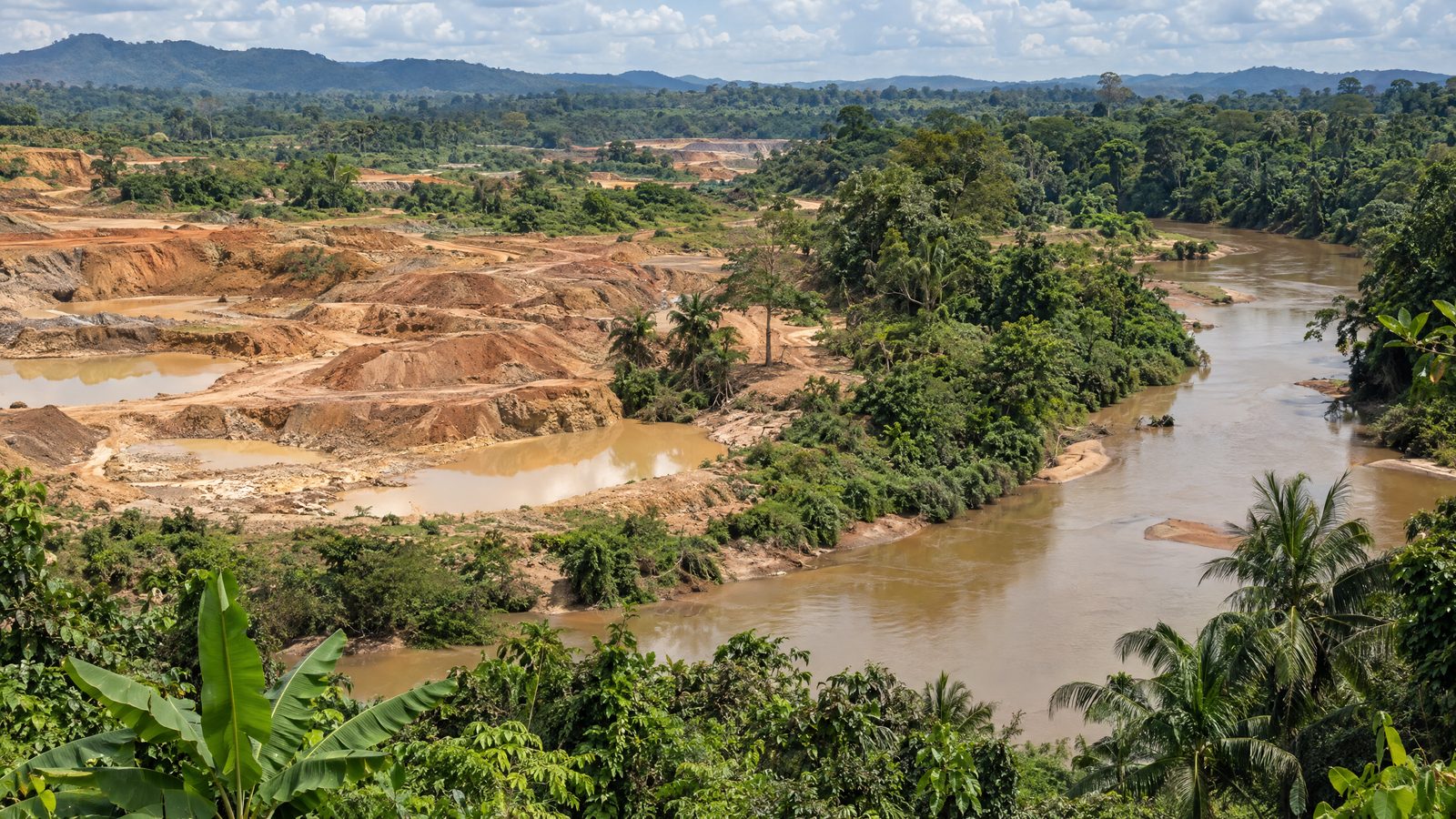

Ghana’s Lands Minister has called for district-level coordination against illegal mining and for damaged sites to be restored, putting local authorities at the centre of the proposed response. Emmanuel Armah-Kofi Buah made the appeal at a conference of regional ministers and local government leaders in Kumasi on 2 November 2026.
The minister proposed that every mining-affected local assembly establish or strengthen a coordination mechanism bringing together local departments, regulators, security agencies and community representatives. The proposal concerns areas affected by mining; it does not establish that a new taskforce has already been formed in each district.
Buah also urged regional ministers and local chief executives to meet within 30 days to identify illegal-mining hotspots, threatened water bodies and abandoned pits needing attention. The purpose of the meetings would be to set priorities and coordinate lawful action, rather than to provide proof that the identified sites have been cleared or repaired.
Separately, local government minister Mahama Ayariga directed leaders in mining-prone districts to submit reports to his office within 30 days, identifying affected sites and communities. His request for reports and Buah’s proposed local meetings are distinct steps in the conference response.
How local coordination would work
The national anti-illegal-mining operations secretariat already has a role in coordinating and leading field operations. Buah said local assemblies should support such work with local information, community engagement, logistical coordination within their lawful capacity and follow-up monitoring. He also named the police and armed forces as enforcement partners.
Ashanti regional minister Frank Amoakohene raised the question of communication between those conducting security operations and district leaders. He cautioned against operations taking place without the local chief executive’s knowledge and called for clearer contact arrangements so local authorities could support the response.
Restoring damaged land
The appeal went beyond stopping active mining. Buah asked local authorities to pay attention to land and water bodies already damaged, warning that abandoned pits could put children, farmers, livestock and others at risk. He promoted tree planting, stabilising soil, restoring riverbanks and treating disused sites safely to approved technical standards.
He also urged district leaders to seek restoration by those responsible for damage, rather than rely only on central government support. That is a call for local action and accountability, not evidence that responsibility has been established at any particular site or that reclamation has been completed.
Mining, livelihoods and pollution
Buah encouraged assemblies to help prospective miners understand the authorisations required and to explain approved options, including cooperative mining, where available. Small-scale mining is not synonymous with illegal mining: the issue addressed by the conference is activity carried out outside the applicable rules.
The distinction matters for livelihoods. In 2023, Ghana’s wider artisanal and small-scale mining sector was estimated to employ around one million people directly. That estimate covered the wider sector, not just illegal operators, and is not a current count of people working unlawfully.
A project launched in Ghana in 2023 aimed to support formalisation, improve access to finance and encourage gold production without mercury. The initiative was planned for 2022 to 2027. Those were project aims and a planned period, not a measure of how many miners have since changed their practices.
Mercury is used in some small-scale gold processing to bind gold particles, but it is toxic and can enter the environment. Once released, it can accumulate in food chains. Its use is therefore a concern for both people working around mining and communities exposed to contaminated land or water.
The proposed approach leaves practical questions about local capacity and implementation, including how many coordination mechanisms are already operating, what resources each assembly will receive and which damaged sites might be restored first. The conference call does not itself mean that a particular site has been reclaimed.







