The science and art of dental implant surgery have never been in better harmony. In order to be successful, over the decades, it relied more on the experience of the clinician, perception of space, and the capability of converting a two-dimensional image into a three-dimensional reality. Things are not that way today. CAD/CAM technology has been used to guide dental implant surgery, transforming the way in which implants are planned and placed. Neither dramatic nor excessive, but touching. Measurement of accuracy is now possible, predictability and repeatability can be achieved, and patient outcomes can now be more predictable and satisfying.
From Visual Guesswork to Digital Planning
The implants were placed using a conventional method that was largely performed with reference to the study models, radiographs, and hand-drawn surgical models. These strategies were successful in most cases, but they were also marked by some weaknesses. The phase of converting flat images into complex anatomy introduced a contributing error and was most inaccurate in patients who are completely edentulous, or in aesthetically demanding ridges such as the anterior maxilla.
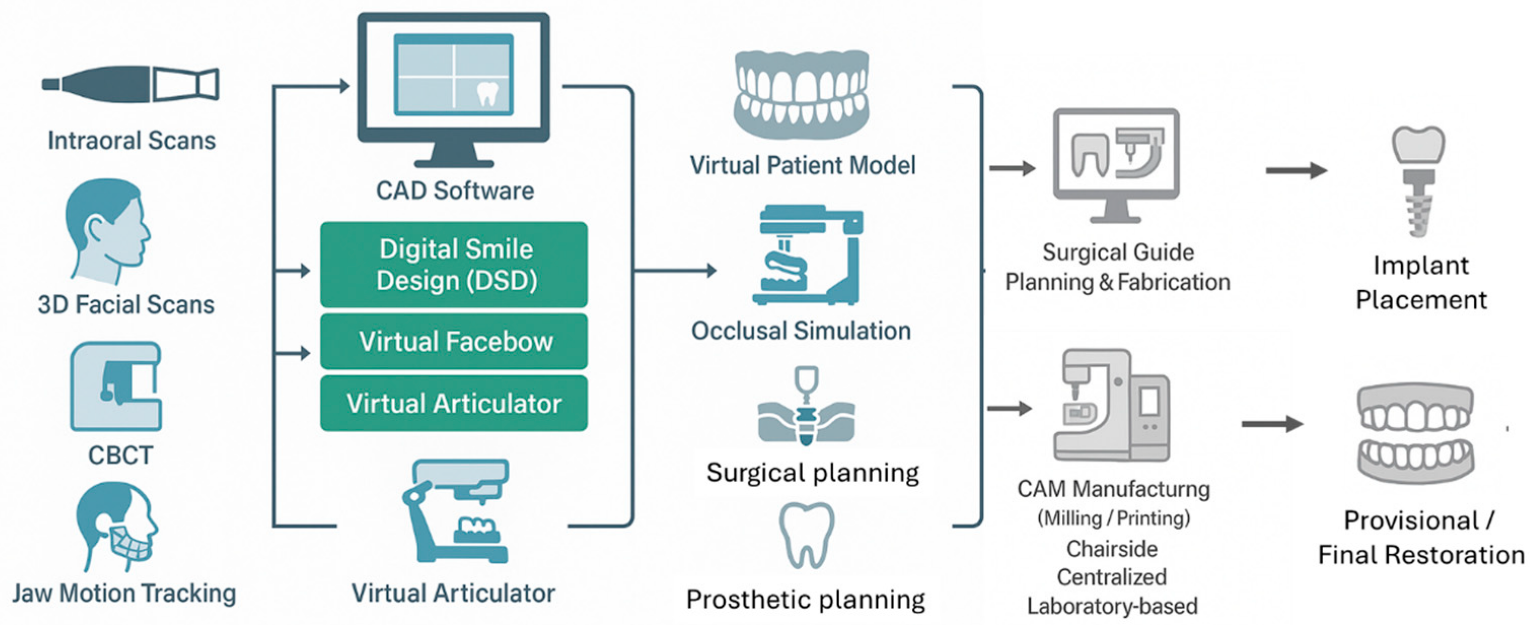
Online planning has the effect that even the very act is initiated long before the day of surgery. Surface scans and cone beam imaging create a full virtual image of a patient. The implants are placed with computerised understanding, in a comprehensive way, of the size of the bone, the anatomical structures, and the purpose of the prosthetic. This qualitative attribute of this type of prosthetic means that it is the ultimate restoration, which determines the plan of the operation, and not that the prosthesis is forced to adapt in the future.
CAD / CAM Surgical Guides and Surgical Accuracy
After the virtual plan is finalised, the information is translated into a physical surgical guide with the help of CAD/CAM technology. These are implant guides that fit anatomically into the patient and are used to control the angulation, depth, and position of the implants. The output of this process is the direct application of the digital plan to the clinical setting.
Guided surgery can achieve a plausible degree of spatial accuracy that is not easily obtained with the freehand technique in problematic situations, such as full edentulism or severe ridge deformities. The visual examination of the surgeon might not provide ideal emergence profiles, implant positioning, or optimum spacing. Rather, it is the operation that is accurate. It has been reported that guide fabrication and deviation in imaging are insignificant and can be accepted according to clinical standards, and this confirms the uniformity of the method.
Predictability Through Structured Workflows
Implant dentistry is not predictable only due to accuracy. It takes into account the outcome of the surgery, compatibility of the prosthesis, and reduced uncertainty at the intraoperative phase. Guided implant surgery is one of the most systematised working processes, with few unforeseen events. The imaging process, which passes through the fabrication process, and then the insertion of the implants, is done in a sequence.
Orders placed on patients with edentulism permit the management of bone loss, optimum vertical distance between the prostheses, and positioning of tilted implants where necessary to avoid anatomical structures. It is an anticipated procedure that will conserve time during operations and enable complex full-arch restorations to be performed more easily. Having such a close relationship between planning and execution, the results will be more predictable, both in the context of patients and clinical situations.
Enhancing the Patient Experience
Technology may be associated with numbers and measures, but the value of technology is experienced by the patients. Implant-guided surgery helps in supporting minimally invasive techniques and flapless surgeries in appropriate instances. The mild forms of tissue trauma can be translated into decreased postoperative pain and accelerated recovery.
In the case of instant restoration processes, digital instructions may also be provided. As the implants are placed at the same site where the prosthetic is to be placed, there is no longer the fear of providing immediate, complete dentures or overdentures. Patients are cared for with reduced frequency, greater comfort, and restored functional and esthetic functions more rapidly. The evidence, in the case of follow-up assessments, is more likely to show the following attributes: good aesthetics, good patient acceptance, and a stable biological environment.
Integrating Static and Dynamic Guidance
The new online processes demonstrate that the application of static guides and dynamic navigation are complementary and do not incur competition with each other. Physically, static CAD/CAM guides offer both stability and spatial control to more dynamic systems that provide visual feedback in the operating room. This combination technique can be used to great effect to improve accuracy in performing numerous step processes, including extractions, bone reduction, and immediate implant placement.
It is a more general process of digital dentistry integration. Clinical judgment is not being replaced by technology. It is imposed with more precise information, reduced visualisation, and more realistic implementation.
Understanding the Limits While Embracing the Benefits
There is no restriction to guided implant surgery. The digital functions require high-quality imaging, precision in information melding, and accurate guide positioning. Mistakes in the process can affect the final outcome. Additionally, guided surgery calls upon the practitioner to be trained in conventional implant dentistry to handle unforeseen circumstances with deviations.
The net benefits, however, are not to go unnoticed. As prices have been lowered and digital tools have become more accessible and dynamic in nature, guided implant surgery itself is a field that is continuously changing its state, moving beyond a practice that is offered and into a practice that is a given.
A New Standard for Precision and Confidence
Directed dental implant surgery is one of the greatest changes in patient care, the foundation of which is CAD/CAM. It substitutes the estimating process with planning, uncertainty with regularity, and variability with order. It provides performance guarantees to clinicians. It provides efficiency and reliability to patients. It is a revolution on the internet, a revolution without a voice, which is gradually creating a new frontier of precision and predictability in the field of implant dentistry.