
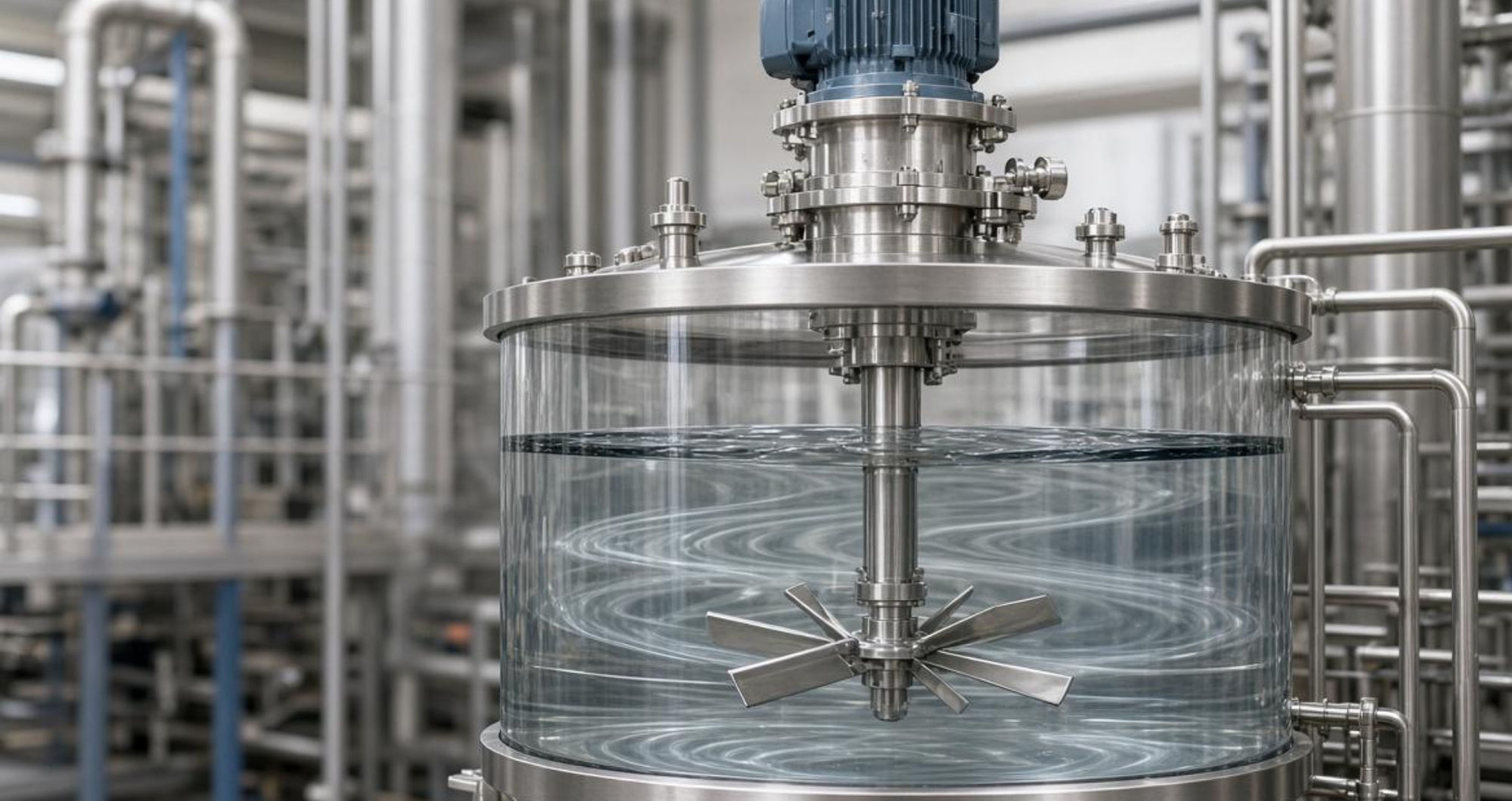

Why Industrial Mixing Deserves More Attention: Industrial mixing can influence batch time, heat transfer, reaction performance, solids suspension, product quality, cleaning, energy consumption, and downstream processing. Yet buyers sometimes select a tank agitator mainly by motor power or price. That approach can create an oversized drive, weak circulation, excessive shear, or poor performance after installation. A more reliable specification begins with the process duty. Engineers need to understand what must happen inside the tank, how the fluid behaves, and which result defines success. The mixer, impeller, drive, shaft, seal, mounting arrangement, and controls can then be treated as one mixing system rather than separate components.
Start With the Process, Not the Motor
The motor rating alone does not describe mixing performance. Two mixers with the same power can produce very different flow patterns because of differences in speed, impeller diameter, blade geometry, off-bottom clearance, tank dimensions, baffles, liquid level, and viscosity. International buyers should therefore provide operating data before requesting a quotation. A useful process brief normally includes:
-
Tank diameter, height, working volume, minimum and maximum liquid levels.
-
Fluid density and viscosity across the real operating-temperature range.
-
Mixing objective: blending, **homogenization**, heat transfer, **solids suspension**, gas dispersion, reaction, or **sedimentation control**.
-
Solid concentration, particle size, settling behaviour, and acceptable mixing time.
-
Operating pressure, temperature, corrosion risk, hazardous-area classification, and cleaning method.
-
Available mounting space, nozzle or flange details, utilities, control signals, and maintenance access.
Side-Entry and Top-Entry Mixers Serve Different Duties
A side-entry mixer is mounted through the tank wall and is commonly evaluated for large storage tanks where bulk circulation, tank-bottom movement, and sedimentation control are important. It can also be useful when the tank roof has limited space. Position and angle matter because the goal is to create circulation through the full working volume without forming stagnant zones or imposing unnecessary hydraulic loads. A top-entry mixer is mounted above the vessel and drives a vertical shaft. It is often considered for process tanks that require blending, reaction, solids suspension, or heat-transfer support. It also provides flexibility for different impellers and multi-level arrangements. Final selection still depends on tank geometry, liquid level, viscosity, shaft length, critical speed, and the required flow pattern.
Buyer Comparison: Selecting the Basic Mixer Configuration
The following comparison is a starting point, not a substitute for process calculations or project-specific engineering. Configuration Common applications Primary strengths Key buyer checks Side-entry Large storage tanks, oil, wastewater, FGD and bulk circulation Compact mounting; effective horizontal circulation; sediment control Nozzle position, installation angle, seal access, tank level, impeller clearance Top-entry Process vessels, blending, reactions, heat transfer and suspension Flexible impeller choice; strong axial or radial flow; multi-level options Shaft length, support, critical speed, baffles, seal, headroom Portable or IBC Totes, drums, small batches and mobile production Easy deployment; suitable for changing containers or recipes Container opening, clamp or bridge, viscosity, duty cycle, lifting and guarding
Impeller Design Determines What the Power Achieves
The impeller converts shaft power into fluid motion. Axial-flow designs generally move liquid parallel to the shaft and can support bulk blending, suspension, and heat transfer. Radial-flow designs discharge outward and may be useful where local turbulence or gas dispersion is required. Pitched blades, hydrofoils, turbines, paddles, anchors, and ribbon-style agitators each address different viscosity and process conditions. Choosing an impeller from a catalogue image is risky. Diameter, blade angle, number of impellers, speed, pumping direction, clearances, and tank internals must be considered together. High speed is not automatically better: it can increase shear, air entrainment, vortexing, vibration, and energy use without improving full-tank circulation.
Use VFD Control for a Wider Operating Window
A variable frequency drive, or VFD, allows the mixer speed to change within an engineered range. This is useful when viscosity changes during heating, reaction, dilution, or cooling; when the tank operates at different levels; or when recipes require different mixing intensity. Controlled acceleration can also reduce starting shock on the drive train. However, a VFD does not correct an unsuitable impeller or poor tank layout. The supplier should define safe minimum and maximum speeds, motor cooling requirements, torque limits, shaft-critical-speed restrictions, and any hazardous-area conditions. Operators also need clear setpoints so speed changes remain connected to measurable process needs.
Monitoring Turns Mixing Into a Manageable Process
London Daily News has explored how digital twins and live system data can help engineers identify inefficiency and equipment wear. Industrial mixing can use the same practical principle without requiring a complex digital project: collect relevant operating data, compare it with expected behaviour, and investigate meaningful deviations. Useful signals may include motor current, power draw, speed, bearing temperature, vibration, seal leakage, tank temperature, level, pH, density, or product-quality measurements. A rising current at the same speed may indicate greater viscosity or mechanical resistance, while increasing vibration can justify a mechanical inspection. Trends are usually more valuable than isolated readings.
Efficiency Means Meeting the Duty With Less Waste
Mixing efficiency should be measured against the required result, not simply the lowest motor rating. An energy-saving mixer that cannot suspend solids or meet batch time is not efficient. Likewise, an oversized unit may consume more power, add mechanical load, and complicate control. The target is sufficient circulation or shear, with a reasonable operating margin, throughout the specified process window. London’s precision-manufacturing discussion highlights how advanced methods can improve consistency and reduce lead times. The same operational logic applies to mixing: repeatable settings, documented recipes, suitable instrumentation, and stable equipment condition can reduce trial-and-error adjustments and variation between batches.
Materials and Seals Must Match the Medium
Wetted materials should be selected according to corrosion, abrasion, temperature, contamination risk, and cleaning requirements. Carbon steel may suit some services, while 304 or 316 stainless steel and other alloys may be considered for corrosive or hygienic duties. A general material name is not enough; buyers should identify which wetted components, fasteners, shaft, impeller, and seal parts use the specified grade. Seal selection depends on pressure, temperature, speed, solids, lubrication, and leakage limits. Buyers should confirm the seal type, face materials, elastomers, support system, replacement method, and availability of wear parts. Maintenance access should be reviewed before surrounding pipework is finalised.
How International Buyers Should Evaluate a Supplier
A credible supplier evaluation should focus on engineering evidence and order control rather than broad claims. Ask how the proposed duty was calculated, what assumptions were used, and which operating conditions define the design limits. Review drawings, data sheets, motor and gearbox information, impeller geometry, shaft calculations where relevant, seal arrangement, materials, coatings, and control requirements. Before placing an order, buyers should agree on:
-
Approved general-arrangement drawing and connection dimensions.
-
Motor voltage, frequency, efficiency class, protection level, and hazardous-area requirements.
-
Material certificates or inspection documents required by the contract.
-
Run-test scope, vibration or noise checks, balance requirements, and inspection records.
-
Painting, rust protection, packaging, lifting points, shipping marks, and spare-parts list.
-
Installation instructions, commissioning support, technical documentation, warranty terms, and response process.
Frequently Asked Questions
Can motor power alone be used to compare industrial mixers?
No. Power must be considered with speed, impeller design, tank geometry, fluid properties, liquid level, mixing objective, and mechanical design. Equal motor ratings do not guarantee equal process performance.
When is a VFD worth specifying?
A VFD is useful when operating conditions or recipes require different speeds, when controlled starting is beneficial, or when process optimisation depends on adjustable mixing intensity. The safe speed range must be engineered.
What information should be sent with an RFQ?
Provide tank drawings, operating volume, fluid properties, temperature and pressure, mixing objective, solids data, materials, seal requirements, utilities, controls, hazardous-area details, destination, documentation needs, and project schedule.
Conclusion
Smarter industrial mixing begins with a precise process definition. When tank geometry, fluid behaviour, impeller design, mounting, materials, seals, VFD control, monitoring, and maintenance are considered together, buyers can make a more defensible equipment decision and improve the likelihood of consistent operation.
When comparing equipment options, buyers should assess each proposed configuration against the actual process duty rather than relying on motor size, catalogue specifications, or general supplier claims. Reviewing engineering calculations, materials, testing requirements, documentation, maintenance access, and long-term operating conditions can help procurement teams select equipment that is appropriate for the application and practical to operate.







