
By Murat Tuarchiev, Operational Management and Strategic Scaling of Multi-Format B2C Retail Enterprises
Macroeconomic Drivers: Rising Rental and Logistics Costs
Retailers can no longer rely on growth driven solely by opening new stores and expanding retail space. Rising rental and facility operating costs are forcing companies to find ways to use every square meter more efficiently. One option is to integrate FMCG, pharmaceuticals, and Non-Food within a single space. However, this model requires more than simply expanding the product range; it calls for a fundamental reassessment of retail organization, logistics, and inventory management.
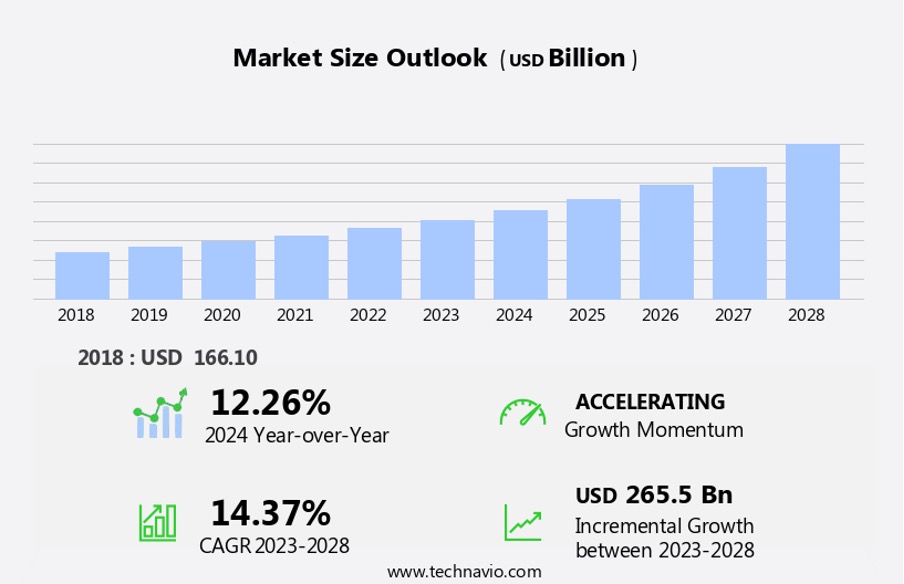
Rental costs in prime retail locations are rising amid a limited supply of high-quality premises and competition for customer traffic. At the same time, the global retail logistics market is growing: according to Technavio’s forecast, it is expected to expand at an average annual rate of 14.37% between 2023 and 2028. Under these conditions, efficient in-store operations become particularly important, as industry research suggests that they may account for up to half of a retailer’s logistics costs.
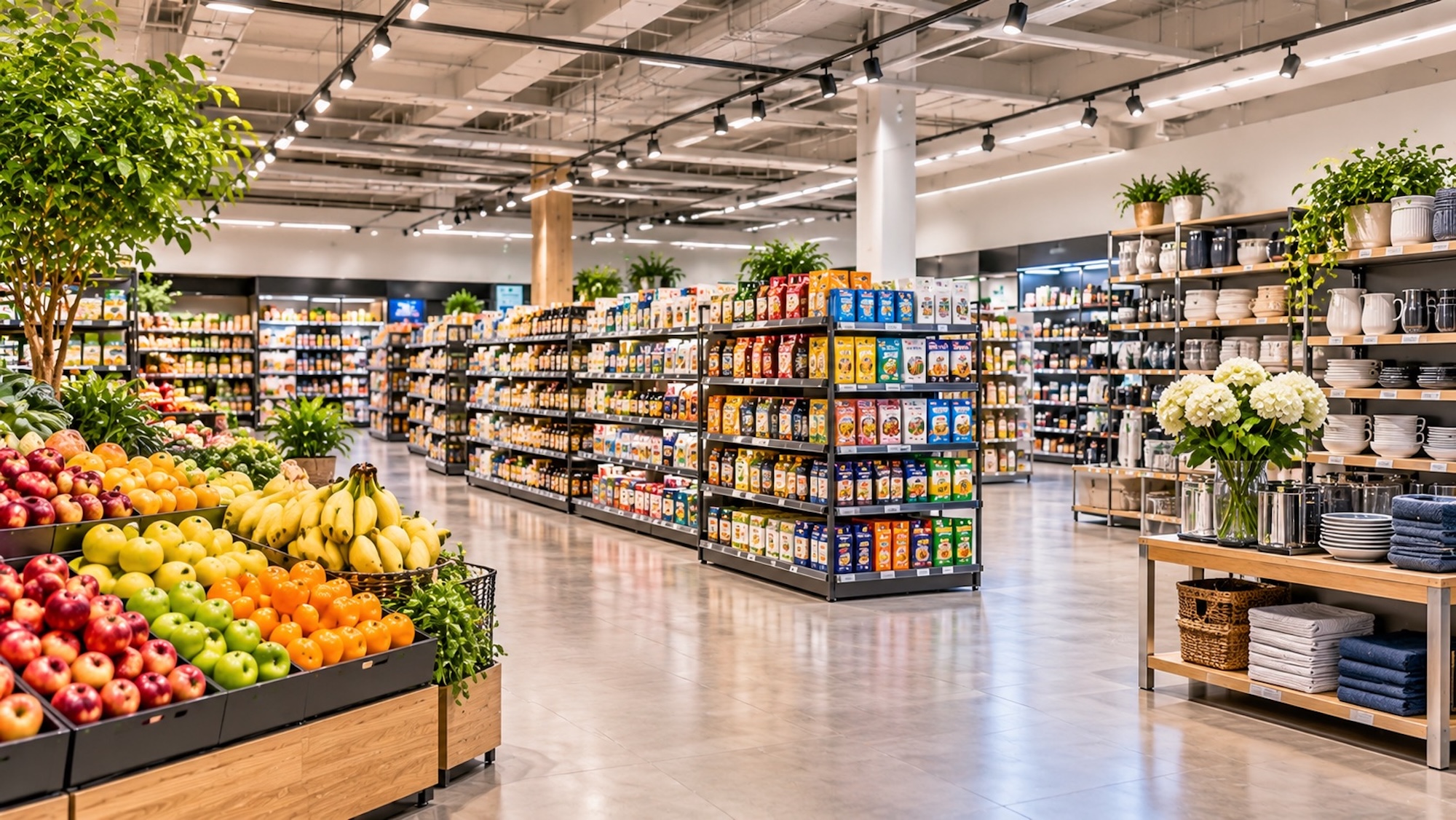
Integrating FMCG, pharmaceuticals, and Non-Food makes it possible to use retail space more efficiently, attract customers across different product categories, and reduce overall operating costs.
Operational Conflicts: Why Three Formats Are Difficult to Integrate
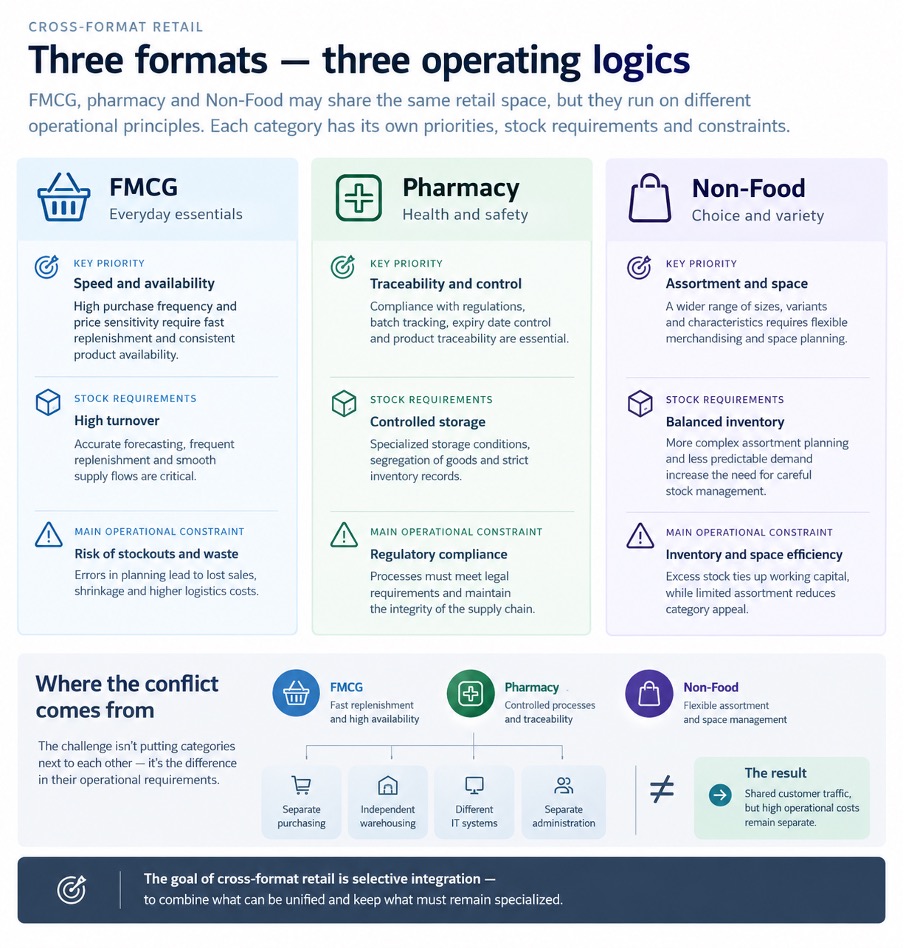
Integrating FMCG, pharmaceuticals, and Non-Food within a single retail model requires aligning fundamentally different operational processes. These categories differ in purchase frequency, product storage requirements, inventory management, merchandising, and quality control. Therefore, sharing the same retail space does not, in itself, ensure operational integration.
FMCG: Speed and Replenishment Accuracy
In FMCG, efficiency depends on inventory turnover, product availability, and service speed. Frequent purchases and fluctuations in demand require accurate forecasting, timely shelf replenishment, and prompt receipt of deliveries. Planning errors lead to product shortages, write-offs, and higher logistics costs.
Pharmaceuticals: Traceability and Control
Pharmaceutical retail is subject to specific requirements regarding storage conditions, batch tracking, expiry-date monitoring, and product traceability. These processes must comply with applicable regulations and be supported by specialised procedures. Integration with other categories is possible, but it must not compromise the safety of pharmaceutical handling.
Non-Food: Assortment and Inventory Management
In the non-food category, assortments often feature a wide variety of sizes, product variants, and specifications, while demand for individual items is less regular. This complicates purchasing planning and the allocation of retail space. Excess inventory increases working capital requirements, whereas an insufficient assortment reduces the category’s appeal to customers.
Where the Conflict Arises
The main challenge lies not in the proximity of the categories, but in the differences between their operational requirements. FMCG depends on timely replenishment and the continuous availability of high-demand products; pharmaceutical retail requires process control and product traceability; Non-Food retail calls for a flexible assortment and effective retail space management. If each format retains its own purchasing, warehousing, IT systems, and administrative infrastructure, integration remains primarily commercial. The company benefits from shared customer traffic, but a substantial portion of its operating costs remains separate.
The objective of cross-format retail, therefore, is to determine which processes can be standardised and consolidated and which must remain specialised. This balance determines whether a unified model becomes a source of operational efficiency or merely a combination of several formats under one roof.
Solutions: Four Levels of Integration
An effective cross-format model integrates shared processes while preserving the specialised requirements of each category. Integration is built on four levels.
Spatial Engineering
The layout must account for customer shopping patterns, assortment, and storage requirements. FMCG generates regular customer traffic, while pharmaceuticals and Non-Food expand the product offering. At the same time, medicine storage requirements must be met, and pharmacy licensing requirements must be observed.
Logistics Engineering
Shared warehousing and administrative processes help reduce duplicated costs. However, the storage and handling of pharmaceutical products require separate control procedures. In an omnichannel model, systems coordinate the picking of products across different categories and combine them into a single order.
Digital Engineering
An integration layer brings together sales, inventory, financial, and customer data while preserving specialised accounting systems. This integration enables consolidated analytics, cross-category loyalty programs, and more accurate demand forecasting.
Economic Model
Integration efficiency is assessed using revenue and gross profit per square meter of retail space, operating expense levels, inventory turnover, and the share of cross-category purchases. These metrics should be compared against baseline values to assess the impact of integration while accounting for changes in demand and assortment structure. The key principle is to consolidate processes where doing so reduces costs and maintain separate operational frameworks where required by product-specific characteristics and regulation.
Case Studies: Mistakes and Practical Solutions
Three typical integration scenarios are examined below.
Case 1. The Cost of Late-Stage Design Changes
When integrating a pharmacy format into a supermarket, requirements for medicine storage, warehouse layout, and access control were taken into account only after the layout had been developed. This required revisions to engineering solutions and internal processes, increasing project implementation costs.
Key takeaway: The requirements of individual categories must be incorporated into the facility’s design before the design process begins. Otherwise, savings achieved through the initial layout may result in additional capital expenditures.
Case 2. Shared Infrastructure Without Standardizing All Processes
A retailer consolidated financial reporting, administrative functions, and customer analytics while maintaining separate systems for accounting and pharmaceutical product storage. This approach made it possible to consolidate business management without extending the constraints of one category to the others.
Key takeaway: Integration should be built around compatible functions and data. A unified management system does not require fully standardized operational processes.
Case 3. Cross-Category Online Orders
Integrating FMCG, pharmaceuticals, and Non-Food into a single online sales channel required coordination of inventory availability, order picking, and order consolidation. At the same time, different product handling requirements were retained within separate operational frameworks.
Key takeaway: A unified customer interface is effective only when supported by a coordinated system for inventory management and order fulfillment. Simply combining product assortments does not guarantee lower logistics costs.
Conclusion
Integrating FMCG, pharmaceuticals, and Non-Food requires not so much a shared retail space as a coordinated operational architecture. Shared administrative, digital, and customer-facing processes help reduce functional duplication, while storage, accounting, and control procedures must reflect the specific requirements of each category. The greatest benefits are achieved when the boundaries of integration are defined at the design stage. The quality of these decisions determines the operational resilience and economic efficiency of the cross-format model.
References
- JLL (2024) Global Retail Outlook 2024. Jones Lang LaSalle Incorporated. https://www.jll.com/en/trends-and-insights/research/global-retail-outlook
- Technavio (2024) Retail Logistics Market Industry Analysis: Global Size, Share, Trends & Forecast 2024–2028. Technavio Research. https://www.technavio.com/report/retail-logistics-market-industry-analysis
- NielsenIQ (2024) Shopper Trends 2024: How Shoppers in Asia Are Redefining Grocery Shopping. NielsenIQ Insights & Analysis. https://nielseniq.com/global/en/insights/analysis/2024/shopper-trends-2024-how-shoppers-in-asia-are-redefining-grocery-shopping/
- NielsenIQ (2024) The 2024 State of Convenience. NielsenIQ Insights & Analysis. https://nielseniq.com/global/en/insights/analysis/2024/the-2024-state-of-convenience/