
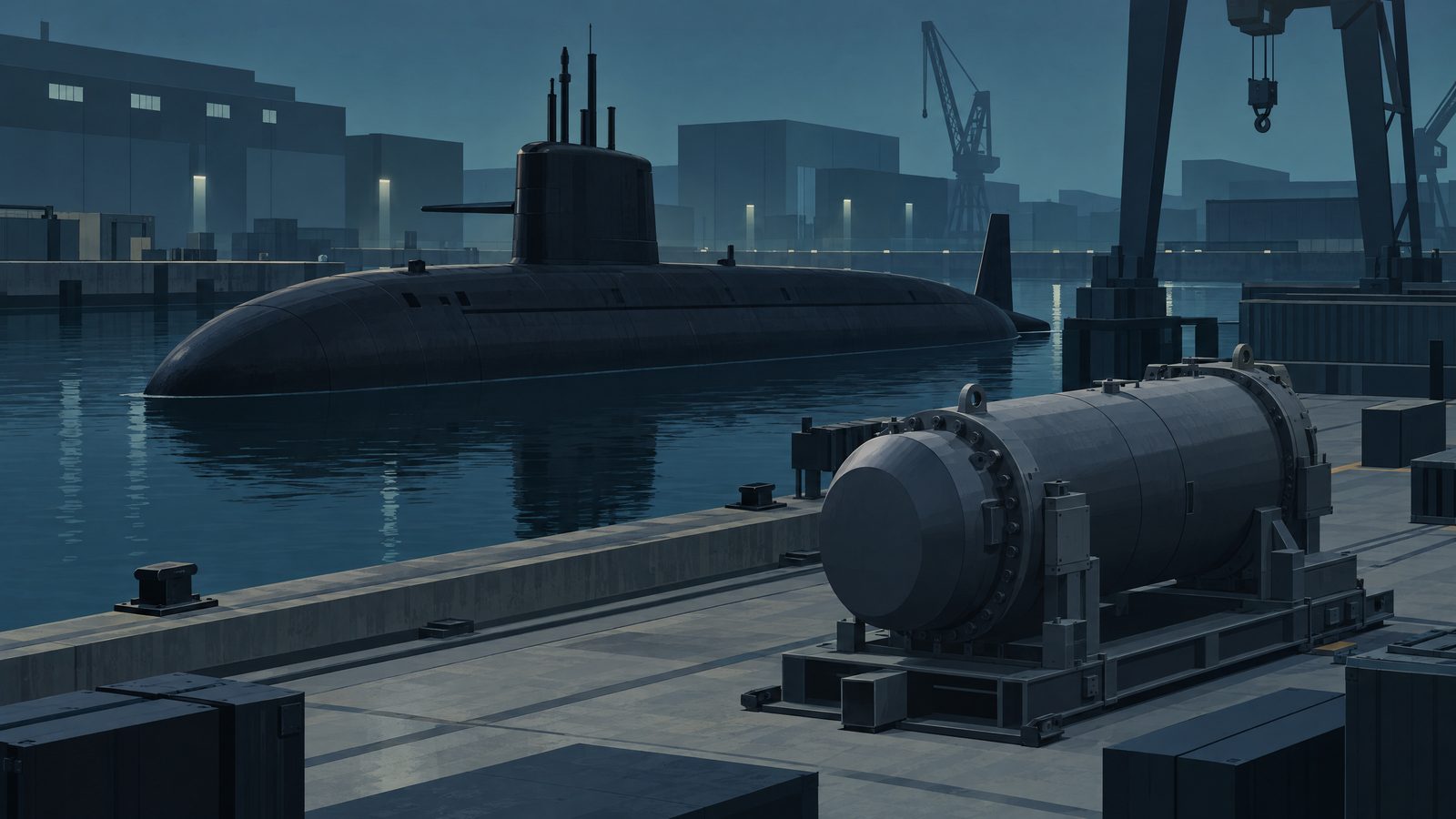

India has opened a new work phase for an indigenous Air Independent Propulsion energy module intended for diesel-electric submarines, marking a further step before the equipment is tested for power production.
The Setting to Work Phase 2 activity was inaugurated on 24 October at a heavy-engineering complex in Hazira, Gujarat. The module has been developed by the Naval Materials Research Laboratory within India’s defence research establishment, with industrial work taking place at the Hazira site.
The work at Hazira provides a point at which the research module has moved into an industrial setting for the next defined process. It does not replace the Navy’s separate technical assessment, which will determine whether the unit can progress to handover. The current phase is therefore part of a controlled development sequence, not a substitute for formal acceptance.
Air Independent Propulsion, often shortened to AIP, is intended to improve the underwater endurance of a diesel-electric submarine by reducing its dependence on atmospheric oxygen. That is the practical purpose of the module now moving through this phase. It does not mean the system has already been fitted to a submarine, entered fleet service or demonstrated a stated endurance gain at sea.
The distinction matters because the programme still has several defined stages ahead. The next phase is due to energise the module for power production, followed by rigorous testing under Indian Navy procedures. Only after those tests is the module expected to be handed to Mazagon Dock Shipbuilders Limited for integration with a Kalvari-class submarine, a step planned for early 2027.
That sequence makes the current development a manufacturing and testing milestone rather than an operational deployment. The inauguration signals that work has reached a more advanced stage on the shop floor, but it is not an announcement that a completed AIP-equipped submarine is ready for patrol. The future handover and integration remain dependent on the testing work still to be carried out.
The project brings together a research laboratory, a heavy-engineering site, a naval customer and the shipbuilder expected to undertake integration. Each has a different role. The research side has developed the module, the industrial phase is progressing its build and preparation, the Navy will apply its test procedures, and the shipbuilder is the intended recipient once the module has met the required standard.
Safety is also an explicit condition in the programme’s next stages. Hydrogen and fuel-cell systems require demanding controls, particularly when equipment is being prepared for use aboard a submarine. The stated timetable therefore sits alongside a requirement to maintain safety standards while the module is energised and evaluated. A planned date for handover should not be read as a guarantee that every test will be completed by then.
The announcement does not give a power output, a precise estimate of additional submerged time, the identity of the boat to receive the module or a date for sea trials. It also does not say that the integration will itself amount to final operational acceptance. Those details may become clearer only as testing, handover and installation progress.
For now, the significance lies in the movement from development towards a defined power-production and validation sequence. If the module passes the required assessments, the planned integration would give India an indigenous AIP system for a Kalvari-class submarine. Until then, the 24 October milestone is best understood as a controlled step in a longer programme, with performance and readiness still to be established through testing.







