
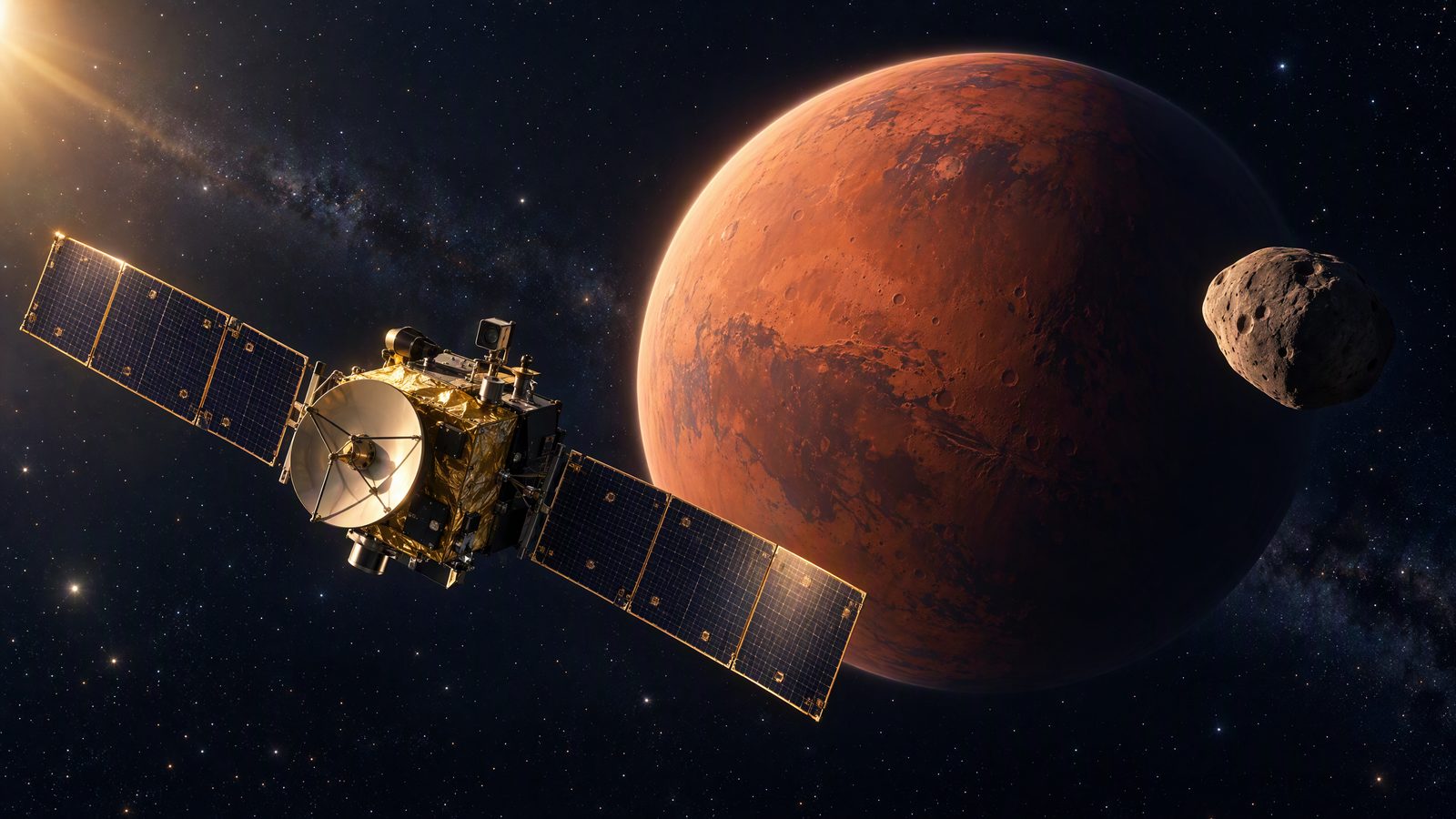

Japan’s Martian Moons eXploration spacecraft has begun its journey towards Mars after a successful launch from Tanegashima on 20 October. The probe lifted off aboard the tenth H3 launch vehicle at 04:41 Japan Standard Time, and its separation from the rocket was confirmed about 71 minutes later.
The mission, known as MMX, is led by the Japan Aerospace Exploration Agency and involves partners in the United States, France, Germany and Europe. Its central goal is to study the Martian moons Phobos and Deimos, then attempt to collect material from Phobos and return it to Earth. The spacecraft is not heading to land on Mars.
A mission to investigate two small moons
MMX is expected to reach the Mars system in 2027. It is planned to observe Deimos before focusing on Phobos, where the spacecraft is designed to enter orbit, investigate the moon and make a surface visit for sample collection. Those are future mission stages, not outcomes of the launch.
Phobos is a small, irregular moon close to Mars. Its origin remains unresolved. One explanation is that it formed from debris after a large impact on Mars; another is that it is an asteroid captured by the planet’s gravity. Studying the moon and analysing a returned sample could help researchers test these competing ideas. The launch itself does not settle the question. The scientific value of a returned sample would lie in detailed laboratory work on material collected directly at Phobos. Remote observations can map and characterise a body, but returned grains can be examined with instruments on Earth. Researchers hope that comparing their composition with the competing origin models will improve understanding of how the moons formed and how material has moved through the Mars system. Those are research goals rather than guaranteed conclusions.
The mission also includes a small rover developed by French and German partners. It is intended to examine the surface and help assess a location for the spacecraft’s planned sampling operation. The rover’s work, like the landing and collection attempt, lies ahead.
International support for the journey
European participation includes deep-space communications equipment supplied for the spacecraft and ground-station support through the Estrack network. Those links are used to send commands and receive spacecraft data across the great distance involved. European researchers are also part of the mission’s science team, contributing to observation planning and later analysis.
NASA, France’s space agency, Germany’s aerospace research centre and the European agency are among the named partners working with Japan. The international structure reflects the mission’s technical and scientific scope, while Japan’s agency leads the programme.
Sample return is a long-term objective. Current plans call for material collected at Phobos to be carried back to Earth in 2031. A successful return would provide researchers with material to examine in terrestrial laboratories; neither the collection nor the return has yet happened. The amount expected is small, but the scientific value would come from direct analysis of material from a moon that has not previously supplied samples to Earth.
For now, the confirmed milestone is the launch and successful spacecraft separation. MMX has left Earth on its multi-year route to the Martian system. The next major phases will depend on the spacecraft’s journey, arrival and operations around the moons, before any attempt to collect and return a sample can be assessed.
Japan’s space agency subsequently confirmed on 21 October that MMX had completed its initial critical operations phase and was in good health. The spacecraft is moving on to functional checks before sustained cruise operations. This is a post-launch engineering status update, not evidence that the mission has reached Mars, collected material or completed its science programme.







